


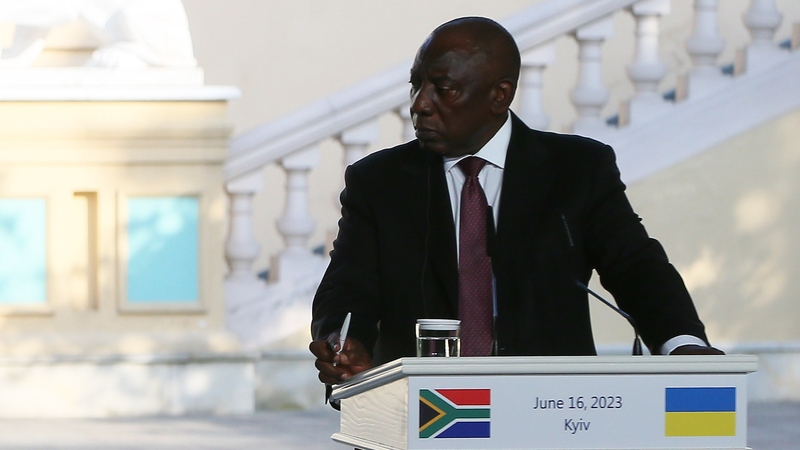
A delegation of African leaders seeking to mediate in the Ukraine conflict has Russian President Vladimir Putin that it was time to negotiate an end to fighting, which they said was harming the entire world.
The delegation, which includes presidents from Senegal, South Africa, Zambia, and Comoros, as well as the prime minister of Egypt, travelled to Kyiv yesterday, where they met with Ukrainian President Volodymyr Zelenskiy.
President Cyril Ramaphosa's arrival in Saint Petersburg "follows constructive discussions with (Ukrainian) President Volodymyr Zelensky," the South African presidency said.
The delegation will "meet (Russian) President Vladimir Putin to seek a road to peace to (end) the 16 months-long conflict (that's) caused devastating economic impact, loss of life and global instability".
The mission includes four presidents: Mr Ramaphosa, Senegal's Macky Sall, Zambia's Hakainde Hichilema and Comoros' Azali Assoumani, who also currently heads the African Union.
The leaders of Uganda, Egypt and Congo-Brazzaville pulled out of the visit at the last moment and sent representatives instead.
Efforts to secure peace appear increasingly perilous, analysts have said, with both Kyiv and Moscow convinced they can win on the battlefield.
"There must be de-escalation on both sides," Mr Ramaphosa said in a press conference in Kyiv the day before, calling for "peace through negotiations".
But Mr Zelensky ruled out that possibility during a joint press conference with the delegates.
"I clearly said several times at our meeting that to allow any negotiations with Russia, now that the occupier is on our land, is to freeze... pain and suffering," he said.
"In our view it is important to listen very carefully to what both countries have to say, and tomorrow we are now going to listen to President Putin," Mr Ramaphosa said.
The visit in Kyiv did not get off to a smooth start.
Air raid sirens sounded in Kyiv shortly after their arrival, which Mr Zelensky said showed that Mr Putin either did not control his army, or was "irrational".
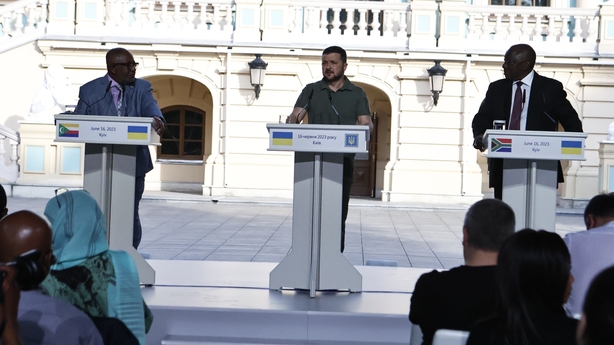
Mr Ramaphosa took the barrage as evidence that both sides needed to stop fighting.
The delegation also comes as both sides are focused on battlefield developments, as Kyiv presses its newly-launched counteroffensive.
Putin's Defence Minister Sergei Shoigu called for more tanks to be manufactured "to meet the needs of Russian forces" in Ukraine.
Kyiv on Friday evening reported tactical successes "practically in all areas where our units are fighting in the south."
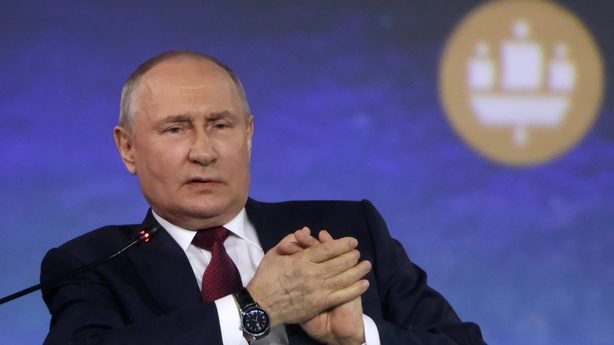
The Russian president showed little appetite for talks speaking Friday at the Saint Petersburg Economic Forum.
"I think that Ukraine's armed forces stand no chance (in the south), as well as in other directions... I have no doubt about that," Mr Putin said.
While conducting a military operation in Ukraine, which Moscow considers within its sphere of influence, Putin has sought to portray Russia as a bulwark against neocolonialism.
In Saint Petersburg, Mr Putin proclaimed the end of "the ugly neo-colonial system", which he often mentions in appeals to African partners.
Russia also accuses the West of blocking its exports of fertilisers and threatens to pull out of a deal - that expires on 17 July - that allowed vital Ukrainian grain exports to resume through the Black Sea.
Securing the future viability of a deal allowing grain from Ukraine to reach the global market would be one potential goal of the delegation.
"This conflict is also affecting African countries negatively, touching on the livelihoods of 1.2 or 1.3 billion people on the African continent," Mr Ramaphosa said in Kyiv.
Analysts said the mediating effort could hope to win some concessions from the Kremlin ahead of a Russia-Africa summit next month.
Prisoner swaps and fertiliser exports will also likely be on the agenda in Moscow, other analysts have suggested.
Mr Zelensky pressed the African leaders on the issue, asking them to "please, let them release our political prisoners. I think this will be an important result of your mission".
African countries have been divided over their response to the fighting, with some siding with Ukraine, while others have remained neutral or gravitated towards Moscow.
