


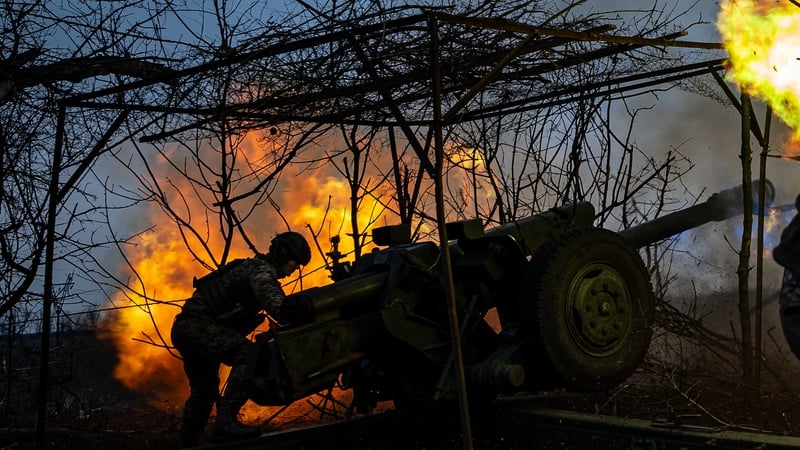
A Russian strike on the southern Ukrainian city of Kherson left three people dead and two others wounded, after Ukraine pledged to fight on in the ruined city of Bakhmut in the east.
"Russian terrorists are shelling Kherson again," Andriy Yermak, the head of Ukraine's presidential office, said on messaging app Telegram.
He posted a picture of firefighters next to a charred car, and several cars were damaged as a result of the shelling.
Oleksandr Prokudin, the head of Kherson's regional military administration, said the casualties occurred when a car was hit by a shell and caught fire.
The strike came two days after Russian artillery fire also killed three people in Kherson, according to the Ukrainian presidency.
Kherson is the capital of one of the four regions, along with Donetsk, Lugansk and Zaporizhzhia, that Russia claims to have annexed but does not fully control.
Despite Russia's retreat from the city of Kherson late last year, it has been regularly pounded by Moscow's troops.
Donetsk's separatist mayor Alexei Kulemzin said that Ukrainian shelling had killed two people including a young boy.
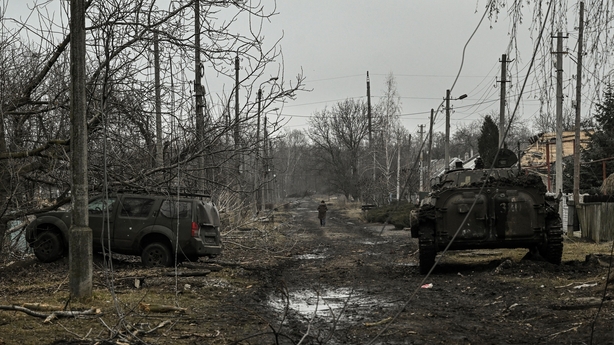
Meanwhile Ukraine has decided to fight on in the ruined city of Bakhmut, which has been a key objective for Russian forces since August.
The commander of Ukraine's ground forces, Oleksandr Syrsky, said the fight for Bakhmut helps win time in preparation for a future counteroffensive.
"The real heroes now are the defenders who are holding the eastern front on their shoulders, and inflicting the heaviest possible losses sparing neither themselves nor the enemy.
"It is necessary to buy time to build reserves and launch a counteroffensive, which is not far off."
Moscow says Bakhmut is important as a step to securing the surrounding Donbas region, a major war aim.
The West says the ruined city has little value and Russian forces are sacrificing lives to give Russian President Vladimir Putin his only victory since sending hundreds of thousands of reservists into battle at the end of last year.
An aide to President Volodymyr Zelensky said that the military would continue its efforts there because the battle there is pinning down Russia's best units and degrading them ahead of a planned Ukrainian spring counter-offensive.
British military intelligence said that the Bakhmutka River in the centre of Bakmut now marked the front line.
"Ukrainian forces hold the west of the town and have demolished key bridges over the river, which runs... north-south through a strip of open ground 200 metres-800 metres wide," the British defence ministry said in an update.
"This area has become a killing zone, likely making it highly challenging for Wagner forces attempting to continue their frontal assault westwards."
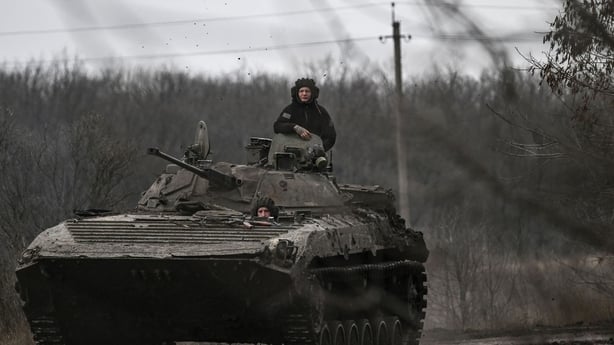
The chief of Russian mercenary group Wagner said that his forces are close to the centre of the frontline of Bakhmut.
In a video posted on messaging app Telegram, Yevgeny Prigozhin is seen standing on the rooftop of a high-rise building in what is said to be Bakhmut.
"This is the building of the town administration, this is the centre of the town," Mr Prigozhin said in the video, pointing towards a building in the distance.
"It is one kilometre and two hundred metres away," he added.
He said that the most important thing now was to receive more ammunition from the army and "move forward."
Wagner has been spearheading offensives against cities in eastern Ukraine and both sides have suffered heavy losses around Bakhmut.
Earlier this week Wagner said its fighters had captured the eastern part of Bakhmut.
Some military experts have questioned the sense of the continued fight for the ravaged town, but Ukrainian officials say that the fall of Bakhmut could lead to further Russian advances in the east.
It comes as Iran said it had reached a deal to buy advanced Su-35 fighter planes from Russia, state media reported.
"The Sukhoi-35 fighter planes are technically acceptable to Iran and Iran has finalised a contract for their purchase," the broadcaster IRIB quoted Iran's mission to the United Nations as saying in New York.
The report did not carry any Russian confirmation of the deal, details of which were not disclosed.
The mission said Iran had also inquired about buying military aircraft from several other, unnamed countries, IRIB reported.
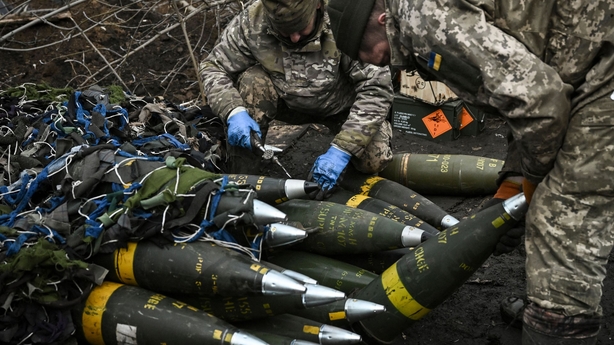
Mr Putin met Iranian Supreme Leader Ayatollah Ali Khamenei in Tehran last July, stressing closer ties in the face of Western pressure over the war in Ukraine.
Iran has acknowledged sending drones to Russia but says they were sent before Moscow's invasion of Ukraine last year.
Moscow denies that its forces use Iranian-built drones in Ukraine, although many have been shot down and recovered there.
Iran's air force has only a few dozen strike aircraft: Russian jets as well as ageing US models acquired before the Iranian revolution of 1979.
Read the latest on Russia's invasion of Ukraine
In the capital of the Czech Republic, Prague meanwhile, thousands took to the streets in an anti-government protest demanding an end to military support for Ukraine. The country is battling record inflation levels caused mainly by a spike in energy prices due to the war.
Protesters called on the centre-right government of Petr Fiala to resign, accusing their leaders of caring more about Ukraine than its own citizens.
Yesterday, Ukrainian officials ordered a historically Russian-aligned wing of the Orthodox Church to leave a monastery complex in Kyiv where it is based.
It is the latest move against a denomination regarded with deep suspicion by the government.
Kyiv is cracking down on the Ukrainian Orthodox Church (UOC) - which accepted the authority of the patriarch of Moscow until after Russia launched its full-scale invasion last year - on grounds that it is pro-Russian and collaborating with Moscow.
The Moscow patriarch, Kirill, has strongly backed the invasion.
The UOC says it has severed its ties with Russia and the Moscow patriarchate, and is the victim of a political witch hunt.
