


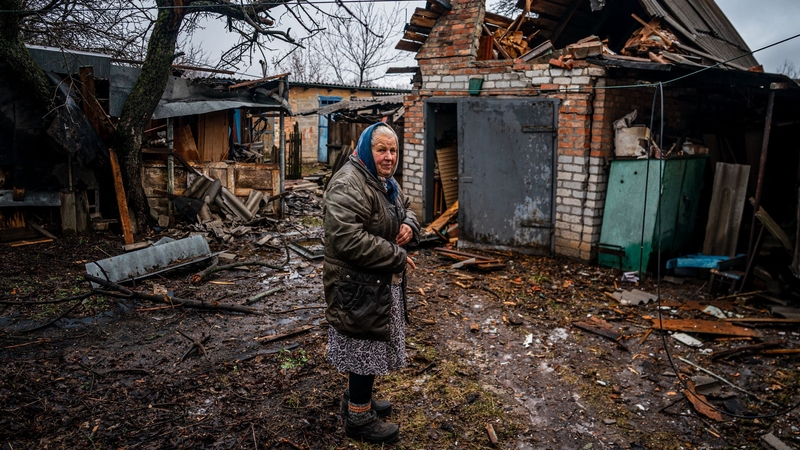
Ukraine has said that its troops were under mounting pressure in the battered frontline city of Bakhmut in the industrial east, a key prize for the Kremlin after months of brutal combat.
As the fighting raged, Moscow said it shot down Ukrainian drones targeting civilian sites in Russian territory while another one crashed near the capital.
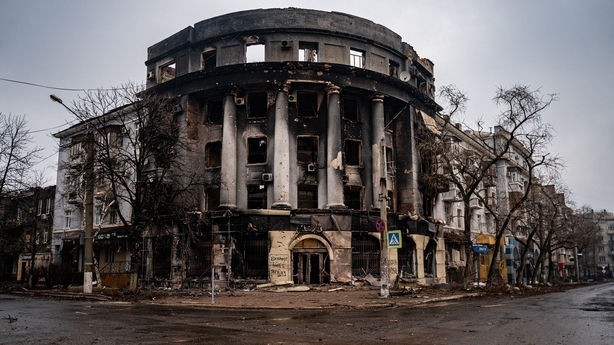
AFP aerial footage released today showed almost all buildings in Bakhmut in ruins and smoke rising over the city once known for its sparkling wine production and salt mines.
"The situation around Bakhmut is extremely tense," said the commander of Ukraine's ground forces Oleksandr Syrskyi.
"Despite taking significant losses, the enemy has dispatched its best-trained Wagner assault units to try to break through the defences of our troops and surround the city," Mr Syrskyi added, referring to the Russian mercenary group.
Bakhmut, which once had a population of around 70,000 people, has seen a gradual exodus and now only 5,000 civilians remain including some 140 children, the regional governor said this month.
Bakhmut 'will fall'
"I think Bakhmut will most likely fall," a Ukrainian soldier told AFP journalists in Bakhmut this week, conceding that Russian forces were making gains around the city.
"They say (Russians soldiers) are idiots, alcoholics and drug addicts," the solider said.
"But they have smart people there, people who know how to fight... They think, they learn, the same way we do."
Ukrainian President Volodymyr Zelensky, who visited the devastated city in December, has said his forces would continue to fight for Bakhmut as long as possible.
He has also urged allies to send more weapons to help Ukraine both hold the city and reclaim territory in the Donetsk region.
Analysts say the city holds more political importance than military value, with Moscow eager for any victory after months of slow gains in the east and setbacks elsewhere.
Valerii, a Bakhmut resident told AFP that he had no intention of leaving the town, regardless of how fierce the fighting becomes.
"My apartment is right over there. And honestly I will die in my apartment, or near my building. Where would we go? Who needs us?" he said.
Russia's Wagner group, a once-shadowy force founded by Kremlin-linked businessman Yevgeny Prigozhin, has taken centre stage in the fight for Bakhmut.
The US-based Institute for the Study of War has said that regular Russian troops may be now "attempting to institutionalise tactics used to marginal tactical effect by the Wagner Group."
We need your consent to load this rte-player contentWe use rte-player to manage extra content that can set cookies on your device and collect data about your activity. Please review their details and accept them to load the content.Manage Preferences
Drones downed over Russia
The assessment of fighting in the east came as Russia said it had downed drones that were closing in on civilian targets.
The incidents are the latest in a series of suspected attacks in recent months inside Russia that Moscow has blamed on Kyiv.
Officials said they downed drones over the southern Krasnodar region, the Adygea Republic and over the border region of Bryansk.
Meanwhile the governor of the Moscow region, Andrei Vorobyov, said a drone that was likely targeting civilian infrastructure also crashed near the capital.
"There are no casualties or damage on the ground. The FSB (security services) and other competent authorities are investigating," he said.
In a meeting with the FSB, Russian President Vladimir Putin said the security services should bolster their work to secure Russia's borders.
Mr Putin's close ally and Belarusian leader Alexander Lukashenko arrived in Beijing for a three-day trip that will include talks with China's leader Xi Jinping.
Mr Lukashenko's visit comes shortly after Beijing released a position paper on Russia's war in Ukraine insisting it is a neutral party and calling for dialogue between the two sides.
It also follows allegations by the US and NATO that Beijing could be mulling sending arms to Russia as the conflict enters its second year. China has strenuously denied the claims.
NATO chief Jens Stoltenberg said the priority for Ukraine was to fight off Russia's invasion with allies' backing and that in the "long-term" the nation would join the alliance.
Yellen in Kyiv
US Treasury Secretary Janet Yellen became the latest senior Western official to visit the Ukrainian capital, promising assistance and more measures to isolate Russia after meetings with Mr Zelensky and other officials.
US President Joe Biden went there a week ago to mark the first anniversary of Russia's invasion of Ukraine.
"America will stand with Ukraine as long as it takes," Ms Yellen, flanked by sandbags at the Cabinet office, told Ukrainian Prime Minister Denys Shmyhal yesterday.
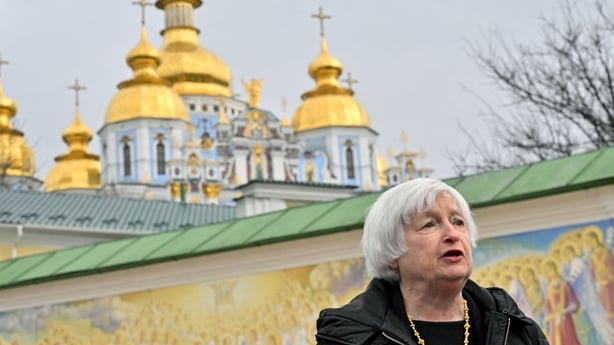
She announced the transfer of the first $1.25 billion from the latest, $9.9bn tranche of US economic and budget assistance, and also backed completion of a fully financed programme for Ukraine with the International Monetary Fund by the end of March.
Mr Zelensky, whose forces are expected to attempt a counter-offensive in the coming months, pushed again for F-16 fighter jets that his Western allies have been reluctant to provide.
"We will be able to completely protect our skies when the aviation taboo is fully lifted in relations with our partners," he said in his radio address.
The first anniversary of Russia's invasion, on 24 February, saw both sides trying to demonstrate resolve for a second year of war.
Russian President Vladimir Putin said Moscow would suspend its participation in the last remaining nuclear arms control treaty with the United States, and he accused the West of seeking to destroy Russia.
Mr Biden, speaking in Kyiv last week, said Ukraine "stands strong" and that Moscow would never defeat it.
Ukraine's outnumbered troops repelled Russia's attack aimed at taking Kyiv early in the war and later recaptured substantial territory, but Russia still occupies nearly a fifth of Ukraine.
Read more:
Tánaiste condemns Russian 'aggression' at Human Rights Council
China urges peace in Ukraine as US warns against aiding Russia
