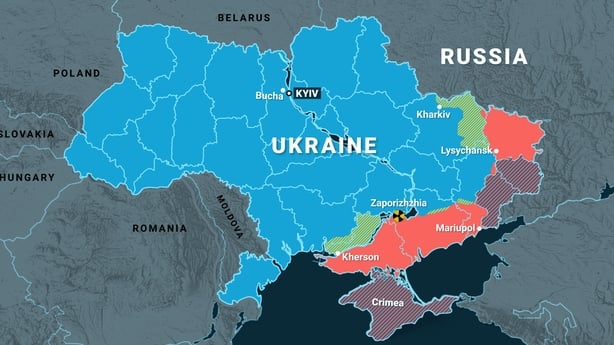
Tens of thousands dead; millions displaced; billions of euro worth of damage inflicted.
The first year of Russia's war against Ukraine has taken a terrible toll. But the conflict has been under way for much longer.
Since 2014, when Russia occupied Crimea and parts of the Donbas region, there was a low-intensity but costly conflict between the two countries.
On 24 February, 2022, that low-intensity conflict became a fully-fledged war - or, as Vladimir Putin called it, a "special military operation".
Russian forces invaded Ukraine from Belarus in the north, from Donetsk in the centre, and from Crimea in the south.
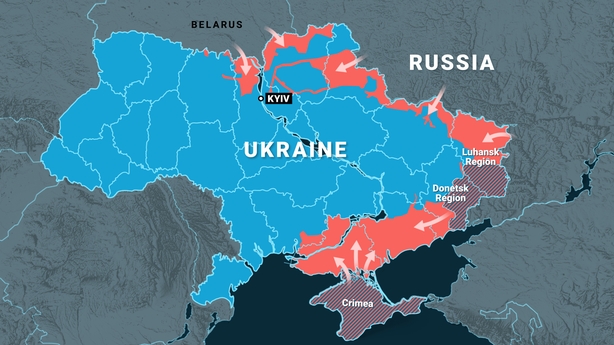
The aim was to capture Kyiv and force a change of government. But while the Russians got within miles of the centre of the capital, the advance stalled due to stiffer than expected Ukrainian resistance.
Russian forces were beaten back from Kyiv by Ukrainian counter-attacks.
On 25 March, a month after the invasion began, Russia announced a change in the focus of the war, saying it would concentrate on consolidating control over Luhansk and Donetsk.
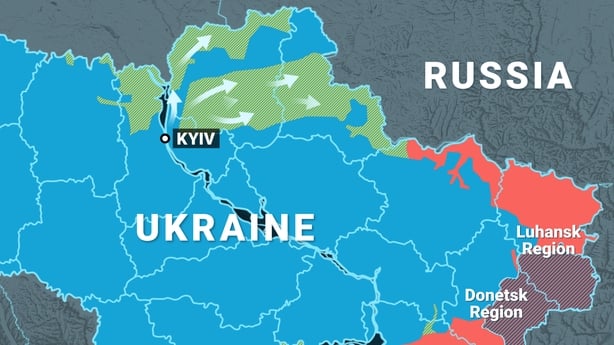
As the Ukrainians retook the town of Bucha, northwest of Kyiv, dozens of civilian corpses were found in the streets, leading to accusations of war crimes.
The refocused Russian attack scored gains - after a lengthy battle, the last Ukrainian forces in the city of Mariupol surrendered at the Azovstal steel plant on the 17 May.
On 3 July, Russian forces completed the occupation of the Luhansk oblast (administrative region) with the capture of the city of Lysychansk.
Encouraged by this, Russia held referendums (dismissed as illegal by the United Nations) in the oblasts of Donetsk, Luhansk, Kherson and Zaporizhzhia, on whether or not to join the Russian Federation.
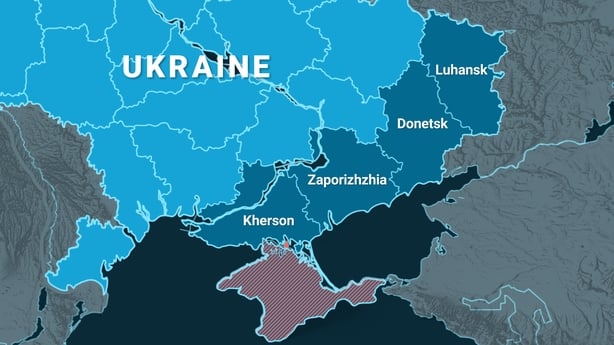
The results predictably showed massive support for the move, and on 30 September, President Putin held a signing ceremony in the Kremlin marking Russia’s annexation of the four oblasts.
But the facts on the ground were telling a very different story.
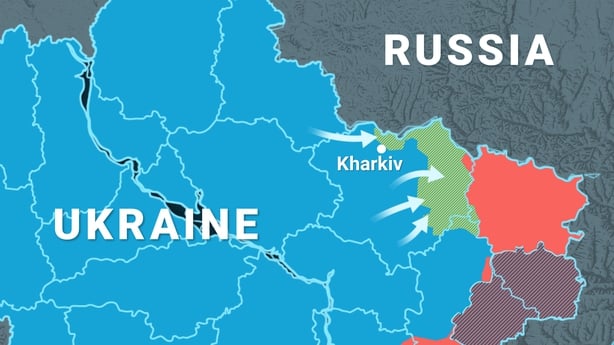
A Ukrainian counter-offensive, which began in August, had seen the recapture of some 6,000 square kilometres of territory around Kharkiv.
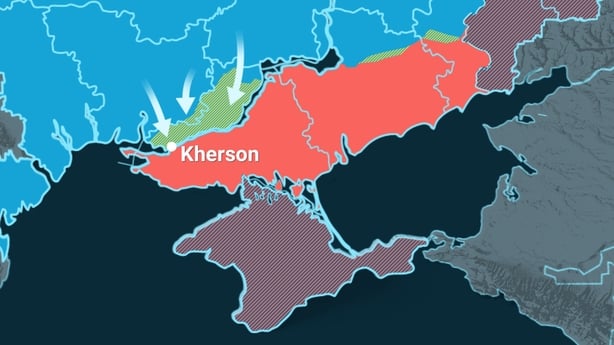
And on 11 November, the city of Kherson - the only regional capital captured by the Russians, and supposedly now part of Russia - changed hands.
Meanwhile, Russian tactics had changed.
From 10 October onwards, missile attacks on Ukrainian infrastructure severely damaged electricity supply, leaving millions without power and water for periods.
With Ukraine waiting for promised supplies of new weapons, especially tanks, Russia has been making small but significant gains.
Both sides are now apparently preparing for new offensives, which will take this war into a second year.