Ukrainian President Volodymyr Zelensky has invited Taoiseach Leo Varadkar to Ukraine during a phone call this evening.
President Zelensky extended New Year's wishes to people here and thanked them for their friendship.
The Taoiseach pledged ongoing assistance to Ukraine including electricity infrastructure.
The phonecall came as Ukrainian forces face waves of assaults by Russian forces on the small salt-mining town of Soledar, according to Kyiv officials.
Russia is striving to make its first breakthrough in the east in months.
Britain's Defence Ministry said Russian troops and mercenaries of the Wagner group were probably now in control of most of the town after advances in the last four days.
Seizing Soledar would give an advantage to Russian forces as they fight to capture the city of Bakhmut, a few kilometres to the southwest.
Troops from both sides have been taking heavy losses there in some of the most intense trench warfare since Russia invaded Ukraine nearly 11 months ago.
Bakhmut is located on a strategic supply line between the Donetsk and Luhansk regions, which make up Donbas, Ukraine's industrial heartland.
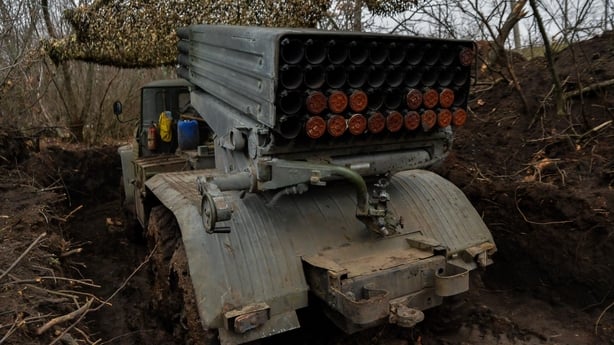
Gaining control of Bakhmut could give Russia a platform to advance on two bigger cities - Kramatorsk and Sloviansk.
It would also give Russia a welcome battlefield victory after a series of setbacks in recent months.
"Russia's Soledar axis is highly likely an effort to envelop Bakhmut from the north, and to disrupt Ukrainian lines of communication," the British intelligence briefing said.
Serhiy Cherevaty, spokesman for Ukraine's eastern forces, said the Russians were deploying their best Wagner fighters at Soledar, which had been struck 86 times by artillery over the past 24 hours.
Russia was using World War One-style tactics, throwing large numbers of men into battle and absorbing heavy losses, he told Ukrainian television.
"This is basically not a 21st-century war," he said.
Journalist Yuriy Butusov, who is embedded with Ukrainian troops in Soledar, wrote for the online outlet New Voice that Russian forces had established fire control over the main Ukrainian supply route to the town.
"This is not a complete encirclement, but normal supply along the route is impossible, (and) this is critical for defence," he said.
Mr Zelensky said in his nightly video address that Bakhmut and Soledar were holding on despite widespread destruction.
He cited new and fiercer attacks in Soledar, where he said no walls have been left standing and the land was covered with Russian corpses.
Russia's defence ministry did not mention either Soledar or Bakhmut in a media briefing on Monday.
Waves of attacks
Wagner was founded by Yevgeny Prigozhin, an ally of Russian President Vladimir Putin.
Drawing some recruits from Russia's prisons, it is active in conflicts in Africa and has taken a prominent role in Russia's war effort in Ukraine.
Mr Prigozhin said the area's significance lay in a network of cavernous mining tunnels below the ground which can hold troops or tanks.
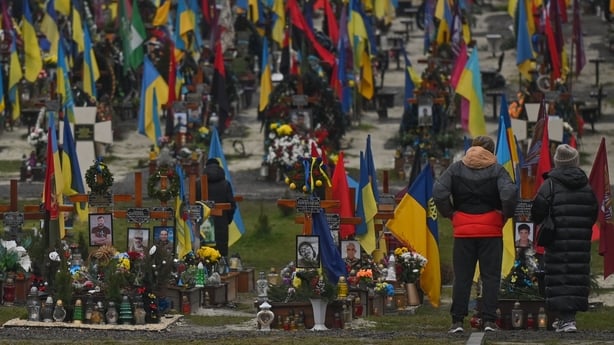
Ukrainian military analyst Oleh Zhdanov said fighting in Bahkmut and Soledar was "the most intense on the entire frontline".
"So many remain on the battlefield ... either dead or wounded," he said on YouTube.
"They attack our positions in waves, but the wounded as a rule die where they lie, either from exposure as it is very cold or from blood loss," he added.
Reuters could not verify the battlefield reports.
Appeal for weapons
Ukrainian officials, led by the commander in chief General Valery Zaluzhniy, have warned that Russia is preparing fresh troops for a new offensive on Ukraine, possibly on the capital Kyiv.
Mr Zelensky has repeatedly urged Ukraine's Western supporters to supply more sophisticated weapons to help it repel attacks and eventually expel Russian troops.
"The world knows that every day of Russian presence on Ukrainian soil means deaths, injuries, pain and suffering of people," he wrote in a message on Telegram this morning, under pictures of Ukrainian soldiers.
"Ukraine must get everything it needs to expel terrorists from our land and to reliably protect our people from any Russian escalation plans," he added.
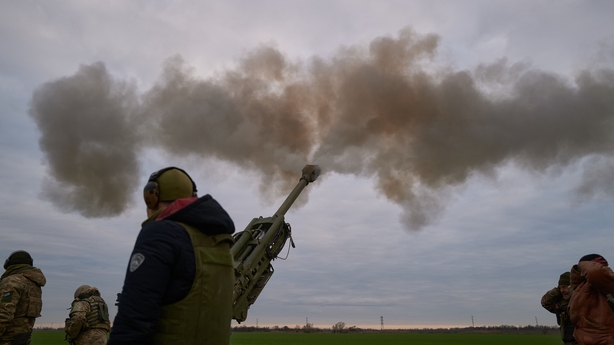
British Prime Minister Rishi Sunak's spokesperson said London had not yet made a final decision on sending tanks to Ukraine.
The spokesperson said that Britain would continue to co-ordinate its support with allies after Germany, France and the United States all indicated last week they would provide armoured vehicles.
Russia began what it calls a "special military operation" in Ukraine on 24 February, citing threats to its own security and a need to protect Russian speakers.
Ukraine and its allies accuse Moscow of an unprovoked war to seize territory.
Moscow has also cast the conflict as a fight between Russia and hostile Western nations.
"The events in Ukraine are not a clash between Moscow and Kyiv - this is a military confrontation between Russia and NATO, and above all the United States and Britain," Russian Security Council Secretary Nikolai Patrushev said.
"The Westerners' plans are to continue to pull Russia apart, and eventually just erase it from the political map of the world," Mr Patrushev, one of Putin's closest allies, told the Argumenti i Fakti newspaper in an interview.
NATO Secretary General Jens Stoltenberg said in Brussels the military alliance must further strengthen its support for Ukraine.
Mr Putin had failed in his attempts to divide Western allies over the conflict, he said.
Meanwhile Russia has appointed Colonel-General Alexander Lapin as chief of staff of the country's ground forces, state-owned news agency TASS reported, despite criticism from hawks over his performance in Ukraine.
His promotion is the latest in a series of changes to Moscow's military leadership over the course of the war.
Ukraine forces to receive Patriot air defense training in US: Pentagon
The US will train Ukrainian personnel at a base in the state of Oklahoma on how to use and maintain the advanced Patriot air defense system that the US is providing to Ukraine, the Pentagon has announced.
The US promised a Patriot battery to Ukraine at the end of last year to help counter relentless aerial attacks by Russia - a significant victory for Ukraine, which had repeatedly pushed the United States for the system.
"Training for Ukrainian forces on the Patriot air defense system will begin as soon as next week at Fort Sill, Oklahoma," Pentagon Press Secretary Brigadier General Pat Ryder told journalists.
"The training will prepare approximately 90 to 100 Ukrainian soldiers to operate, maintain and sustain the defensive system over a training course expected to last several months," Ryder said.
"Once fielded, the Patriot will... contribute to Ukraine's air defense capabilities and provide another capability to Ukrainian people to defend themselves against Russia's ongoing aerial assaults," he added.
Air defenses have played a key role in protecting Ukraine from strikes and preventing Moscow's forces from gaining control of the skies.
But as Russia faced increasing setbacks on the ground, it began systematically targeting critical infrastructure in Ukraine in attacks that have disrupted electricity, water and heat to millions of people.
Made by Raytheon, the MIM-104 Patriot is a surface-to-air missile (SAM) system initially developed to intercept high-flying aircraft.
It was modified in the 1980s to focus on the new threat of tactical ballistic missiles, and was first used in combat against Iraq's Russian-made Scuds in the first Gulf War.
Patriot has been proven effective in Saudi Arabia against Iranian-designed ballistic missiles fired from Yemen, and primary contractor Raytheon says the system has intercepted more than 150 ballistic missiles in combat since 2015.
The goal of Ukraine's international supporters is to build multi-layer air defenses for the country consisting of low-, medium- and high-altitude systems that can protect against a variety of threats.