


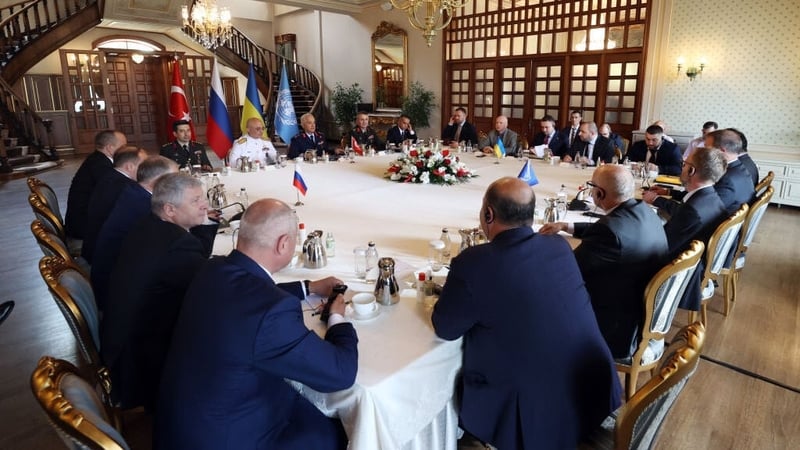
Turkey announced a deal with Ukraine, Russia and the United Nations on Wednesday aimed at resuming Ukrainian grain exports blocked by Russia, raising prospects for an end to a standoff that has exposed millions to the risk of starvation.
Turkish defence minister Hulusi Akar said the deal would be signed when the parties meet again next week and included joint controls for checking grains in ports and Turkey ensuring the safety of Black Sea export routes for Ukrainian grain.
Turkey would also set up a coordination centre with Ukraine, Russia and the United Nations for grain exports, he said.
Ukraine had said earlier that a deal appeared just "two steps away" as Turkey hosted the four-way talks in Istanbul.
UN Secretary General Antonio Guterres said a "critical step forward" had been made toward reviving Ukrainian grain exports but cautioned that "more technical work will now be needed to materialise today's progress".
"Next week, hopefully, we'll be able to have a final agreement. But, as I said, we still need a lot of goodwill and commitments by all parties," he told reporters in New York.
Mr Guterres added that although Ukraine and Russia had engaged diplomatically, "for peace we still have a long way to go".
There was no immediate comment from Ukraine or Russia, both among the world's largest grain exporters.
Russia's Interfax news agency quoted Pyotr Ilyichev, head of the international organisations department at Russia's foreign ministry, earlier in the day as saying Russia wanted to control and inspect grain vessels itself to rule out arms smuggling.
'Safe corridors'
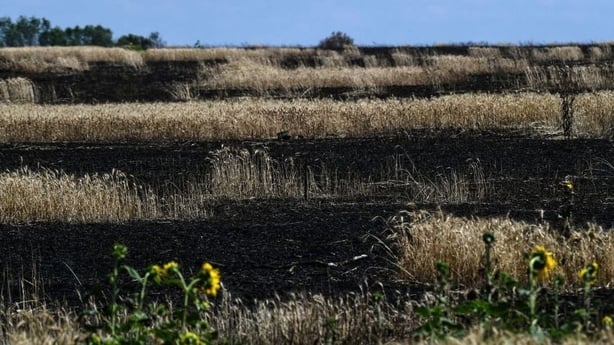
The Istanbul negotiations are being complicated by growing suspicions that Russia is trying to export grain it has stolen from Ukrainian farmers in regions under its control.
Russian authorities in Ukraine's southern region of Kherson today countered with accusations that Kyiv's forces were deliberately burning crops and mining fields.
US space agency data released last week showed 22% of Ukraine's farmland falling under Russian control since the invasion.
Turkey says it has 20 merchant ships waiting in the region that could be quickly loaded and sent to world markets.
A plan by the UN proposes the ships follow safe "corridors" that run between the known location of mines.
Kyiv has also asked that its vessels be accompanied by warships from a friendly country such as Turkey.
Experts say de-mining the Black Sea is a complex operation that could take months - too long to address the growing global food crisis.
Mr Kuleba said he did not think Moscow actually wanted to reach an agreement because proceeds from grain sales would help support a Western-backed government in Kyiv that the Kremlin brands as "Nazis".
"They know that if we start to export, we will get proceeds from world markets, and this will make us stronger," Mr Kuleba said.
'Operational pause'
The talks in Istanbul precede a meeting in Tehran next Tuesday between Turkish President Recep Tayyip Erdogan and his Russian counterpart Vladimir Putin.
Mr Erdogan's ultimate goal is to bring Mr Putin and Ukrainian President Volodymyr Zelensky down to Istanbul for talks aimed at pausing the fighting and launching formal peace talks.
However, the Ukrainian army warned this week that Russia was preparing to stage its heaviest attack yet on the Donetsk region - the larger of the two areas comprising the Donbas war zone.
Ukrainian officials said at least five people died in Russian shelling on the region surrounding the Black Sea port city of Mykolaiv.
Emergency services recovering bodies from a destroyed residential building in the Donetsk town of Chasiv Yar said the death toll from a missile strike on Sunday rose to 48, making it one of the deadliest incidents in the war.
"You never get used to war. It's dreadful and scary," 60-year-old Lyubov Mozhayeva said in the partially destroyed frontline city of Bakhmut.
The Russian army has not conducted any major ground offensives since taking the last points of Ukrainian resistance in the war zone's smaller Lugansk region at the start of the month.
Analysts believe the Russians are taking an "operational pause" during which they are rearming and regrouping forces before launching an assault on Sloviansk and Kramatorsk - Ukraine's administrative centre for the east.
Ukraine is trying to counter the Russians by staging increasingly potent attacks with new US and European rocket systems targeting arms depots.
US officials believe the Russians are trying to recoup their losses by negotiating to acquire hundreds of combat drones from Iran.
