


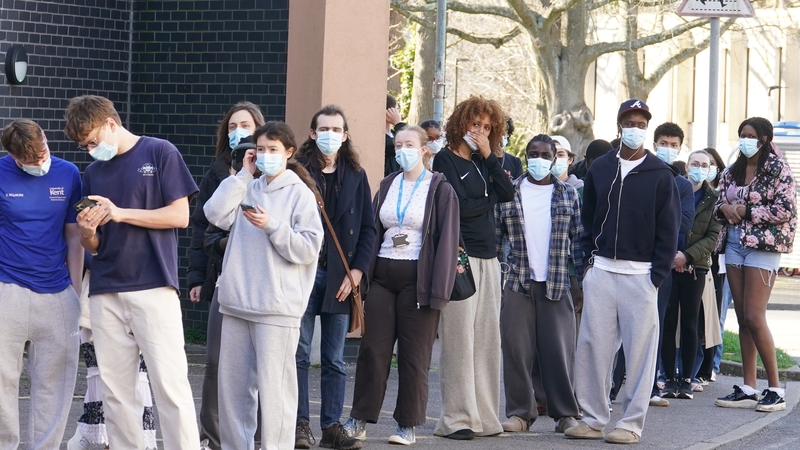
Students have begun to receive a meningitis B vaccine following a deadly outbreak of the bug in Kent.
Around 5,000 students from the Canterbury campus of the University of Kent are being offered the jab, alongside courses of antibiotics.
It comes after two students died and 18 more cases were being investigated by the UKHSA following an outbreak of meningitis linked to a nightclub.
Five new cases of meningitis have now been reported in Kent, taking the total number being investigated by health officials to 20.
Of these, nine cases have been confirmed in the lab and 11 remain under investigation.
Six of the confirmed cases have been confirmed as the meningitis B strain.
A queue has formed outside the sports hall for students waiting for their jabs.
Divine Nweze, an architecture student, was one of the first to arrive for the jab.
We need your consent to load this rte-player contentWe use rte-player to manage extra content that can set cookies on your device and collect data about your activity. Please review their details and accept them to load the content.Manage Preferences
He said: "As soon as I got the email, my parents just told me, get up and get my vaccine. They won't even let me go home because of what’s going on.
"The vaccine rollout should have been done earlier, but now that it’s available, I feel like it is all getting done, so that’s the main thing."
He added his parents will let him come home once he receives the vaccination.
It remains unclear how students who have already left campus will get a vaccine, though it is understood they should be able to get one through their GP practice.
A letter to University of Kent students, seen by the Press Association, said the menB vaccine will continue to be available to eligible students on campus all week.
"If you live in Canterbury campus halls of resident but have already returned home, arrangements are currently being developed to ensure that you can receive the vaccines nearer to home – further information on how you can receive the vaccination will be provided in due course," it added.
The two-dose vaccine course is being given alongside antibiotics as an "additional precautionary measure to help protect students from becoming seriously unwell with meningitis if you are exposed in the future", the letter said.
GPs across the country have now been told to prescribe antibiotics to anyone who visited Club Chemistry in Canterbury from 5-7 March, plus students from the University of Kent.
This is to ensure anyone who has left campus can make sure they get the right treatment.
So far, more than 2,500 doses have been given to students, close contacts and others - including some of those who attended Club Chemistry between 5-7 March.
The number of cases is expected to rise because the incubation period for the infection to when symptoms appear is two to 14 days.
The outbreak is being viewed by experts as unprecedented owing to the high number of cases appearing in such a short space of time.

Scientists work to identify source of spread
Health officials stressed that people should not skip antibiotics if prescribed them, with a single tablet of Ciprofloxacin reducing the risk of meningitis in a household by about 80% to 90%.
Experts said many of those affected attended Club Chemistry in Canterbury over 5 March to 7 March.
The UKHSA said all 15 cases reported had required hospital admission, with four cases confirmed to have menB.
Laboratory scientists are urgently trying to work out if the spread is caused by a possible mutant strain of menB.
The genome of the menB strain identified in the outbreak is undergoing whole genome sequencing to see if there are any differences to known strains.
It will also be tested against available menB vaccines, though experts stressed people should get a jab if eligible.
We need your consent to load this flourish contentWe use flourish to manage extra content that can set cookies on your device and collect data about your activity. Please review their details and accept them to load the content.Manage Preferences
The UKHSA stressed there is plenty of NHS stocks of menB vaccines after pharmacies reported they were struggling to obtain stock for people who want to pay privately.
Regarding NHS stock, a UKHSA spokeswoman said: "There are sufficient menB vaccine stocks. We will work with local resilience partners to ensure effective distribution."
All reported cases so far have a link to Kent, according to the UKHSA.
At least one person who fell ill and had links to Kent attended a London hospital.
This person had "no community contacts in London", the UKHSA said, suggesting the risk of spread in the capital is low.
Meanwhile, French authorities said a person who was admitted to hospital with meningitis in France with links to the Kent outbreak is now in a "stable" condition.
The French Ministry of Health said no other cases of meningitis linked to the outbreak in Kent have been reported in France.
At Prime Minister's Questions, Keir Starmer expressed his condolences.
He said: "Our deepest condolences are with the families and friends of the two young people who have died following the outbreak of meningitis B in Kent. Others are seriously ill. This will be a deeply difficult time for their loved ones."
Health Secretary Wes Streeting told BBC Breakfast: "What’s worried us about the Canterbury outbreak is the pace and extent of the spread of the disease.
"That is unprecedented, and that’s why we are being so proactive in the provision of antibiotics, because they’re an effective treatment, but also standing up vaccination at a pace and in a way that we wouldn’t normally do.
"I hope that that will give some reassurance to people."
Asked if there was concern the outbreak could spread to other parts of the country as students leave Canterbury, Mr Streeting said: "No, and lots of students from Kent have already gone home.
"It’s exam week at the university this week, so there are still quite a few students around sitting their exams.
"Lots of students will have gone home, and that’s fine. That’s okay.
"What we need people to do is to think through in terms of their individual situations – were they at Club Chemistry on March 5, 6 or 7? If the answer to that question is yes, the sensible thing to do is to access antibiotics."
