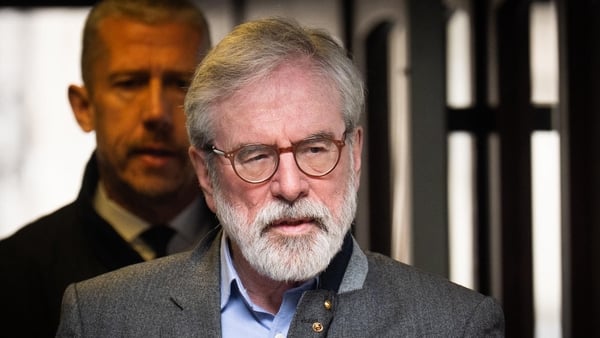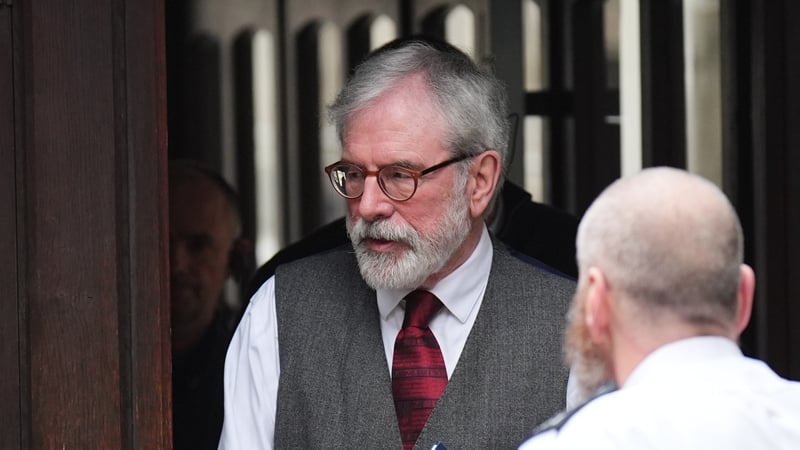

Gerry Adams was "directly responsible for and complicit" in the decisions made by the Provisional IRA to detonate bombs in England, the High Court in London has heard.
John Clark, a victim of the 1973 Old Bailey bombing in London, Jonathan Ganesh, a 1996 London Docklands bombing victim, and Barry Laycock, a victim of the 1996 Arndale shopping centre bombing in Manchester, all allege that Mr Adams was a leading member of the Provisional IRA on those dates, including of its Army Council.
The three men are bringing legal action against the former Sinn Féin president and are seeking £1 in damages.
Mr Adams denies that he had any role in the Provisional IRA and is opposing the claim.
He arrived at the Royal Courts of Justice wearing what appeared to be a bullet-proof vest, and was driven into the car park.
The court heard that the three men want to show how Mr Adams was involved in the Provisional IRA "in the course of that conflict and to show on the balance of probabilities that he was as involved as the people who planted and detonated those bombs".
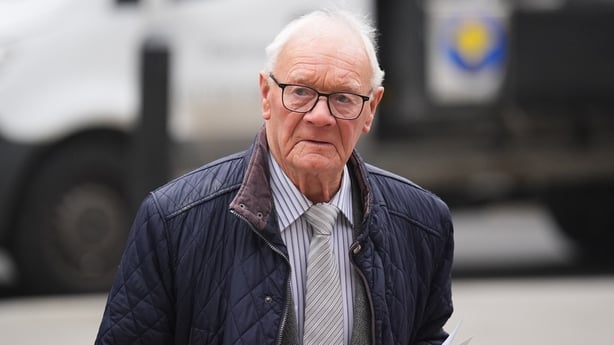
Opening her case Anne Studd KC, representing the men, also said Mr Adams was "directly responsible for and complicit in those decisions made by that organisation to detonate bombs on the British mainland in 1973 and 1996".
In written submissions, Ms Studd said: "The defendant carefully draws a distinction between being a member of 'the Army' and being a member of Sinn Fein.
"In reality, the evidence will demonstrate that this was not the clear either/or choice as the defendant would have you believe.
"For many individuals, we say, including Mr Adams, that was a distinction without a difference."
Ms Studd told the court that a "jigsaw" of evidence from those who knew Mr Adams and those who knew of him will prove the case against him.
She added: "The claimants' case is that none of these bombings in the United Kingdom mainland took place without the knowledge and agreement of the defendant in his role in the Provisional IRA and latterly as a member of the seven-man Army Council."
She concluded: "There is no doubt that the defendant contributed to the peace in Northern Ireland, but the claimants say that on the evidence he also contributed to the war."
Ms Studd also told the court that Mr Adams had "a foot in each camp" of the military and political sides of the Irish Republican movement.
She said: "What we have here are witnesses who give evidence about intelligence that they saw amassed over years.
"It provided details of the structure of the Provisional IRA, the election of the army executive and the appointment of those executive members of the seven-person Army Council.
"The Army Council set the strategy for the Provisional IRA through all the years of the Troubles. It did not really change in its basic information, which was that the defendant was an instrumental force in the organisation of the Provisional IRA and building of the two-strand attack – Armalite and the ballot box."
'An axe to grind' - defence counsel
Lawyers for Mr Adams, who denies the claims, said Mr Adams "played an instrumental role in the peace process which culminated in the signing of the Good Friday Agreement in April 1998, which brought an end to the decades-long conflict".
Edward Craven KC, for Mr Adams, told the court: "Mr Adams emphatically, unequivocally and categorically denies any involvement in the bombings.
"And he emphatically, unequivocally and categorically denies that he was ever a member of the IRA."
He said: "There is no dispute that claimants are victims of bombings that occurred in 1973 and 1996.
"There is no dispute they have suffered immensely as a result of those bombings."
He added: "Nothing is intended to deny or downplay either the existence or extent of their injuries."
He also said there was "no shortage of people with an axe to grind" who sought to discredit his client.
He said people such as British officials, members of the Royal Ulster Constabulary or other republicans opposed to the peace process had an interest in discrediting Mr Adams, who denies ever being a member of the Provisional IRA.
The barrister said: "The claimants are saying, there is a lot of smoke, there must be fire, but that is not right."
He added: "There is no doubt whatsoever that during The Troubles, Mr Adams sought to justify the actions of the IRA."
In written submissions, Mr Craven said: "The defendant’s alleged factual and legal responsibility for the claimants’ injuries is strongly contested, as is the claimants’ ability to bring these claims against the defendant several decades after the expiry of the applicable limitation period."
He added that there is "no legal or practical reason why these claims could not have been issued long before 2022".
Mr Craven continued: "Even if the claim were not bound to fail on limitation grounds, the claim must inevitably fail on the merits.
"The defendant strenuously denies any involvement in the bombings."
He also said: "The defendant has never been arrested on suspicion of, still less charged or convicted of, any offence in connection with any of the bombings.
"Had law enforcement authorities been in possession of information which created a reasonable suspicion that the defendant may have been involved in those bombings, he would have been arrested and questioned."
Speaking after the first day of the trial, Mr Adams said: "I’m here to defend myself and to challenge the allegations being made against me.
"We will let the court get on with its business.
"But I would like to say for the record and at the outset that the only thing that I am guilty of is being an Irish republican committed to ending British rule in our country and seeking to unite the people of Ireland on the basis of freedom, equality, peace and solidarity."
The trial before Mr Justice Swift is expected to end next week.
'Here to defend myself' - Adams
Speaking to reporters after today's sitting, Gerry Adams, said: "I'm here to defend myself and to challenge the allegations being made against me. We will let the court get on with its business.
"But I would like to say for the record and at the outset that the only thing that I am guilty of is being an Irish republican committed to ending British rule in our country and seeking to unite the people of Ireland on the basis of freedom, equality, peace and solidarity."
Those due to give evidence in the six day trial include former members of the British military, former police officers and former members of the IRA.
It is a non-jury trial civil action, not a criminal case, so the standard of proof required is "on the balance of probabilities" and not the criminal standard of "beyond reasonable doubt".
In court documents, lawyers for Mr Adams say the action should fail because of the time taken to bring the proceedings and because "the evidence comes nowhere close to constituting clear and cogent evidence capable of establishing the defendant’s alleged responsibility for the bombings".
Mr Adams was charged with IRA membership in 1978, but the case was dropped due to insufficient evidence.
Last year, the 77-year-old was awarded €100,000 in damages over a BBC Northern Ireland programme which alleged that he had sanctioned the murder of former Sinn Féin official Denis Donaldson.
Mr Donaldson was shot dead in Co Donegal in 2006 shortly after it emerged that he had worked as an agent for MI5 and police for 20 years.
We need your consent to load this rte-player contentWe use rte-player to manage extra content that can set cookies on your device and collect data about your activity. Please review their details and accept them to load the content.Manage Preferences