


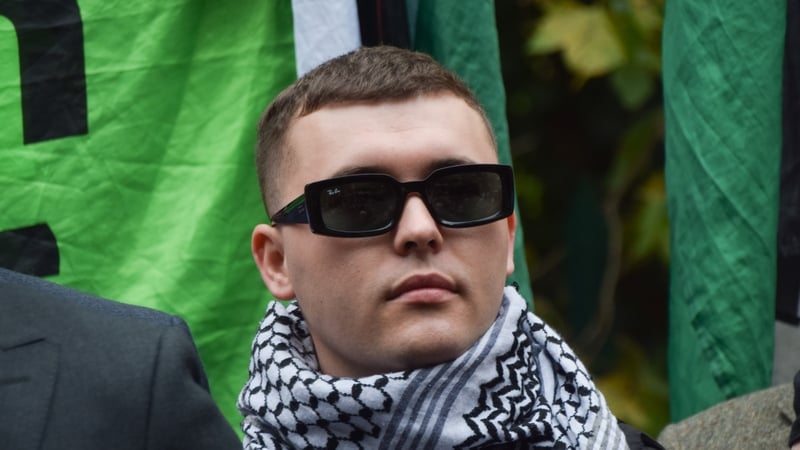
An appeal against a judge's decision to throw out the terrorism case against Kneecap rapper Liam Óg Ó hAnnaidh is under way at the High Court in London.
The rapper, who performs under the stage name Mo Chara, was accused of displaying a flag in support of proscribed terror organisation Hezbollah at a gig at the O2 Forum in Kentish Town, north London, in November 2024.
But the case was thrown out on technical grounds in September last year, with chief magistrate Paul Goldspring ruling that the proceedings were "instituted unlawfully".
Britain's Crown Prosecution Service (CPS) announced the following month that it would appeal against the decision, stating that the case involved an "important point of law which needs to be clarified".
Mr Ó hAnnaidh is opposing the appeal, with Kneecap stating last year that "we will win again".
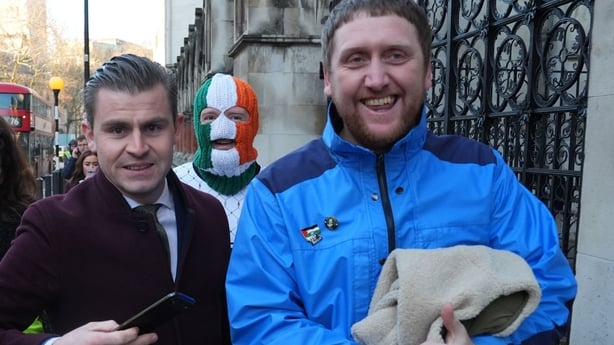
Kneecap's JJ Ó Dochartaigh, whose stage name is DJ Provaí, and manager Daniel Lambert are attending the hearing.
Paul Jarvis KC, for the CPS, said the Attorney General's permission was in place before Mr Ó hAnnaidh's first court appearance on 18 June, meaning the requirements were met.
The barrister said in written submissions that the requirement for the Attorney General or Director of Public Prosecutions' agreement applies "when the defendant appears before the magistrates' court to answer the charge he faces".
Mr Jarvis continued: "That interpretation is consistent with the case law both before and after the introduction of that particular consent provision and applies irrespective of whether the offence is summary-only or indictable."
The barrister said if the chief magistrate's ruling was correct, it would likely mean proceedings would be "instituted" when written charges are issued, rather than when a defendant appears at court to answer the charge.
Mr Jarvis said: "The appellant submits that that is an example of the tail wagging the dog."
The barrister later said that as the Attorney General's permission had been given on 22 May, "it follows that valid consent to the respondent's prosecution was in place before the proceedings against the respondent were 'instituted' on 18 June 2025".
However, Jude Bunting KC, for Mr Ó hAnnaidh, said Judge Goldspring's findings were "unassailably correct".
He continued in written submissions: "The answer to this appeal is straightforward... The necessary permission and consent were not provided at the time the proceedings were 'instituted'.
"As such, the chief magistrate was plainly correct to hold that these proceedings were not instituted in the correct form within the six-month statutory time limit."
The barrister said no previous case supported the CPS argument that magistrates' court proceedings are only "instituted" when a defendant appears in court.
Mr Bunting continued: "The appellant's case is at odds with the principle that the law should be coherent: the Crown invites the court to interpret the relevant statutory scheme in a manner leading to absurd results, whereby criminal proceedings would be deemed to have been 'instituted' at multiple different points in the same set of proceedings."
He later said written charges can lead to defendants pleading by post and never appearing in court in person.
"A lack of consent or permission at the time of charge could therefore lead to a defendant pleading guilty by post, and thereafter being summarily convicted of a charge issued by the police, to which the Director of Public Prosecutions had not and might never have consented, and which the Attorney General had not or would not have permitted."
