


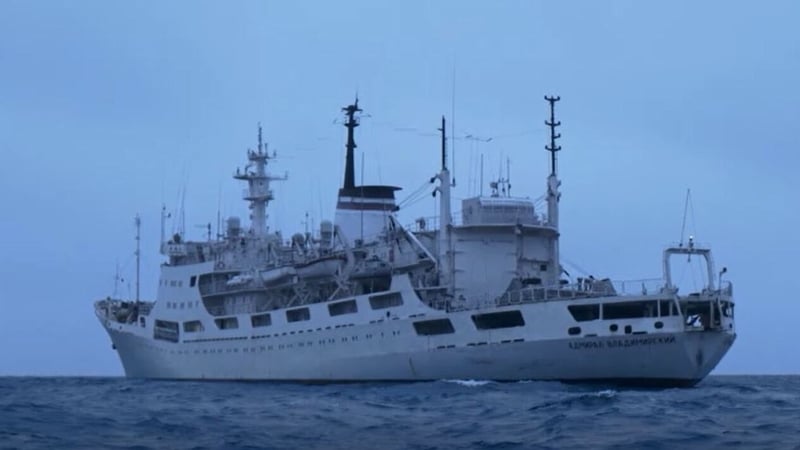
A Russian "spy" ship stopped at sites off the British coast as part of plans to sabotage key energy infrastructure, an investigation by European broadcasters claims.
A joint report by broadcasters in Denmark, Sweden, Finland and Norway claims the Admiral Vladimirsky was part of an operation to map undersea infrastructure.
According to the report, the ship sailed around the Baltic Sea and the North Sea for a month, passing current and future wind farms off the coast of several Scandinavian countries, as well as Britain.
The broadcasters say that the ship is part of a fleet of espionage boats, disguised as fishing trawlers and scientific research vessels, which is examining key energy sites for possible sabotage.
Danish broadcaster DR has published video of an encounter at sea between a small boat carrying their team and the Russian ship, filmed off the Danish coast in November.
It shows a man, wearing a balaclava and military gear and carrying an assault rifle, appearing on the deck of the Admiral Vladimirsky.
The ship is thought to have entered the Moray Firth, off the coast of Scotland, on 10 November last year.
Russia dismissed the claims as a "mistake" and "without basis", reiterating its appeal for "a transparent and impartial international inquiry" into the sabotage of the Baltic Sea Nord Stream gas pipelines last September.
Swedish Prime Minister Ulf Kristersson deemed the documentary's claims "serious".
"This just goes to show that we have a very risky situation in our immediate vicinity," he said.
MP says UK should expand its armed forces
Chairman of the House of Commons Defence Committee Tobias Ellwood told The Telegraph newspaper that the UK must expand its armed forces in response.
"We simply can no longer protect our near seas and, rightly, step forward further afield, with our current peacetime-sized Navy, Army and Air Force," he said.
A Ministry of Defence spokesman said: "The government takes the security and resilience of our national infrastructure very seriously.
"That is why we increased Royal Navy presence patrols after the Nord Stream incident and have invested £65 million in the first of our two Multi-Role Ocean Surveillance ships.
"We continue to review all our investments and activities against the full range of threats and risks."
Offshore Energies UK (OEUK), the trade body for the offshore sector, said the safety of their installations was a matter of ongoing discussion with the government.
Operations Director Mark Wilson said: "Offshore Energies UK remains engaged with relevant government bodies, including the Department for Energy Security & Net Zero (formally BEIS); North Sea Transition Authority; Health & Safety Executive; and Police Scotland, on resilience and security of UK energy supply.
"We also operate the OEUK security committee at which relevant government bodies provide briefings.
"The physical security of offshore and onshore energy infrastructure continues to be part of these regular engagements."
Earlier this month, the Defence Forces said it was aware of and was monitoring two Russian-flagged ships off the southwest coast of Ireland.
It was reported that the two ships had the capability to interfere with sub-sea cables.
