


Part of me is uncomfortable with the degree of licence and the potential impact attached to the drama/documentary format, writes RTÉ Northern Editor Tommie Gorman.
Productions like Oliver Stone’s JFK, Stephen Frear’s The Queen, Neil Jordan’s Michael Collins, Steve Mc Queen’s Hunger and Tom Hooper’s The King’s Speech have become widely-accepted versions of important events and individuals.
Such is the power of the flickering screen.
When my own employers scheduled the three-part 'Charlie' to run on successive Sundays, the King Canute in me decided I’ll give this one a miss, just as I behaved in relation to the earlier "blockbuster", 'Love/Hate'.
Eleven nights after the first 'Charlie' episode was screened, when the rest of the household was in bed, I succumbed and began to catch up via the RTÉ Player.
It’s too early to pass judgement on the enterprise.
That exercise deserves space and time.
But two anecdotes, both 100% true, came to mind after the viewing and they may be worth sharing.
The first was from my time as RTÉ’s Europe Editor in 1996, in France after the death of Francois Mitterrand.
The former president was buried in the family tomb at Jarnac in southwest France.
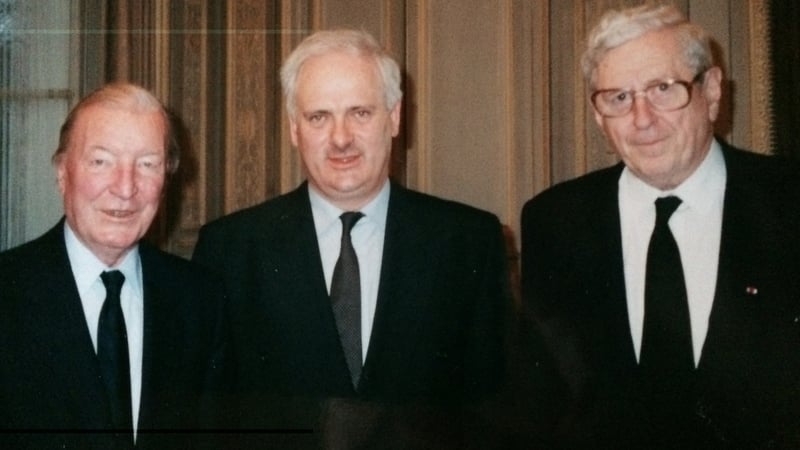
But in Paris, although Mitterrand had died an agnostic, a memorial mass was held in Notre Dame Cathedral, attended by 1,300 dignitaries, included then taoiseach John Bruton and two of his predecessors, Garret FitzGerald and Charlie Haughey.
On that January afternoon, the trio used the Irish Embassy at Rue Rude on Avenue Foch as their base.
Pat O’Connor was the serving Ambassador at the time. It was a "three bulls in a [foreign] field" moment.
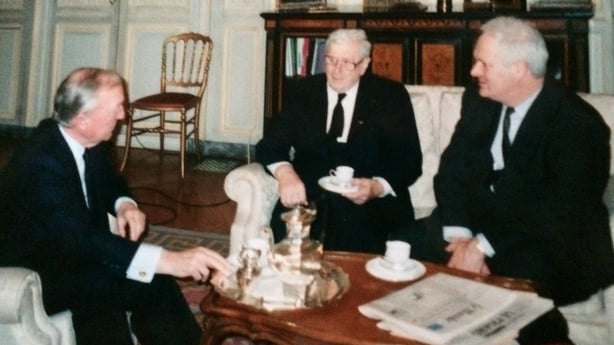
Part of my report on the day included an interview with John Bruton and it provided access to the embassy drawing room.
I had the neck and good sense to ask the three dignitaries if they would like a photograph of the occasion.
Hostilities and suspicions were temporarily suspended.
The second story is from 1979. At the time I was the 23-year-old managing editor of the Ballina and Sligo based Western Journal, a two-year-old, precarious enterprise.
Two of the directors were journalist John Healy and car dealer Cathal Duffy.
Healy was, deservedly, a legend in our trade.
Duffy could have mixed it with the Corleones: he was chairman of the board that established Knock Airport and unveiled the "birthplace of Charles Haughey" plaque in Castlebar.
Several times before his death in October 2009, Cathal Duffy told me about events in 1979.
Jack Lynch had resigned as taoiseach and Haughey was about to become taoiseach.
Healy and Duffy went to the new Fianna Fáil leader and urged him to include the thrusting Castlebar-based Fianna Fáil TD, Pádraig Flynn, among his ministers, even at what Healy called the "half car" (minister of state) level.
They were told Flynn’s name wasn’t on the teamsheet but they were requested to make a case, in writing.
(Before he died, Duffy sent me a copy of that long, convincing letter to Haughey, written by Healy).
The record shows that the ministers of state in the 21st Dáil includes one Pádraig Flynn.
Cathal Duffy and John Healy went to their graves believing that the person knocked off the junior ministers list,to accommodate Flynn was a Kildare-based deputy called Charlie McCreevy.
