


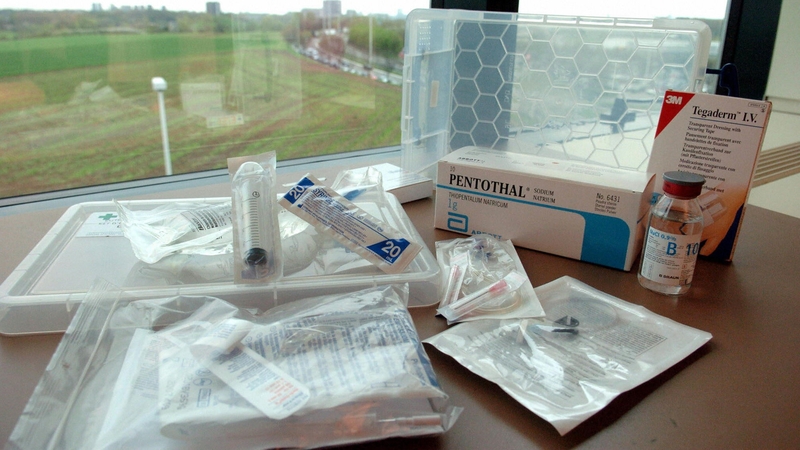
Tánaiste Eamon Gilmore has called for a broad discussion on the question of euthanasia - suggesting that the best place the topic could be considered would be an Oireachtas Committee.
He was commenting as it was revealed that Taoiseach Enda Kenny has requested to meet multiple sclerosis sufferer, Marie Fleming, who lost a Supreme Court challenge to the ban on assisted suicide.
If such an Oireachtas debate were to happen, one of the countries which undoubtedly would come under close scrutiny is Belgium.
 RTÉ's Paul Cunningham reports on Belgian euthanasia laws
That's because it is one of the world's most liberal countries when it comes to euthanasia.
Indeed Belgium is now on the cusp of becoming the first country ever to remove an age limit for the procedure.
As it stands, you have to be at least 18 before you can request assistance from a doctor to die.
However, a Senate committee has now voted overwhelmingly to also allow children to seek it.
If political observers are to be believed, the proposal will be passed by Parliament within a matter of months.
One of those backing the liberalisation of the law is Linda van Roy whose ten-month-old daughter Ella-Louise died from Krabbe disease, a rare and terminal genetic mutation that damages the nervous system.
While Ella-Louise was heavily sedated in her final days, she was still in agony.
Linda van Roy told RTÉ News last March: "She's absolutely not with you any more, but the pain on her face.. It was... yeah, it was horror."
Linda sat powerless in the hospital as her tiny frail daughter was ravaged with terminal illness and racked with pain.
She said she would have liked to have been able to request that the doctors administer a fatal dose of medication at that stage.
"It would have been beautiful - we take her in our arms and we give the last medicine that can end her struggle, that can end her life. Because all the other days... the last seven or eight days... they were of no use,” she said.
Belgium legalised euthanasia back in 2002. The law allows over-18s to end their life if at least two doctors believe they are suffering either a) unbearable physical pain from a serious physical illness without prospect of improvement or b) serious and prolonged psychological pain.
The procedure can be conducted either in a hospital setting or a home.
It is carried out via intravenous line, in which the person is first is put to sleep and then the medication stops their heart beating.
Death happens within minutes.
In 2011, there were 1,133 cases of euthanasia in Belgium, making up around 1% of the total number of deaths in the country.
Under the law now being proposed, minors would also be entitled to seek euthanasia - but solely on the grounds of only suffering pain from a terminal illness.
Belgium's neighbour, the Netherlands, already allows children over the age of 12 to request euthanasia, with the consent of their parents. Since the law was introduced back in 2002, only five children have chosen that option.
Belgium in 'league of its own'
Eliminating the age limitation altogether, would put Belgium in a league of its own.
While the proposed further liberalisation of the euthanasia law is controversial in Belgium, the Senate hearings were conducted in a calm and methodical fashion.
Much of the discussions centred on what safeguards might be put in place, such as insisting parents approve of their child's decision to die.
Some critics questioned whether children are capable of making an informed decision on whether to end their own lives.
Among those opposing the plan were the Christian Democrats, who are currently in the coalition government.
However, Prime Miniser Elio di Rupo's Socialists backed the proposal, along with the liberals, greens and Flemish nationalists.
Yet there have been misgivings about the manner in which the existing law has been applied.
This came to the fore in 2012 when a pair of identical twins, who were deaf, were granted euthanasia after they both were diagnosed as going blind.
The 45-year-old twins, who spent their entire lives together, were otherwise in good health.
Yet they successfully argued they should be able to die and thereby avoid the prolonged psychological stress of never being able to see each other again.
Despite concerns, the law looks likely to be expanded to include children.
Earlier this month, 16 paediatricians wrote an open letter in two national newspapers demanding an extension of the practice, including Gerland van Berlaer, Chief of Paediatric Care at Brussels' Free University.
He used to practice in Holland where he performed euthanasia on a minor, following the request of the child and their parents.
He told RTÉ's Morning Ireland last March that "I'm trained as a paediatrician to save life... to maintain life... so going the other way is very painful."
However, he argued that legislation is needed now as parents and medical staff are operating beyond the law "It's already happening today (in Belgium) - just in a grey zone. If you do something in a grey zone, it's never the best practice."
Dr van Berlaer said children and their parents who want to avail of euthanasia should have the choice, even if others choose hospice care. He told RTÉ that "they can say goodbye to their family.. be with their family.. and plan the way they want to do it."
Yet there was significant and vocal opposition to any further liberalisation.
The Catholic Church argued such a move would not be in keeping with the common good.
There were also doctors who strongly opposed any move that hospitals be involved in the assisted suicide of children.
One of those doctors was Chantal Kortman. She zoned in on one proposed aspect of the law - the right of 16 and 17-year-old terminally ill children to request euthanasia without parental permission.
She told RTÉ at a news conference in Brussels, that "behind my back this doctor may have a needle... may give my child a deadly injection? Because the doctor - who does not know my child as well as I know (them) - interprets signals from my child? That expresses - in the view of the doctor - that he wants to die?"
Yet despite those concerns, the Belgian Senate Committee recommended that the law on euthanasia be liberalised so that there would be no age limit.
The bill will now be brought to the full Senate. If, as expected, it is passed - then it will go to the House of Representatives. Political observers in Belgium think this will happen in a matter of months.
Early next year, it would appear, the bill will be sent-on to the king to be signed into law.
