


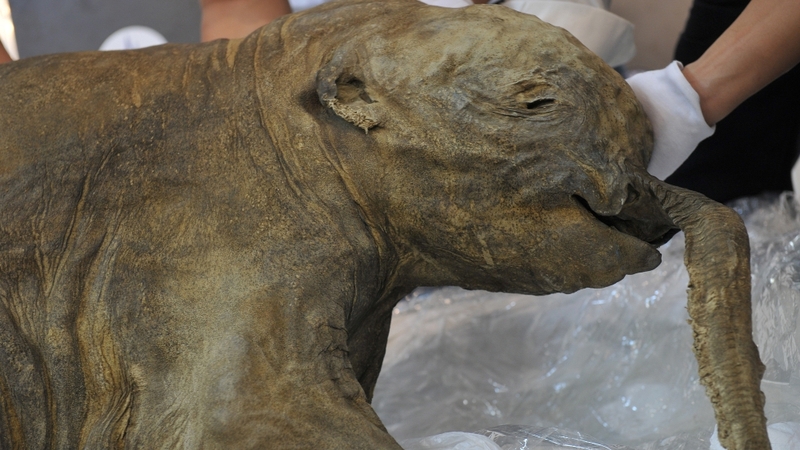
The smallest-ever mammoth roamed Crete up to 3.5 million years ago and was the size of a baby elephant today.
A new study says the Mammuthus creticus weighed in at about 310kg and probably had no woolly coat unlike some of its relatives.
Study author Victoria Herridge, of London's Natural History Museum's paleontology department, told AFP that the animal was "probably quite cute."
"If you were to reconstruct it, I would say OK, make it look a bit like a baby elephant but probably chunkier ... with sort of thicker limbs, stockier, and as an adult it would have had curly tusks.
"The nearest image you're going to get is a baby Asian elephant, but with tusks."
Compared with its extinct cousins, whose shoulder height could exceed four metres and whose name in English has become synonymous with extreme bulk, this version was "tiny," said Ms Herridge.
"I suppose if you were to meet one you'd be a bit intimidated, because they'd still be a metre tall with tusks."
The study, published in the journal Proceedings of the Royal Society B, said Mammuthus creticus is an early example of a phenomenon known as insular dwarfism - animals evolving smaller in isolated environments.
It probably descended from either Mammuthus meridionalis or Mammuthus rumanus, the two earliest European mammoths, Ms Herridge said.
These adapted to warmer weather and did not have woolly coats.
Dwarf mammoths tended to share the physical characteristics of the infant versions of their ancestors rather than being scaled-down versions of their bigger peers, the scientist added.
"The earliest they (the dwarfs) could have gotten to Crete would have been about 3.5 million years ago, so that gives us like an upper bracket, but we don't know whether they were there then," she added.
She said that little fossil evidence existed apart from tusk samples.
Its teeth suggested the creature probably ate a mixture of plants.
The findings confirm earlier scientific assertions that the animal previously known as Palaeoloxodan creticus, which lived on Crete, was a mammoth and not a dwarf in the straight-tusked elephant family.
The elephant is the closest modern relative of the mammoth, a generally huge, woolly mammal believed to have died out with the last Ice Age.
