


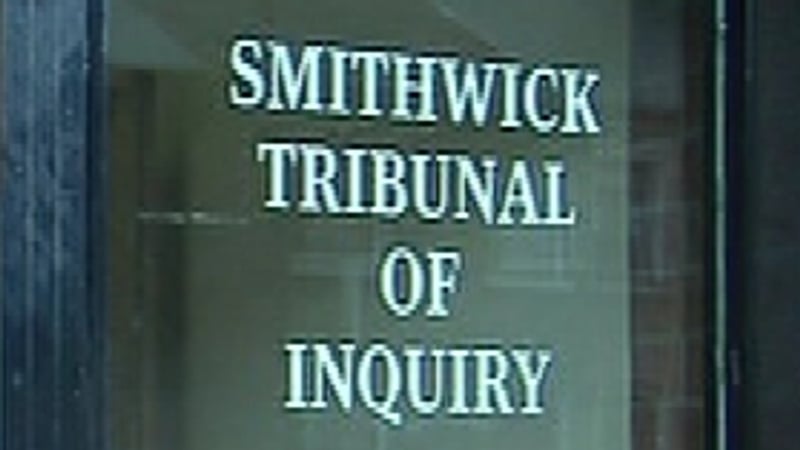
The Smithwick Tribunal was due to resume hearings this week after the Christmas break but they have been put on hold, possibly to the end of the month.
This gives the legal teams more time to plan their strategies for the witnesses still waiting to give evidence as well as review what they’ve heard so far.
Since he started in June, Judge Smithwick has heard from serving and retired police officers from both sides of the border, IRA men, retired British Army officers, civilians, civil servants and journalists.
His aim is to find out if there was collusion involving one or more named gardaí; Owen Corrigan, Leo Colton or Finbarr Hickey, in the IRA murder of two senior RUC officers; Chief Supt Harry Breen and Supt Bob Buchanan.
They died in March 1989 just minutes after leaving a meeting in Dundalk Garda Station. All three former gardaí deny the claims of collusion.
Of all the witnesses the last one to give evidence is perhaps the most important.
His appearance at the Tribunal was with the consent of the British security forces, including MI5, who continue to pay him.
At one stage I counted seven armed gardaí in the hearing room to protect the man in question, Peter Keeley. There were, undoubtedly, more around the rest of the building.
Mr Keeley has used the name of ‘Kevin Fulton’ for several years. It is because of his allegations to retired Canadian Judge, Peter Cory that the Smithwick Tribunal was set up.
A native of Newry, Mr Keeley joined the British Army but was recruited by military intelligence and sent back home with orders to become an agent.
He gave evidence from behind a screen as to how he did that, providing a fascinating insight into the dirty war in Northern Ireland.
Over the years, Mr Keeley infiltrated the IRA and became close to a previous witness; Patrick ‘Mooch’ Blair, who was described to the Tribunal as a leading bomb-maker, and, at the time, a senior member of the IRA.
In fact, he said Mr Blair “green booked” him (a reference to the IRA’s induction and training manual), which officially meant he was an active member of the organisation. Mr Blair denied the claim.
Mr Keeley said he believed Mr Blair was also involved in preparing the Omagh bomb – while Mr Blair himself said phone calls on the day from phone numbers linked to the Real IRA attack were “purely co-incidental.”
Mr Keeley said he believed Mr Blair was protected by British security forces as operations set up to catch him inevitably failed.
It was a similar story for Freddie Scappaticci, the man who denies he is Stakeknife, supposedly the most important British agent within the IRA.
In fact, Mr Keeley who was involved in the IRA’s internal security unit - known as the ‘nutting squad’ - along with Stakeknife, said there were a lot of British agents within the organisation and probably two or three others within his own active service unit.
There is no doubt that he participated in IRA activities but at the same time was passing information to his handlers in British intelligence. He claimed this saved several lives.
Over the years, Mr Keeley worked for a variety of British security agencies; the shadowy British Army group known as the ‘Force Research Unit’, the RUC CID, customs service and MI5.
The latter appeared to be his favourite, at least for debriefing sessions. While the others met him in safe houses in the North or in car parks, MI5 flew him to London, Edinburgh or even Paris for weekend debriefings.
Their pockets were much deeper, he acknowledged.
In later years he worked for CID and the customs service. He told his handlers about planned IRA operations including fundraising crimes. He took part in many of these as he had at this stage officially been given ‘participant status’.
That allows agents to break the law as long as they provide information to their handlers who were employed to uphold the law. It never is, and never was, a question of morals.
It’s just a question of returns. Will the information gleaned from the crime justify the crime in the first place?
However, during his three days of evidence, Mr Keeley did seek to distance himself from other crimes – most notably the kidnapping and murder of Tom Oliver.
The Cooley farmer was abducted, tortured and shot by the IRA because, they claimed, he was passing information to the gardaí about IRA activity in the area.
Mr Keeley said he participated in a previously unknown first kidnapping of Mr Oliver when he provided transport. He said he was away in France when the second and final abduction took place.
However, in his autobiography, Unsung Hero, he said he was in the north at the time. He explained this to the Tribunal by saying the book contained several errors.
However most crucial is his evidence about how the IRA found out about Mr Oliver. He said it was because a garda told them – specifically, now retired Det Sgt Owen Corrigan. Mr Keeley said he knows this because he was there when it happened.
He said he drove ‘Mooch’ Blair out to the car park of a pub in north Louth where Mr Corrigan got in and they discussed Mr Oliver and what would happen to him.
This is the most critical part not only of his evidence but of all the evidence given to the Tribunal so far.
However, Jim O’Callaghan, counsel for Mr Corrigan, pointed out that his client had been on sick leave for over a year when the witness said this meeting took place.
Both ‘Mooch’ Blair and Mr Corrigan denied that such a meeting ever took place. Mr Keeley insisted it did.
The Oliver family have always denied that Mr Oliver was passing information to the gardaí.
The former British agent also alleged that Mr Corrigan removed forensic evidence from a bomb found in Omeath and that he effectively destroyed possible forensic evidence at the site in north Louth, where the IRA had lain in wait for British soldiers.
The ambush at Narrow Water Castle in Warrenpoint in 1979 killed 18 members of the Parachute Regiment.
Mr Corrigan claims none of this ever happened. In fact, his counsel’s description of Mr Keeley as an “attention seeking, egotistical, fantasist and liar” would find a lot of support among previous witnesses from the RUC / PSNI and some gardaí too.
Several witnesses described him as “an intelligence nuisance.” However this was, by no means, a universal view among police officers.
Mr Keeley did admit lying to the Stevens Inquiry which was looking at claims of RUC collusion in the murder of solicitor Pat Finucane and Loughlin Maginn.
He told the Tribunal he did so because he said his handlers were trying to set him up to be killed.
There were many elements to Mr Keeley’s evidence for Judge Smithwick to consider.
His claim he wanted to disappear into the background but was yet preparing work for a gallery called ‘Explosive Art’.
How he demanded money from a newspaper for using a picture of him but didn’t raise concerns about it identifying him and his ongoing legal actions against parts of the UK security establishment.
However the key question for the Judge is who does he believe - a former garda who is being investigated and the man who is alleged to have been his IRA handler - or a British agent who worked within the IRA but who has admitted lying to another inquiry and who has been branded a fantasist and liar by many.
The Judge will, most likely, seek corroborative evidence to back up one version over another or rely on evidence already heard to form his opinion.
One thing is clear arising from the evidence of Peter Keeley. Nothing was or is straightforward regarding the dirty war during The Troubles. There’s very little black and white - it’s mostly shades of grey.
Whether it’s darker or lighter grey depends on your own perspective.
