


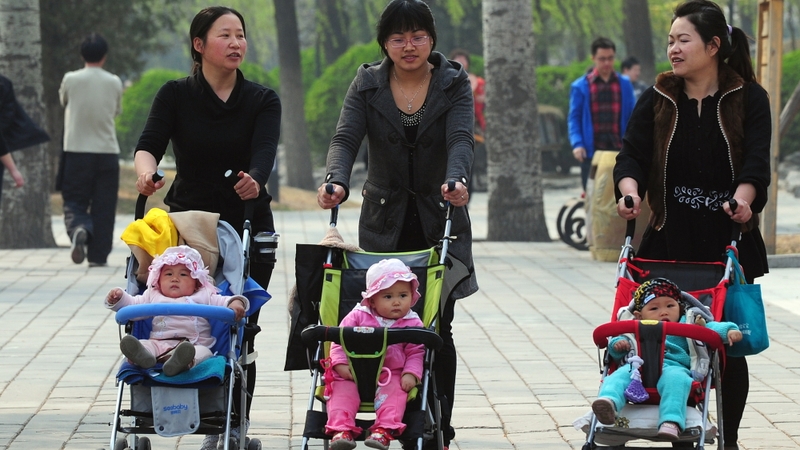
Concerns over gender imbalances and an ageing population has spurred China's most populous province to seek permission to ease the one-child policy after more than 30 years.
Guangdong in southern China wants Beijing to allow couples where just one parent is an only child to have a second baby, according to a local government official.
China's one-child policy, introduced in 1979 to curb population growth in the nation of more than 1.3bn people, has become increasingly unpopular with the country's ageing population.
Critics blame the policy for creating gender imbalances resulting in sex-specific abortions, female infanticide and the abandoning of baby girls.
The policy also puts pressure on only children to support their parents and two sets of grandparents.
Policy violations usually result in hefty fines and a cut in social services, although some ethnic minorities and farmers whose first born is a girl are excluded from the restriction.
Some areas allow parents who are both only children to have a second baby.
'To allow the new policy will have little overall impact on population growth,' said Guangdong family planning chief Zhang Feng.
'The increase in population is still a big problem affecting our social and economic development. But in the long term, ageing will also be a problem.'
The Guangdong trial would help alleviate problems caused by the family planning measure, such as the ageing population adding pressure on the nation's economy.
The results of the latest nationwide census released in April show 118.06 boys were born in China to every 100 girls over the past 10 years, creating an imbalance based on Chinese preference for male heirs and viewed as a possible source of instability.
A study last year warned more than 24m men of marrying age could find themselves without wives in 2020.
He Yafu, an expert in close contact with some of China’s official demographers, told AFP last year that officials planned to launch similar pilot projects in five provinces to evaluate the effects of relaxed rules.
The proposed test provinces were Heilongjiang, Jilin and Liaoning in the northeast, Jiangsu and Zhejiang in the east.
'Official demographers say that those five provinces have basically been determined as the first pilot provinces, and over the next five years or so it will spread to the whole of China,' Yafu said.
The census showed Guangdong, with 104m residents, was the country's most populous province up from 86m in 2004.
Much of Guangdong's population increase is due to rapid rises in the migrant labour work force based in the city’s booming export-oriented industry.
Despite the problems caused by population controls, President Hu Jintao said in April the 'one-child' policy would continue because the population exerts an increasing strain on resources and government services.
