


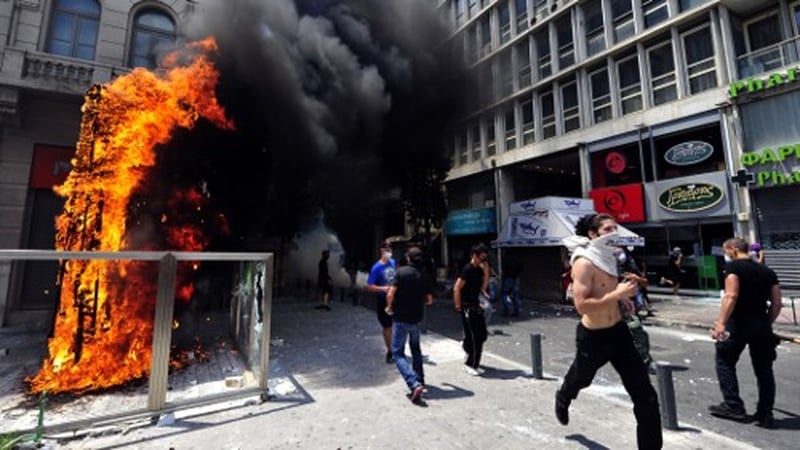
 Following the violence on 29 June, RTÉ's Europe Editor Tony Connelly (@tconnellyRTE) looks at the origins and aims of Greece's anarchists.
By late afternoon on Wednesday 29 June, Syntagma Square felt saturated in tear gas. Its toxic smoke shrouded buildings, its residue dusted pavements and trees.
Even moving through the square days later, eyes would sting and weep, and throats would flinch and gag at its vestigial effects.
What better metaphor for the very murky world of the Greek conspiracy theory.
The Eurozone debt crisis is played out on many levels. There’s the world of banks and bond spreads, debt rollovers and credit default swaps.
But on the ground in Syntagma Square, the focus of outrage against the government imposed austerity programme, its impossible to disentangle the crisis from a very Greek blend of history and politics.
It’s no wonder that it was the ancient greeks who came up with a word for it: paranoia.
Within hours of the rioting there were rumours that police agents provocateurs had deliberately started the trouble.
It was even backed up by YouTube footage, later aired on Greek television, which showed riot police parlaying with masked youths before they went back into the square.
Attitudes and suspicions
The reflex towards paranoia can be traced back to recent history.
After World War II there was a bitter civil war between right-wing extremists and communists.
Then in 1967 a group of right wing colonels took power in a coup, deposing the king and then running a repressive military junta for seven years.
As a result a culture of fragmented and passionate left wing groups have remained a enduring part of a highly charged and polarised body politic. Attitudes and suspicions have long outlived the fall of the Berlin Wall.
Indeed, the US government’s friendly attitude to the Colonels meant that antagonism to the West and NATO continued well into the 1990s.
Often demonstrators who surged up against the parliament in recent weeks would hurl Junta-era slogans at riot police and beyond, out of earshot, at the MPs inside.
Ironically it was prime minister George Papadreou’s father Andreas who founded the PASOK movement to oppose the colonels.
The Junta has also left a legacy which has allowed many leftist groups to flourish in universities.
During the coup tanks rolled onto campuses to confront student opponents, so afterwards as a reaction against the Junta years, student demonstrations were given special protection.
In 1982 a law forbade police from entering universities to pursue suspects, and the law has divided Greek society ever since.
Some feel it is a necessary bulwark against police brutality and in favour of freedom of assembly and expression; others say it gives anarachist groups cover for mindless violence and vandalism.
A new bill is currently in the Greek Parliament which, if passed, will quietly remove campus impunity.
But what about those anarchists who have been repeatedly blamed for causing the trouble around Syntagma Square?
It wasn’t until the 1980s that anarchists joined the political scene, and their appeal has often coalesced around the so-called martyrdom of young members killed in clashes with the police.
The high point was 1985 when 10,000 marched in Athens following the death of a 17 year old.
Revival
Again, anarchist groups have enjoyed a revival since 2008, when 15-year-old Alexis Grigoropoulos was killed by police gunfire.
Today there are 10,000-20,000 active members in Greece, scattered across different factions, and all using social network sites and YouTube to expand.
The anarchist creed of a classless society, with no masters, and no power, has clearly found fertile ground in the debt crisis.
As one Greek journalist explained: ‘There is a childish defiance among anarchists: the more you demand they do something, the more they revolt against it.’
Apply that to the austerity demanded by the EU and IMF and you get the picture.
The groups tend to support violence, although they differ on when and how to start it.
One group, which translates roughly as Cells of Fire, has a hardcore of youths who believe violence is a legitimate response. Many of their members are in jail.
During the disturbances of April 2010 anarchists were accused of burning down a branch of Marfin Bank leading to the deaths of three employees.
Indeed on Syntagma square I watched as some argued furiously over whether or not to burn down a bank which was in the building next to ours.
But violence is not their only method. In the notoriously anarchist neighbourhood of Exarchia social anarchists overnight turned a derelict square, due to become a parking lot, into verdant park.
They also organise language classes and food distribution for immigrants.
Many anarchists say their arguments, that Greek society was always corrupt, has been proved right even to the extent that the EU and IMF would agree.
But their appeal in 2011 is a sad one and it is based on the notion that no matter what Greeks do their future will be no better and they can only, therefore, rely on themselves.
As one journalist who follows anarchist groups explained, ‘even if life was tough for our fathers and grandfathers they knew that if they worked hard they could improve their situation.
‘Today,’ he says, ‘you have a generation of 18 to 35-year-olds no longer believe that.’
Greeks pride themselves on being historically unruly towards anyone who tries to impose their will on them, whether it be the Ottoman Empire, which ruled from the fall of Constantinople in 1453 to Greek independence in 1821, or the Italians under Mussolini, or the Nazis during World War II.
Whether their unruliness will survive the current crisis remains to be seen.
Tony Connelly
