


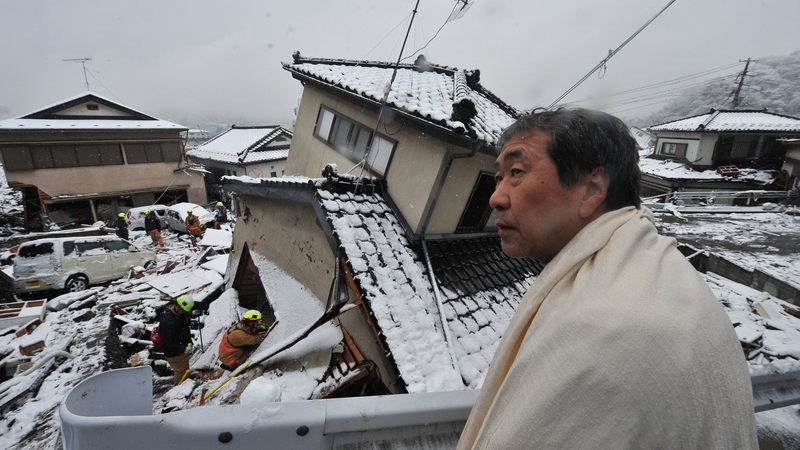
 Paul Cunningham (@RTENewsPaulC) visits the towns of Taro and Miyako, both destroyed in the tsunami last Friday.
A blanket of pristine snow covered what used to be the town of Taro, concealing the horror underneath. Famed for its beach, Taro was flattened in 1933 by a tsunami.
Now it has happened again.
Matt Ketchum, an English teacher in the neighbouring town of Miyiko, surveyed the damage with me. Many of his students came from Taro. Now he stood in silence, surveying the obliterated town.
The only identifiable structure was the train station on the left and a baseball stand on the right. Between those two points - a distance of a half a kilometre - nothing was left standing.
Kick away the snow and the contents of 2,000 mangled houses are revealed. A bag here. A table there. Curtains. Wardrobe. There's something distinctly uncomfortable about being able to see other people's personal belongings. It's an invasion of their personal integrity. You look away.
The police were on hand directing traffic. Soldiers were clearing pathways through the debris. Residents were returning to find out what had happened.
One woman was driven towards the edge of town. She had her hands over her mouth as her eyes darted left and right. As the full nightmare was revealed, she covered her eyes and looked down. The car didn't stop, but simply took a right hand turn and left the scene.
Cameraman Pol Reygaerts and I walked on into the centre of town. Army officers were using cranes to knock down houses that had been wrecked but were still half standing. The word apocalyptic sprang to mind.
Our journey had started out at half seven after less than four hours sleep. The nine hour time difference between Ireland and Japan means reporting for RTE's 6.1 News at 3am local time.
Our journey was possible because we took a taxi. They are able to beat the fuel shortages because they drive on both petrol or LPG - Liquid Petroleum Gas. There may be lengthy queues for petrol but acquiring LPG is no problem.
With an hour we were passing those signs that give you the shivers: Estimated Tsunami Inundation Area. Most of the road signs are bilingual and that one really stops you dead in your tracks.
Just as we approached Taro, a barrier had been placed across the road. The area was being used by emergency services. Our only option was to take a 45 minute detour over the top of a mountain on a narrow road covered with compacted snow. After a six hour trek we'd arrived.
We'd met Matt a short time earlier in the town of Miyako. Hailing from Pennsylvania, he stood out from the crowded street with his brown hair and baseball cap turned backwards. Would he show us around the town and, maybe, do a bit of translation? His answer: No problem.
Miyako is now internationally famous - which is something for a regional town that could probably best be described as sleepy. It all changed when the tsunami swept through, and the moment was captured on video.
First broadcast on Japanese TV, and then around the world, it showed how sailing and motor boats in the harbour was carried on the tsunami waves onto a highway that hugged the coastline, and then smashed against a bridge.
A large speedboat is still wrapped around the columns supporting the bridge. Several other boats ended-up on streets, or inside buildings.
Matt took us to his apartment block. It's virtually unique in Miyako as it remained untouched. The bottom floor may have been destroyed; the front entrance detached but his apartment was still intact. I inquired about the broken window. He laughed saying he'd broken the pane while trying to retrieve his passport and few other belongings - a guitar and some clothes. All around him was a wasteland. A house which had been located two streets back was now side-by-side with his building.
Matt kindly came with us to Taro and was clearly taken aback at the scene - a place he know well had simply disappeared. One man was walking his way through the disaster-zone.
Matt asked him if he felt it was possible for the town to recover from the havoc the tsunami had brought. He considered the question for a moment. Then the man said that while Taro had been rebuilt after 1933, he wasn't certain this time. The buildings had virtually all been demolished. The people had left.
All the time, the snow fell from the sky and covered-up the wreckage. A place destroyed in mere moments by what Matt described as a black wave from hell.
More than 500 people are known to have died here. The number of missing / believed dead has yet to be calculated.
Paul Cunningham
