


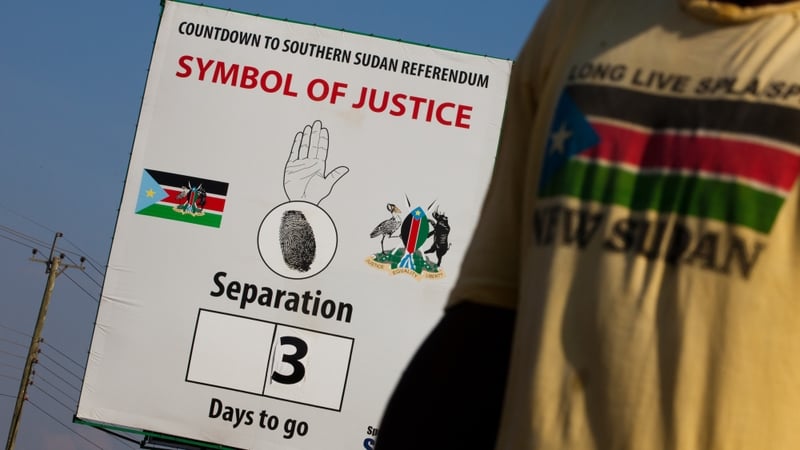
South Sudanese go to the polls this week in a referendum that could see the mostly Christian south break from historical domination by the Muslim north.
The vote marks the culmination of decades of war and six years of peace.
Despite serious doubts just a few months ago, the 9-15 January vote that could divide Africa's largest country in two finally looks set to go ahead on time.
'We are ready. We have distributed the election material to all the designated places. It's now up to the referendum commission to send them to the voting stations,' Dennis Kadima, the head of the UN referendum agency UNIRED, told AFP.
'We are really 100 percent prepared for the great day,' Chan Reec, deputy chairman of the Southern Sudan Referendum Commission (SSRC), said.
There is also growing optimism about the future relationship of north and south Sudan even if the southerners choose independence.
The two were bitter enemies during a devastating civil war that lasted 22 years.
This week, in a rare visit to the southern capital Juba, Sudanese President Omar al-Bashir said: 'I personally will be sad if Sudan splits. But at the same time I will be happy if we have peace in Sudan between the two sides.'
'I am going to celebrate your decision, even if your decision is secession.'
Some 3.9m southerners, mostly living in the south, but with others in the north and abroad, have registered to vote in the referendum.
History
The predominantly Arab north and largely black south have shared a violent history, from the days of slavery through the colonial period until now.
Religious differences and the concentration of power in Khartoum have been key factors behind the fighting since independence in 1956.
Between 1920 and 1947, the British colonial rulers administered the two regions separately, limiting the movement of people between them and encouraging Christian missionary work and English in the south.
The first north-south civil war broke out several months before independence and lasted until 1972.
The southerners took up arms again in 1983 and finally signed a peace deal with Khartoum in 2005 that guaranteed them a referendum on their future six years later.
The fighting killed 2m people and left another 4m displaced.
The vast, resource-rich south, still recovering from so many years of war, has an estimated 8.5m inhabitants and has been autonomous since the 2005 peace accord was signed.
'They are almost two independent states already,' said a diplomat in Khartoum speaking on condition of anonymity.
Senior politicians in Khartoum, including President Bashir himself, have recognised in recent weeks that independence will be the likely choice of southerners.
But for the vote to be valid at least 60% of those registered must cast their ballot.
There are however concerns about the transparency of a voting process that will mostly take place in one of Africa's least-developed regions.
International bodies charged with monitoring the referendum include the Carter Centre, the European Union and the Arab League.
If it does vote to secede, south Sudan would become an independent state in July, at the end of the six month interim period stipulated by the peace agreement.
The 2005 peace accord (CPA) that ended Sudan's devastating north-south civil war also stipulated that a referendum would be held simultaneously on the future of the disputed oil-rich district of Abyei.
However, that vote has been postponed indefinitely.
