


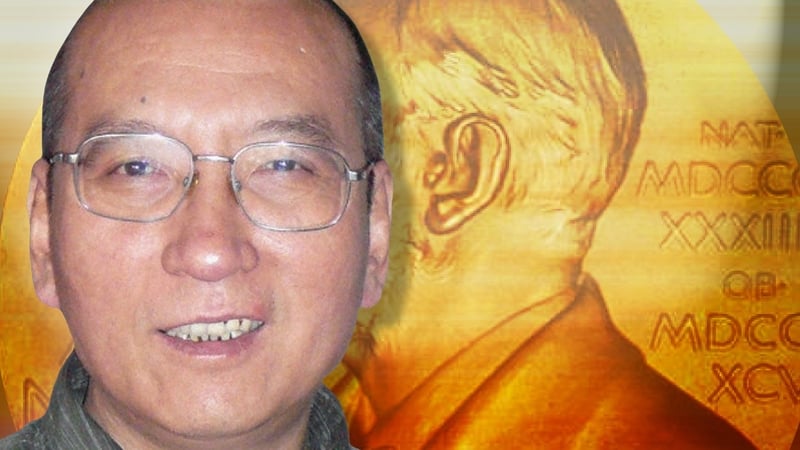
 Margaret Ward reports from Beijing on the day the Nobel Peace Prize was awarded in absentia to Chinese dissident Liu Xiaobo.
It’s a fairly anonymous street in the western suburbs of Beijing, but today it was the focus of the world’s media attention.
When we arrived security men were still nailing up a blue fence to prevent TV crews getting a clean shot of the home of China’s most famous dissident, this year's Nobel Peace Prize winner Liu Xiaobo.
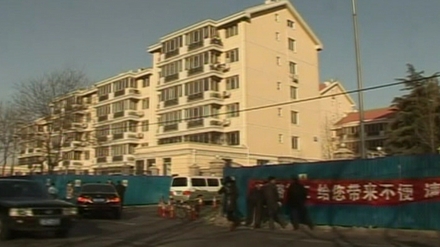
Liu Xiaobo wasn’t there of course, and he wasn’t in Oslo either: he’s in jail in Liaoning province serving the first year of an 11-year sentence for what’s called the subversion of state power.
He was one of the main authors of Charter 08, a manifesto calling for sweeping reforms of the Chinese political system. Liu was arrested just before he and others were due to launch it.
All day long, policemen filmed us and the other crews, and old ladies wearing red armbands patrolled the streets around the complex. Inside Liu Xiaobo’s wife Liu Xia is a virtual prisoner – she has no phone or internet access - and police control her every move.
Nobel rules mean that only the winner, or close family, can pick up the prize so there was no one there to receive it. The prominent artist Ai Weiwei, one of the designers of the Bird’s Nest Olympic stadium, tried to leave China and was stopped at Beijing airport, apparently because of concerns he might try to attend.
Other activists were sent out of town or placed under house arrest.
Some have been told it will end on 12 December.
The Chinese authorities appear to believe that the world’s news cycle will have moved on by then.
And they may well be right. There’s only so much room for stories about Chinese dissidents. The authorities knew they would have a difficult few days around the ceremony, but they’re prepared to weather that storm internationally.
Because their main concern isn’t what the outside world thinks of them: it’s what the Chinese people think of them.
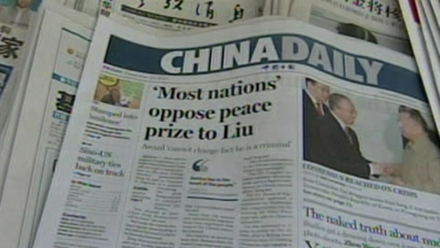
Hence the need to get other countries to boycott the ceremony so China can tell its own people that it’s not the only one that thinks giving the peace prize to Liu Xiaobo is a bad idea. The Communist party’s version of events is basically that the award is a western plot to upset China because it doesn’t like China’s growing importance in the world.
But if China were so confident about its system and its place in the world it could afford to brush off the award and let anyone who wants go along. Instead it feels the need to bully countries into staying away, stop people attending the ceremony, block international TV coverage and erect blue fences so cameramen can’t film.
None of this helps China win the PR battle internationally: but the authorities obviously believe it will help them win the battle at a national level, or at least limit the damage.
However while most people in China still don’t know who Liu Xiaobo is, still less know what he stands for, the prize has undoubtedly raised his profile.
Four other Nobel peace prize winners were unable to pick up their prize in person. Three of the regimes that made that impossible were Nazi Germany, Soviet Communism and Polish Communism.
They all once looked invincible, and are all now gone. There's no immediate threat to the Chinese Communist party but these are three good reasons for it to be afraid of Liu Xiaobo.
Margaret Ward
