


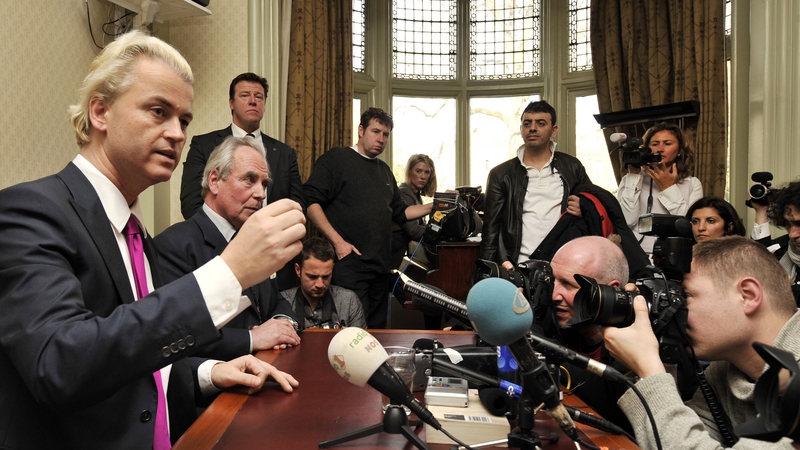

Ray Colgan reports from the Netherlands on recent election gains by the far-right Freedom Party.
Voters in the Netherlands went to the polls in June to elect a new government. They still haven't got one, as talks on the formation of a coalition look set to continue for some time.
The most significant gains in the election were made by the far right Freedom Party. Its supporters will tell you its platform includes a tough stance on law and order, and improved health care for the elderly. But the party really has just one core issue - ending what it terms the Islamisation of the Netherlands.
It's a policy that certainly struck a chord with many Dutch voters. The party had nine seats in the last parliament. It now has 24. And its support continues to grow.
A poll over the weekend suggests that if another election were held now, the party would win a further 11 seats.

If you want to understand the party's success, the town of Almere, about 25 minutes drive from Amsterdam, is a good place to start. Built on reclaimed land, it is one of the Netherlands youngest cities, and one of the fastest-growing. The atmosphere is slightly strange: the uniformity of the architecture gives a sense that the town maybe arrived flat packed. As elsewhere in the Netherlands, bicycles are everywhere.
Around a third of the 185,000 people living there were born outside the Netherlands, and the Freedom Party is the biggest group on the local council. Some people are reluctant to say they voted for the Freedom Party, but they explain how they believe immigrants are getting housing before Dutch born citizens, and say north African youths are responsible for much of the crime in the Netherlands.
They give the Freedom Party and its leader Geert Wilders credit for putting the their concerns on the national agenda.
Geert Wilders is not just the party leader, he is its sole member. He rarely gives interviews, yet manages to put himself centre-stage with often controversial daily text messages.

He's now planning what he's termed an 'international freedom alliance', linking up with other similarly minded groups in five European countries.
Some analysts have suggested that the economic crisis has heightened tensions. But according to Dr. Andre Krouwel, a political scientist at Amsterdam's Free University, the integration of immigrants in Dutch society has been badly handled, with a result that parts of the Muslim population are neither part of Dutch society nor the workforce. That's why to some, the Freedom Party's proposal to end immigration from Muslim countries is a good idea.
The irony is that some Dutch Muslims are working very hard to integrate, while also being loyal to their own values.
One such group meets in the Polder Mosque in an Amsterdam suburb. Men and women pray in the same room, the Imam preaches in Dutch, and the community is administered by a woman.

Eliza Bernauer, a Dutch convert, explains there is a conscious decision to be open. Sermons are in Dutch so the wider community can understand what's going on. Unlike many other Mosques, the Polder Mosque is not supported by wealthy foreign benefactors. Surprisingly, Eliza suggests that some in the Muslim community have played a part in allowing the climate of suspicion to grow. She argues many have been happy to practice their religion, but have remained out of communication with the wider Dutch society.
Geert Wilders is most unlikely to play a part in the next Dutch government. A right-wing coalition would only have a majority of one seat.
But what worries some at the Polder Mosque is that Freedom Party has cleverly tapped into the fears of many, and that main stream parties may chose to take some of their ideas on board.
Ray Colgan
