

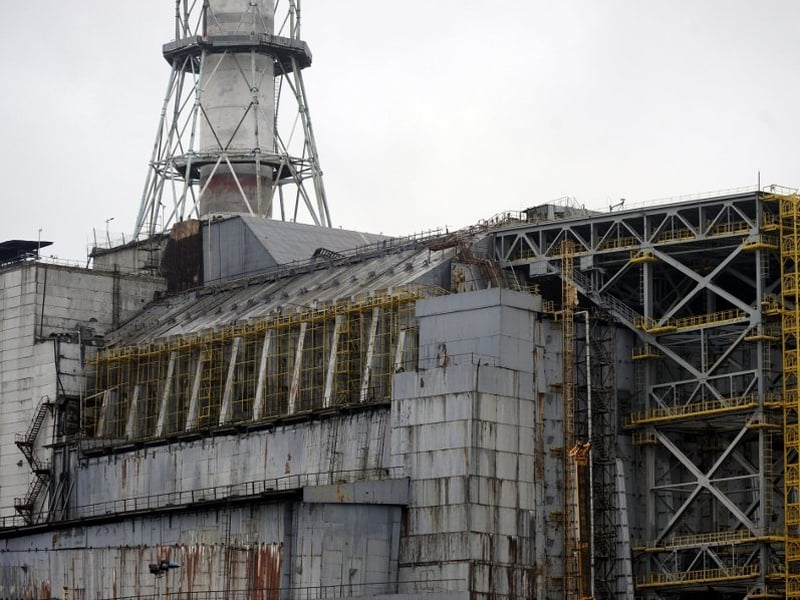

With radiation levels much higher than expected and cancer levels continuing to rise, the dangerous legacy of the Chernobyl disaster is still a hugely significant issue for Europe.
New research issued by the American Geophysical Union indicates that it will take between 180 to 320 years for the Caesium 137 - a radioactive isotope - to disappear from the local environment, much longer than the 30 years that had been expected.
The Chernobyl nuclear disaster occurred on this day 24 years ago - 26 April, 1986 - when a reactor exploded during a test of its emergency system, contaminating the then Soviet states of Ukraine, Russia and Belarus as well as creating a fallout which spread to other parts of Europe. As a result, thousands of children and adults are living with social, economic and medical deprivation to this day.
Speaking from the heart of the Chernobyl zone, Adi Roche, Founder of Chernobyl Children's Project International, said studies underscore that Chernobyl cannot be relegated to history.
She said: 'Let us spare a thought for the children and families whose inescapable reality is living with the radioactive contamination of their homeland.
'Imagine what it is like to be one of the 1.8m people living with the silent but none the less deadly radioactive contamination and to be a refugee in your own homeland. This is the enduring legacy of Chernobyl'.
Today, CCPI launches National Chernobyl Week which runs from 26 April to 2 May. The nationwide campaign is aimed at highlighting and raising awareness of the programmes that assist and empower children and communities in Belarus, Ukraine and western Russia.
 The Chernobyl effects, recently documented by the New York Academy of Sciences, mean that there has been a significant rise in all types of cancer causing thousands of deaths, an increase in infant and perinatal mortality, a growing number of deformities and genetic abnormalities, delayed mental development, neuropsychological illness, blindness, and diseases of the respiratory, cardiovascular, gastrointestinal, urogenital and endocrine systems.
Doctors at the Children's Cancer Hospital in Minsk, Belarus, and at the Vilne Hospital for Radiological Protection in Ukraine, are seeing a spike in cancer rates, mutations and blood diseases among their patients, with a direct link to the nuclear explosion.
Forest fires currently rage in the 30km exclusion zone and as temperatures rise in the lead-up to the summer months, these fires cause a surge in background radiation, endangering local children and families who are already living in highly contaminated areas.
In Germany last weekend tens of thousands of people joined hands to form a human chain to protest against nuclear energy.
The protest was also aimed at opposing proposals by Chancellor Angela Merkel's government to delay the closing of the country's 17 nuclear power plants beyond a 2020 target date.
The demonstration organisers estimate that more than 120,000 people took part in the human chain which stretched for 120km along the Elbe river through the port city of Hamburg.
The organisers, a grouping of environmental, religious, youth, union and political organisations, called in a statement for the government to 'correct its policy in favour of the atom'.
They urged Berlin to 'definitively' close the nuclear plants in the north at Brunsbuettel and Kruemmel, which have had several breakdowns in recent years.
Germany decided in 2000 to close its 17 nuclear reactors by 2020, but Ms Merkel's government wants to look at extending the life of some plants, which produce around 30% of Germany’s power.
Chernobyl Figures
- At the time of the disaster, only 3% of the radiation was expelled; 97% of the radioactive material still remains within the Chernobyl reactor.
- 4.5m children and adults continue to live on contaminated land.
- A UN toll published in September 2005 set the number of victims at just 4,000, a figure contested by non-governmental organisations.
- In Belarus today, 85% of the children in contaminated areas are ill; before the explosion, this figure was 15%, according to The Belarusian National Academy of Sciences.
- The Academy also estimates 93,000 deaths and 270,000 cancers.
- The Ukrainian National Commission for Radiation Protection calculates 500,000 deaths so far.
