


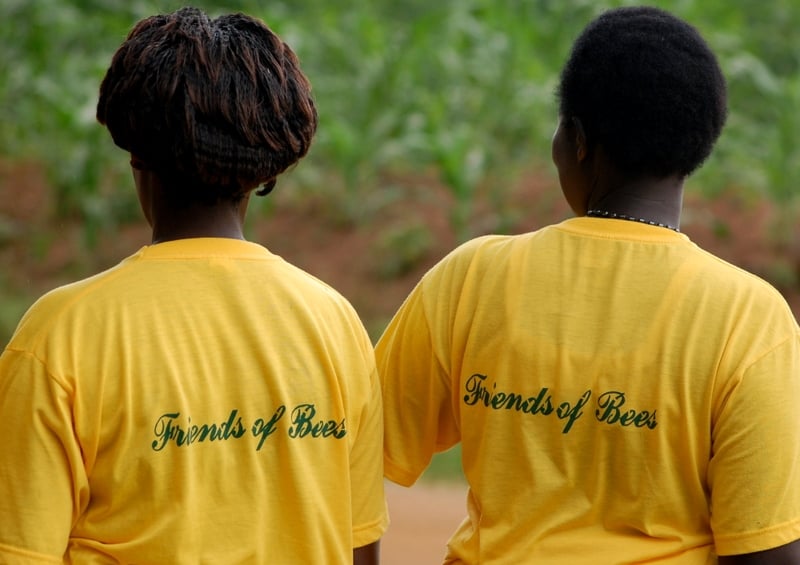

In part three of the series, Blathnaid Healy travels to Tororo in Uganda to find out more about a women's beekeeping project and some of the benefits and challenges experienced with it.
In a striking ankle-length dress made of red and pink-patterned fabric, Annet Opondo moved carefully between the low branches of the trees to inspect the beehives in her apiary.
With a white, wide-brimmed hat on her head and a veil draped over her face, which settled on the shoulders of her slight frame, the farmer, beekeeper and mother-of-four carried out her routine checks on the eight hives on her farm.
Situated down a narrow lane near the town of Tororo, close to the border of Kenya in Uganda, the Opondo’s small farm is surrounded by a perimeter of trees and shrubs framing their house.
The smell of thick grey dust churned out of a nearby cement factory hangs in the air, sweetened only by the subtle aroma of honey and the scent of some flowering yellow plants.
 Annet has eight hives full of bees that produce honey and wax, which she processes and gets money for.
With the corrugated metal lids of the timber-frame rectangular boxes lifted, Annet examined the hives for any pests that might harm her colonies of bees.
Three years ago the 33-year-old received the gift of three beehives from the Irish aid agency Bóthar – a donation she said has changed her life.
With the money made from beekeeping, Annet bought two goats - which produced four others - and some guinea fowl for the farm.
Annet’s interest in beekeeping was piqued by something she heard on a radio programme. Although she was initially frightened by the small, but sometimes dangerous insects, after receiving help and training she quickly found herself carrying out even the most difficult of beekeeping tasks - removing the honey from the beehives.
On the other side of Tororo, in a tree-filled farm, it was a visit from a relative while her young child had a cough that prompted Felistas Kapenge to start beekeeping.
Felistas said she heard how honey could help with her children’s health from a relative who was visiting, which prompted her to use some leftover timber bought for work on the family’s house to make two beehives.
With some beekeeping instructions from her relative, Felistas successfully attracted bees to her hives and when the time came to harvest the honey she found she had more than she needed for her children’s health – so she sold the balance.
This income from her first honey harvest gave Felistas the desire to increase the number of hives on the farm.
 Like Annet, Felistas got three beehives from Bóthar to add to her existing two. She subsequently added a further 11 giving her 16 in total.
Both women are members of a beekeeping association in Tororo - a project funded by Bóthar for three years from 2003 to 2006.
Over that time the Irish organisation, through a partner organisation Heifer International, spent $36,000 reaching 200 farmers through the Tororo Women (sic) Beekeeping Association.
While the project was being funded, most of the farmers were each given three beehives and training in keeping bees. The association established a processing centre where honey and wax could be extracted from the combs and transformed into saleable goods.
Like all of Bóthar’s programmes, the beekeeping project in Tororo should have grown as the farmers made money and passed on hives to their neighbours or other members of the association – but only 20 were passed on.
Bóthar uses the ‘pass on’ principle with all of the livestock it donates. With a cow or goat the family signs a contract with the agency that says it will give the first-born calf or kid to another family; this system, Bóthar says, helps people to help themselves.
With bees it can be more difficult. Instead of the offspring being donated the money equivalent is passed on through a contribution made by the beekeepers in the project.
There are women in Tororo who have been trained but are currently waiting to receive beehives.
 The project worker Anne Asinde, who assists the beekeeping association in Tororo, said it was envisaged that families who received beehives could pass on the money needed to purchase more after they had harvested honey and wax twice.
Anne said the programme was structured so that farmers would have to bring back all of their bee products to a centre for processing - that way the association could subtract the money needed to pass on hives – but this has not gone to plan.
At a gathering of some the women from the association in the yard outside the processing centre they complained that it took a long time to get money from the association after they brought in their honey and wax.
Anne said she believes that the beekeepers are not bringing all of the honey and wax back to the processing centre and are instead selling direct to neighbours and friends, which means the organisation is not getting enough money to enable it to reach more beekeepers and expand.
She also said that low honey production among some of the beekeepers has been a factor.
Anne was paid while the programme was funded by Bóthar, but since the funding ended she has given her time and beekeeping expertise to the farmers mostly for free – which often means the beekeepers do not have sufficient support for problems or knowledge to draw on.
She said that, together with the committee of the association, she is looking at ways to make sure that all of the honey from the association's members comes to the processing centre so they can get more money to buy beehives.
The committee should act as a support for the beekeepers, but currently the chairwoman and another committee member do not keep bees themselves or have the knowledge to assist the women.
This is something the Deputy Director of Bóthar’s partner organisation Heifer International in Uganda said needs to change.
Dr Margaret Makuru said only people who keep bees should be on the committee and they should be the model farmers for the group.
‘These model farmers would have demonstration farms where others come and learn and they would also be the source of planting materials like the forage trees and the various flowers, which they could plant and they would get knowledge by seeing how it could be done,' she said.
The need for beekeeping in Tororo is great, according to this former vet, because the mostly dry environment is not conducive to growing cash crops or keeping livestock, but there are challenges.
‘At the moment the funding for this project has ended,’ she said. ‘They are all now relying on passing on a gift, which is taking time because it is after they sell the honey they collect and they are able to pass maybe two or three beehives per season.’
Dr Makuru said that honey production levels could be improved in the association to produce more income. More flowering trees and plants were required on farms with low production, she said, before adding that the women should join the Uganda Beekeepers' Association.
'They could travel and see what other members are doing because there are other by-products which others are producing which these (the women) are not yet producing,’ she said.
'They could improve their honey production and get a better market. They could also get to know the markets as they move.'
 Aside from the small number of hives being passed on and the delay in money for the women, the group of gathered beekeepers also said they were concerned that there was not enough protective suits in the association for them to work safely with the bees – and they said the suits they do have either have holes or do not work anymore.
Bee suits protect the beekeeper from being stung, especially during honey and wax harvesting when the bees become very aggressive.
Bóthar in Ireland said it was unaware that so few beehives were passed on after the initial ones were donated while it funded the programme up until 2006. It said it did not know there were problems with the sustainability of the project.
Bóthar Chief Executive Peter Ireton said he was surprised.
‘It seems as if the whole project has not succeeded; in this case it seems everything is pointing towards it,’ he said.
But he said situations like these do happen and that while 85% of all the projects they fund are successful, the rate of families passing on livestock to others would not be up to what the public might suggest.
The chief executive said that in the broad sense beekeeping programmes in African countries have worked and they have had some tremendous successes with them, but, he said, sometimes things just go wrong.
Bóthar said it would look again at the project in Tororo to see how the situation could be rectified and the problems solved.
Dr Makuru said there is a lot of potential for beekeeping in Tororo and Uganda - something both Annet and Felistas have demonstrated.
 Aside from generating an income, both women were enthusiastic about the social and development aspects of the training they received through the association.
Annet said she now knows how to talk to people and has gained skills that have helped her to feel comfortable when visitors come to her home.
Together with the other women who were gathered in the association's yard, Annet looked on as two beehives were passed on through their contributions during the year to another member.
Addressing the women, Bibiyani, the recipient, expressed her thanks. She said she hoped the beehives would give her chance to chase poverty from her family.
'I am very happy today to get a gift that will help my home,' Bibiyani said.
Another woman from Tororo - who had been waiting in the wings – has now started to keep bees.
'The Humble Bee' is brought to you in part by the Simon Cumbers Media Challenge Fund
Click to return to the main page of the series
