


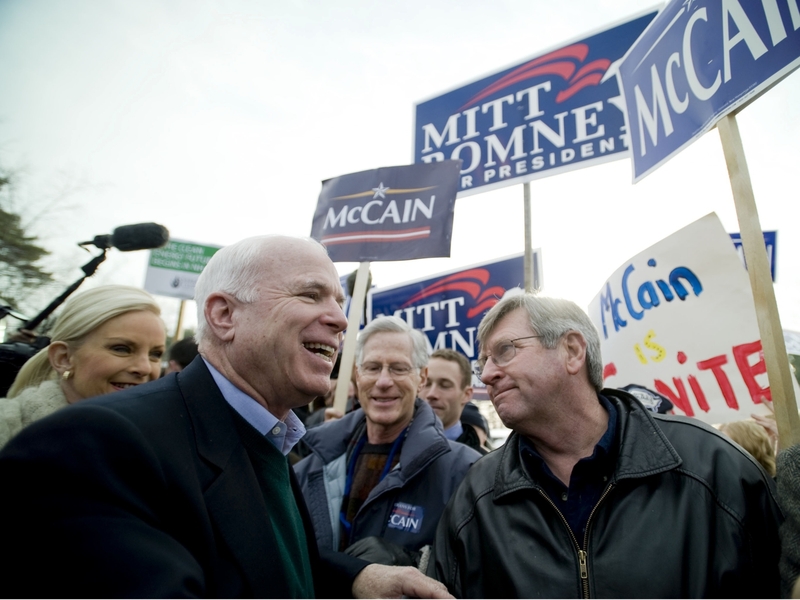
It will be ten more months before we know who the next US president will be, but the process by which Americans pick that person has been building up for months.
This month the results of hand-shaking and baby-kissing are starting to be revealed as the first primaries and caucuses take place in a number of states.
Voters in small states like Iowa, New Hampshire and South Carolina will make or break campaigns and set the stage for the coming weeks.
While they are technically choosing delegates to represent their wishes at the national conventions later this summer, recent conventions have been lavish, predictable affairs with the nominee known for months ahead of time.
Although there have been some years (and episodes of the TV programme 'West Wing') when late-night wrangling in 'smoke-filled' rooms produced the candidate.
Since the days of Jimmy Carter's election in 1976, Iowa's caucus wields a good deal of power and influence for a small midwestern state.
 Winning candidates, like Barack Obama and Mike Huckabee (left), can experience boosts to their campaign while others, like Senators Dodd and Biden, drop out.
Last week, registered members of both parties went to their assigned precinct to declare their preference (there are more than 1,700 across the state). While Republicans vote by secret ballot, Democrats literally go stand in their candidates' corner.
On 8 January the small New England state of New Hampshire held the 'first-in-the-nation' primary, a straightforward ballot box election.
Both Iowa and New Hampshire have been criticised for having too much power in shaping the race, even though they are not demographically (read: too white) or politically (read: too moderate) representative of US voters nationwide.
In response to that criticism, the primary calendar has been radically altered this year.
Later this month, primaries in Nevada (19 January) and South Carolina (19 Jan for Republicans, 26 January for Democrats) could reduce the field of candidates to just one or two per party.
But the big event will be Super Tuesday on 5 February when 22 states including the three of the most populous ones (California, New York and Illinois) hold their primaries. This year it has been dubbed 'Super-Duper Tuesday' with more states voting at an earlier date than previous years.
Many believe a clear winner could emerge on the morning of 6 February.
If that is the case, both nominees will have a few months to rest, re-group and, of course, raise millions of dollars before the real dog fight - the general election on 4 November.
This is a historic US election. Not only could the next president be a woman or African-American, but this is the first time both parties have 'open' nomination slots (that is, there is not an incumbent president or vice-president candidate).
Click here for a breakdown of delegates by state.
