
A project to rehabilitate salmon spawning beds in the Boyne catchment has had early signs of success in efforts to restore the salmon population of the river and its tributaries.
Fisheries Officer Dr Maureen Byrne said there had been a "huge and catastrophic loss" of river habitat over the years, due to arterial drainage and other pressures on the rivers.
But that restoration work was having an "immediate impact" on bringing numbers of Atlantic Salmon back up.
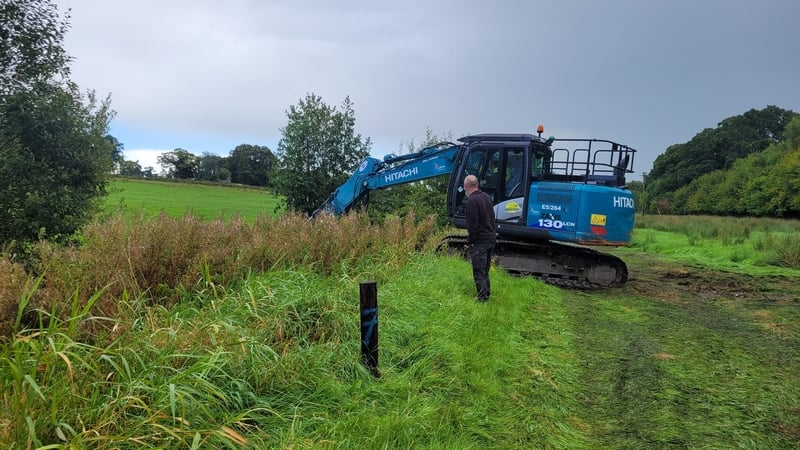
Inland Fisheries Ireland has spent the last five years restoring over 18km of salmon spawning and nursery habitat in the Boyne catchment.
This involved putting 8,670 tonnes of gravel into the riverbeds, as well as erecting 15km of fencing and planting 1,800 native trees along the riverbank.
Dr Byrne said that salmon populations in the area have been depleted and have disappeared in some areas, over the last 10 to 20 years.
"A lot of pressure has come to bear on the Boyne. We have issues with water quality, habitat degradation and human intervention into rivers that has caused a big drop in the numbers of salmon coming up the river," she said.
'Huge and catastrophic loss'
Dr Byrne said that the intensification of agriculture has put pressure on rivers, along with development and wastewater infrastructure.
But the long-term effects of a process undertaken 50 years ago, are now being seen in our rivers.
Dr Byrne explained that the Boyne catchment underwent a process called "arterial drainage", which was designed to drain the midlands, which were "very boggy", to create good agricultural land.
"That involved having to straighten river channels, to deepen them. It was very damaging on rivers. So, it meant there was a huge and catastrophic loss of proper instream river habitat available to all sorts of wildlife.
Any habitat that was left is gradually degrading and disappearing out of the river, which is having a really serious affect on the success of salmon and other wildlife species that depend on the river for life".
She said that the impact on the Boyne and its tributaries has led to a "very worrying and steep drop in the numbers of salmon coming back into spawning tributaries to spawn".
To keep track of the numbers, salmon nests or "redds" are counted.
"The numbers of those redds have gone down and down and down over the last 10 to 20 years to the point where in some areas they have disappeared altogether," Dr Byrne said.
She added: "In their heyday, there would have been tens of thousands of salmon coming up the Boyne system to spawn. Now we're down into thousands."
The numbers are now so low that they have dipped below the "conservation limit", meaning that the Boyne catchment has been closed for salmon fishing this year.
"Without putting gravel in, the salmon would disappear. They'd have nowhere to spawn"
Habitat restoration
Since 2021, working with colleague Robert Bergin from Inland Fisheries and the OPW, they have been trying to replace the habitat lost since arterial drainage happened.
"Arterial drainage straightened and deepened rivers, and it also removed the salmons' spawning beds, or many of them. Many of them were in shallow, gravelly, fast flowing sections of river," Dr Byrne said.
She added: "We have to go in and replace the gravel from local quarries and restore the gravel for salmon spawning beds.
"Generally, we put in hundreds of tonnes of gravel, because we want to give it plenty of gravel to work, because the river can mould itself. If we give it the material, it can somewhat fix itself over the coming years.
"Without putting gravel in, the salmon would disappear. They'd have nowhere to spawn."
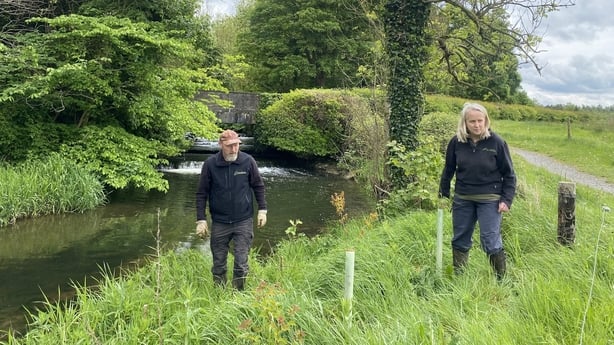
They want this effort to stand the test of time, so have taken extra steps to protect the river and the spawning beds, including fencing and planting trees along the riverbanks.
Fencing them off keeps livestock from getting into the water.
According to Dr Byrne, this is "one of the most important things we can do to help rivers to repair themselves".
She said that over the years, trees have been removed from riverbanks for various reasons, leaving them exposed to the sun beating down over long stretches and causing water temperatures to rise.
It is hoped that by planting more native trees along the banks, they will in time provide much-needed shade for the cold-water species in the river like salmon, trout and lamprey.
"Once the water goes over 15C or 16C, they're starting to get into trouble. We've been monitoring water temperatures on the Boyne for a few years now and they're starting to get into the high teens and into the 20 something degrees, which is putting those species under big pressure," she said.
Dr Byrne said that climate change is having an impact on the river as a habitat, due to the rising temperatures and increasing floods.
"Big floods will have an impact on salmon spawning beds in that they will wash gravel out of them. It's one of the reasons we had to go in, it was all getting washed away".
"If they don't have habitat to reproduce in then we're going to lose them very quickly."
Immediate impact
The success of these measures has been felt quickly.
"When we put the gravel in, we do it during the summer months. The salmon come back in the winter, and immediately, you get an immediate impact," she said.
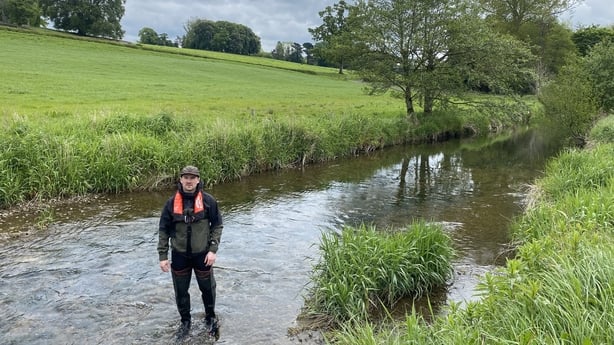
This has been evidenced in the River Skane, one of the Boyne's tributaries flowing through Dalgan Park in Navan, where about 500 metres has been rehabilitated, and further work is ongoing upstream.
"It had a historically excellent salmon spawning bed, it always did very well, but it deteriorated very badly over the last few years because of loss of gravel.
"We put fresh gravel into it two years ago, and immediately the following winter we had salmon coming back in to spawn. The numbers of salmon now coming back in a couple of winters later is now getting very close to what it was in it's heyday 20 or 30 years ago," Dr Byrne said.
She added: "It's successful, and it's successful very quickly. It's a really important measure. If they don't have habitat to reproduce in then we're going to lose them very quickly."
Fish kill
Amidst all this good work, 200 brown trout were found dead in a fish kill along the same stretch of the River Skane last month.
"Fishkills are relatively rare, but every one is one too many and something we hate to see", said Dr Byrne.
Despite spending a week walking the river, taking water samples and samples from the fish, the cause of the fish kill has not been identified.
She said that it appeared that fish in a localised patch succumbed to some sort of toxin, and that it was likely a "damaging incident" had happened a few days earlier, as fish had been seen struggling in the river.
She urged anyone who sees fish struggling to report it to Inland Fisheries Ireland as soon as possible.
Boyne biodiversity
The river rehabilitation work isn't just benefiting the Atlantic Salmon.
Biodiversity Officer with Meath County Council Ben Malone said that the Boyne was hugely significant, as a protected and designated habitat under the EU Habitats Directive, for species like salmon, lamprey, kingfisher and otters.
"We know it's important for biodiversity. We know it's important for the angling sector, but also from a produce perspective, we rely a lot on our natural environment in Meath to market what we export," he said.
He said that plants that rely on the aquatic systems like the Boyne drive the food chain, through to invertebrates, fish, birds, and mammals like the otter.
"If we take a deep-dive into the river today, and take a kick sample, we'd probably be looking at invertebrates like mayfly, stone fly, midge larvae, molluscs and things like that. They're what's driving the food chain that salmon and trout and other fish species rely on," he said.
Mr Malone said that improving the river also has an overarching effect on the ecosystem and everything else that lives in it.
However, he said that water quality is an issue in the Boyne, with over 70% of different sections of the river "below what we would expect a healthy river to be at".
This, he said, was a complex issue to resolve, with different pressures on the river each requiring a different response.
Meath County Council plays its part on a regulatory front, he said.
Mr Malone said that the project is trying to improve the physical structure of the river to what it once was in a natural way, but that "we can't ignore the fact there are other water quality issues in the catchment".
He said these were affecting things like the "nutrient status", of which an excess can drive algal growth, plant growth and can change the ecosystem in a negative way.
"Some invertebrates do better in healthier conditions, if there is pollution, we begin to see them drop off and other more tolerant species begin to be the most abundant in the system," he said.
He said improving the river is not only about addressing physical challenges but also addressing water quality issues.