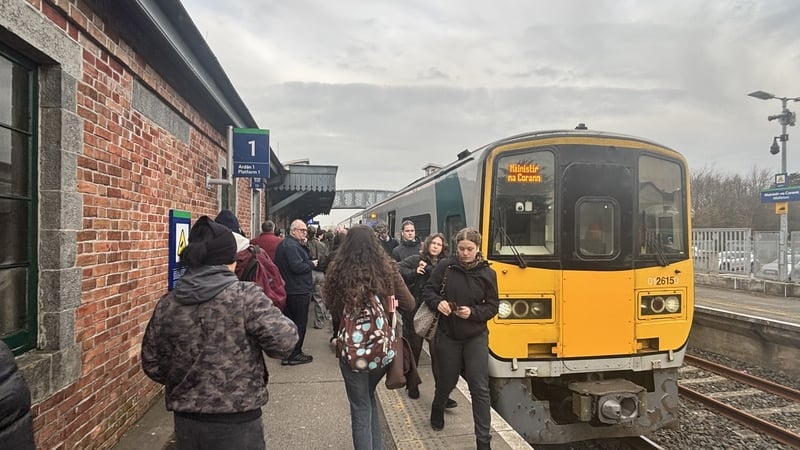

It is 8.15am, and rail commuters in Midleton are clambering onto their city-bound train.
With two carriages in use, it is standing room only as it begins its 23-minute journey to the city, stopping briefly along its harbourside route at Carrigtwohill, Glounthaune and Little Island before arriving at Cork's Kent Station.
Among the daily commuters is Ballinacurra resident Stephen Geary. He gave up driving to work six years ago in despair at the cost of city parking and long delays in traffic heading to and from the Jack Lynch Tunnel.
"I was spending hundreds of euros a month on parking in the city. Now I get the annual tax saver ticket, and it is a fraction of the cost, so for me, economically, it is fantastic, it is less stress, it is just so much easier, and it is so reliable," he said.

However, there is a big 'BUT'.
Passenger numbers on the route have exploded since the line reopened in 2009, reflecting the year-on-year growth in populations along its route.
"This morning, it is only two (carriages), unfortunately, that is part of the issue, the four carriages would be a rarity, but we did have them a few times last week and it made a huge difference to the comfort on the train," he said.
Stephen and other train users like Pawel Arwicz, who also works in the city, say Iarnród Éireann's Cork Area Commuter Rail (CACR) programme, which aims to improve the frequency of the service to every ten minutes, is welcome but it needs to happen sooner rather than later.
"I find the service shocking. We do have a train every half an hour, but it is absolutely packed. It looks quiet here at the moment but in the next 15 minutes, it will get crazy here. Like, we are talking about three to four rows of people just lining up, trying to get the train."
The rolling stock all dates from the early 1990s.
Peak time congestion on the train in east Cork is mirrored in the west, with the early morning sight of cars bumper-to-bumper travelling in convoy towards the city.
The 2019 City Boundary Extension saw the city grow by nearly five times its size. With two-thirds of the county's population within 25km of the city, it is widely accepted that the city's road network at peak times is at full capacity.
Last year, commuters lost an average of 107 hours in rush-hour traffic, while the Department of Transport says traffic congestion is set to cost the local economy €97 million by 2040 due to its growing population and economic growth.
Nationally, there is huge ambition for the Cork Metropolitan Area (CMA) with Project Ireland 2040 identifying Cork as a counterbalance to the eastern seaboard.
But the question is can the transport infrastructure keep pace?
Construction Industry Federation, Southern Region Director, Joanne Treacy says Cork's role as a counterbalance to Dublin "cannot rest on rhetoric alone".
"Quicker decision-making, clearer timelines and co-ordinated action are essential to achieving our objectives," she says.
More commuter stories:
Challenges and reality of commuting from the northeast to Dublin
How long is a commute in Dublin's rush hour traffic?
Bike, car and bus - which gets to centre of capital first
Cork's transport objectives are outlined in what is called the planning transport bible for metropolitan Cork - the Cork Metropolitan Area Transport Strategy (CMATS) 2040.
Its ambition is to reduce dependency on the private car while improving sustainable transport options including bus, commuter rail, light rail, biking and walking.
According to the National Transport Authority, 75% of journeys into the city are currently made by car, with only 7% of journeys to work are made by public transport.
Key projects include a 19km and 25 stop Luas Cork; a multi-strand upgrade of the city's bus services BusConnects Cork, including 11 sustainable transport corridors; the Cork Area Commuter Rail (CACR) Programme which is the largest investment in Cork's rail network and includes 8 new railway stations; as well as the 14km Cork City Northern Transport Road, two new park and rides, and active travel infrastructure.
Professor Justin Doran, head of UCC's Department of Economics and Co-director, Spatial and Regional Economics Research Centre, believes these major transport infrastructural projects need to be accelerated to future-proof the city for the population growth that is anticipated.
"If we want more people to live in the city, not just work in the city, we need this infrastructure in place. We want a city that is big enough on one hand, but small enough where people want to live and work. For younger people, the standard of where they live is important. It is important for the future of the city that it continues to be attractive to people to live and work in," he said.
AJ Cronin, who is driving the Cork Area Commuter Rail Programme, the largest-ever investment in Cork's commuter rail network, says the multi-million euro commuter rail project is part of an overall integrated transport strategy for Cork, and other elements need to be accelerated.
"What is key is that we continue to deliver as quickly as possible. The heavy rail is just one part of the strategy.
"There's active travel, BusConnects, Cork Luas, to be delivered as part of an overall integrated network. While we are accelerating and really delivering on the heavy rail, we have to progress on, say, the active travel projects and integrate them all. This is where Cork will get huge benefit that allows for population growth, housing and economic development," Mr Cronin said.
Iarnród Éireann announced its €1.8 billion Cork Area Commuter Rail Programme last June.
Already, there have been major upgrades to Kent Station, twin-tracking between Glounthaune and Midleton is nearly complete, and Phase 2 which includes eight new railway stations, full network electrification, a new fleet and a new depot, has begun.
Other strategic transport projects are continuing at various speeds through the design and planning stages, including the Northern Distributor Road.
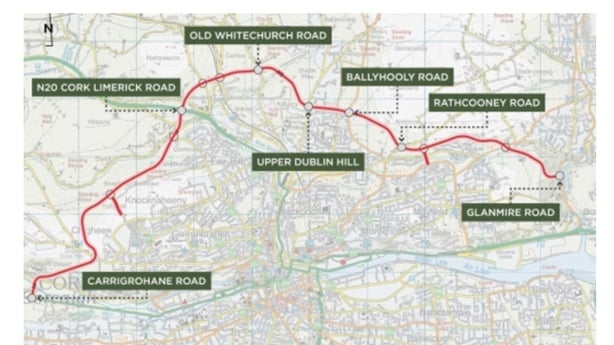
This route has been identified by Cork City Council as a priority. It would link the west of the city at Carrigrohane to the east at Glanmire, relieving serious traffic congestion in the city centre and the suburbs such as Mayfield, Blackpool and Ballyvolane.
But it will be 2028 before it can submit plans to An Coimisiún Pleanála and funding has yet to be ringfenced.
Cork City Council CEO Valerie O'Sullivan believes the pace of delivery matters.
She recently told the Irish Examiner that "just because major capital projects like those mentioned above are under way, and just because there have been some recent funding announcements, does not mean the Government has now fulfilled its requirement to fund the development of Cork City".
One of the most anticipated, if challenging, transport projects under CMATS was announced last April.
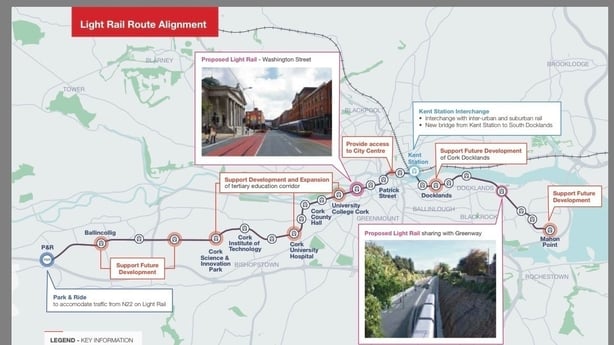
Luas Cork is an 18km long, 25-stop light rail for the city which would run from Ballincollig in the west to Mahon in the east.
A spokesperson for Transport Infrastructure Ireland (TII) says details of a preferred route are to be announced soon, however, construction can't begin until "a number of key milestones including tendering are achieved, and funding is ultimately approved".
But one of the most immediate problems facing planners in trying to persuade the public to leave their cars is the city's bus services.
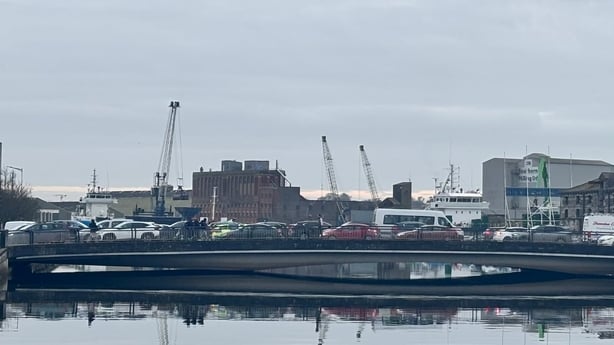
The National Transport Authority acknowledged serious reliability issues due to traffic congestion, a lack of drivers and mechanical issues but claims a recent recruitment drive has resolved many of the issues, although "mechanical-related reliability issues remain a problem".
The city's bus problems were referenced during a recent visit by Taoiseach Micheál Martin to Apple on Cork's northside where over 6000 people are employed.
The company reminded him of its transport needs, in particular, the need for a dependable, regular bus service.
Another cornerstone of CMATS is BusConnects - a multi-strand major transport infrastructural project which aims to transform the city's public transport network.
Last year, some 9,800 submissions were received by the NTA on its plans for 11 Sustainable Transport Corridors along key bus routes in the city.
Like Luas Cork, some of the proposals and routes have proven very controversial in a number of places, like on the Douglas Road and the planned removal of gardens and mature trees.
Statutory consent applications are to be sought from An Coimisiún Pleanála, on a phased basis this coming summer.
Also, under the umbrella of BusConnects are plans for a new bus network in the city to provide a 50% increase in services, as well as a new ticketing system, but these projects are all dependent on funding from the Department of Transport, according to the NTA.
Labour Party Councillor Peter Horgan is chair of local authority's Transport Committee. He believes the benefits of all these projects are not likely to be felt for several years to come.
"We do need to see the BusConnects corridors published, we need to see the second round of consultation for Luas Cork. The only thing I see progressing is the Cork Commuter Rail programme.
"There's a lot of big-ticket items out there that everyone is in favour of. It all sounds brilliant, but the lived reality for people living and commuting in Cork is that nothing is changing.
"We need someone who is ultimately responsible for Cork transport, like a directly elected mayor, who will pull all the strands together like they have in Paris or Manchester."