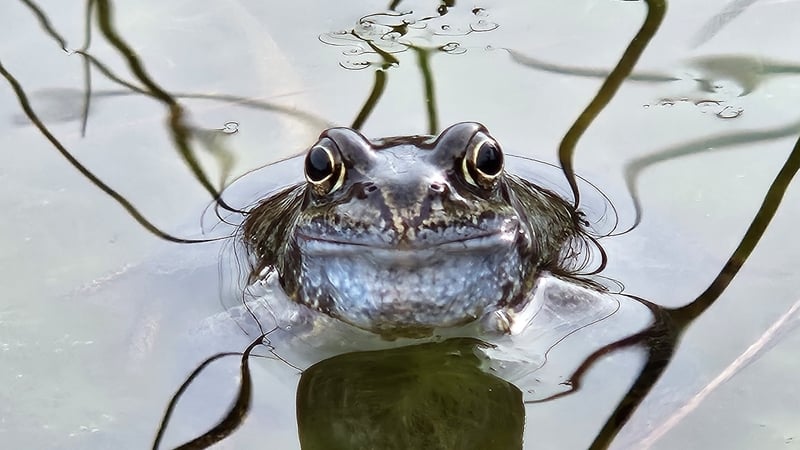

Galway County Council's Biodiversity Office is asking members of the public to help record sightings of the common frog across Co Galway.
By capturing small pieces of information, powerful datasets can be created that help scientists understand the environment, track changes over time, and support better decision‑making for nature and biodiversity.
Galway County Council, in partnership with the Irish Peatland Conservation Council (IPCC), is seeking the public’s help to paint a clearer picture of how frogs are faring across Galway.
Biodiversity Officer with Galway County Council Rosina Joyce recalled that she did not encounter many frogs when growing up in Galway city.
"It was only when visiting cousins in the countryside each spring that frogs became part of my world - from collecting frogspawn to watching tadpoles in ponds and being utterly convinced that their transformation into frogs later in the year had to be magic.
"Many people in Ireland carry vivid memories of early childhood encounters with frogs - whether it was an unexpected hop that came a little too close for comfort, the surround‑sound croaking from a pond during the breeding season, or perhaps the disappointment of a hasty kiss not producing a prince," she said.
Ms Joyce said that that while such encounters are often exciting, educational and formative in developing a connection with the natural world, they may seem incidental.
However, these individual observations can contribute to something much bigger.
Since 1997, the Irish Peatland Conservation Council (IPCC) has coordinated Ireland’s longest‑running frog survey - the 'Hop To It’ frog survey.
The citizen science initiative asks members of the public to record and submit observations of the various stages of the common frog lifecycle.
While easily recognised and well known, the common frog (rana temporaria) is Ireland’s only native frog species and, despite its name, is listed as vulnerable across Europe.
The species is legally protected under the EU Habitats Directive and the Irish Wildlife Acts.
The common frog is also considered a biological indicator of environmental health.
Its smooth, moist skin is highly sensitive to pollution, meaning the presence - or absence - of frogs can tell a great deal about local environmental conditions.
Annual monitoring of frog populations supports national conservation efforts and leads to a better understanding of local environmental quality.
However, last year, only five frog records were received from Co Galway.
The IPCC said this does not necessarily point to the decline of the common frog but without records, we simply do not know.
It is calling on the people of Galway to become citizen scientists and take part in the 2026 ‘Hop To It’ frog survey.
If you spot frogspawn, tadpoles, froglets or adult frogs in your garden or local area, you can submit your observation to the Irish Peatland Conservation Council by filling out the Hop To It survey form on its website: www.ipcc.ie