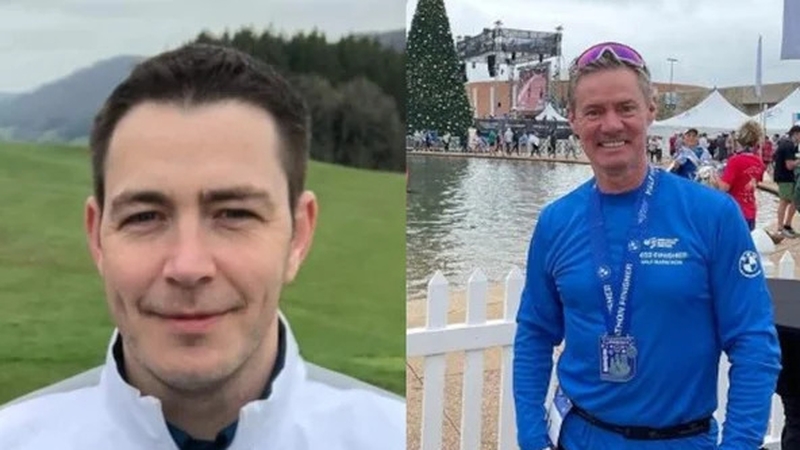

A verdict of accidental death has been returned in the case of 64-year-old Canadian Ivan Chittenden, who was one of two people who drowned during an Ironman triathlon event in Co Cork in 2023.
A decision on a verdict in the case of 45-year-old Brendan Wall, who was originally from Co Meath, has been adjourned as the coroner wants to hear from a kayaker whose evidence he described as "most important".
The inquest into the deaths of both men who died during the IRONMAN 70.3 half triathlon on 20 August 2023 resumed today in Youghal.
It had been opened briefly in July 2024 so that death certificates could be issued.
Re-opening the inquest, Coroner Frank O'Connell asked gardaí to play a compilation of video material obtained by them following a public appeal so that everyone could see the conditions, the weather, the sea, and the crowd on the day.
He said that he would not be adjudicating on a disagreement which has broken out between the organizers IRONMAN and the Triathlon Ireland as to whether the event was sanctioned or not at the time as it went beyond the scope of the inquest.
Det. Sgt. Ger O'Shaughnessy then outlined the garda investigation and said that they were advised by the Director of Public Prosecution in May 2025 that there was insufficient evidence to prosecute any individual in connection with the deaths.
Sgt. O'Shaughnessy said 1,396 participants in the two races, 52 did not finish, either turning back or being taken out of the water, and two were deceased.
John Innes, a seasoned yacht master who helped design the course and oversaw safety supports on the day told the inquest into the deaths of the two IRONMAN 70.3 competitors that he was satisfied "in his own heart" that it was safe for the swim to go ahead on the day.
Decision taken at first light for races to go ahead
Mr Innes told Cork County Coroner Frank O'Connell that the half triathlon had been cancelled from the day before because of the impact of Storm Betty but the wind had dropped overnight and a decision was taken at first light for both races to go ahead.
He told the Coroner that the sea was "flat beyond the initial rolling waves - about 50 or 60 metres out - and calm for the reminder of the course".
He said there were a number of delays in the event starting due to athletes arriving late and the course was shortened to take account of the sea current.
He told the inquest that he was aware that the weather was to worsen after 9.30am and they were "operating in a window".
Another witness David O'Brien, who was among a number of people providing safety support for the race on the water that day gave evidence of being asked by someone in "an Ironman top" to check the course at around 6.15am.
He said the challenge for him was to get through the surf for about 40 to 50 metres. He said that he has "excellent sea skills so I found it fine" despite being worried about loosing his contact lenses.
He said his role on the day was to keep an eye on people in the "challenging zone".
Here, he said, "it is cold, adrenaline is high, and there is a lot of swimmers".
"As they are not spaced out there, there is a greater risk of people being in contact with each other", he told the Coroner.
He described conditions as modest and not 'exceptionally challenging' for him, "a reasonably skilled swimmer".
Chittenden was a seasoned athlete
Ivan Chittenden's wife Siobhán Hyland told the inquest into his death that her husband was a seasoned triathlete - well prepared, experienced and fit.
He did not have any health conditions and she had no concerns about him participating in the race.
He had been doing triathlons for many years, having completed five full, and eight half triathlons and had run several marathons including the Boston marathon a few months earlier.
He was an accountant for 42 years with Ernst and Young and having retired, did consultancy work for them.
Her cousin, Dr Meave Hyland told the Coroner how she and her partner had joined Mr Chittenden in Cork for the race.
She told how she had tried to track him on the race app earlier that morning but became very concerned when she noticed that it was showing him still in the water an hour later.
She presumed it was faulty but then got a call from gardaí who came and collected her.
She went to the medical tent and Dr Hugh Doran told her that resuscitation had been unsuccessful and he had passed away.
She rang his wife Sioibhán and put the doctor onto her. After formally identifying Ivan, she picked up his Garmin watch from the floor, where it "had been cut by those working on him".
'Rough and tough' conditions, says participant
In a statement read into the court, another participant Conor Hillock said he had been a lifeguard in New Jersey and he believed these conditions would have warranted a red flag. He described conditions as 'rough and tough'.
He said in his opinion "it was chaotic in the sea, there was a sense of unease".
Colin Ryan, another participant in the 70.3 half triathlon who found Mr Chittenden's body described how the sea was very rough and that the race had been delayed a number of times while the markers on the water were being moved.
He said he found it confusing because there was a mix of yellow and orange buoys.
Mr Ryan said he didn't remember anyone distributing any instructions on the current.
It was "a big challenge' to get into the waves, it was very rough, and people were 'stumbling and falling into the water', he said.
He said while he was in the water the instructions to people like him who were clearly not going to make the orange buoy, was to head for the yellow buoy.
"I changed direction and left the current bring me towards the yellow buoys. It was a much easier swim now," he said.
He recalled he saw a dark mass in the water. He thought it was seaweed or a rock but when it broke the surface, he realised it was a wetsuit, and a swimmer head down.
He said he swam to him, turned him over and started giving him CPR while also shouting for help.
Eventually, help came and Ivan Chittenden's body was returned to the shore.
Brendan Wall's fiancée told the court that if he had known that Triathlon Ireland had advised calling off the race, he would not have entered the water.
Tina McKay described Brendan Wall as well prepared and risk adverse. She said that he trusted that "on the day that health and safety would be paramount".
Mr Wall's sister Marie O'Connor, who lives in Youghal and who took part in the race with her brother and two others, said when she completed the swim and was getting out of the water at Green Park, someone said to her "Oh Marie, don't look, there is a poor man there being resuscitated".
She said she went up the ramp but had "a great fear for Brendan".
"I asked one of the stewards about the man. She told me he was being looked after and to get ready for the bike race," she said.
Ms O'Connor got on her bike and began the cycle. Later she was met by friends who told her what had happened.
"I was traumatised," she told Coroner Frank O'Connell.
Following evidence from two medics who attended the men at the scene, Dr Hugh Doran and Dr Jason van der Velde, and from the State Pathologist Dr Margot Bolster, who said the cause of death was acute cardio-respiratory failure due to drowning, with mild blunt-force trauma to the head, Mr O'Connell returned a verdict of accidental death in the case of Mr Chittenden.
He adjourned his decision in the case of Mr Wall as he wanted to hear in person from a kayaker whose evidence he said was most important'.