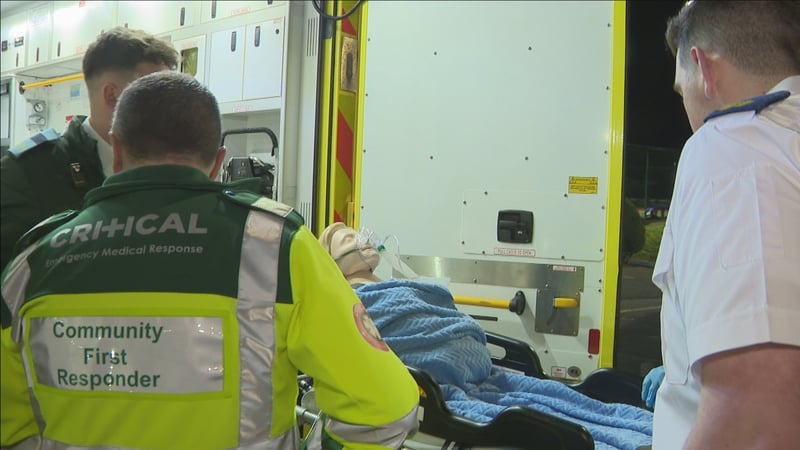

Volunteers attached to a newly established Community First Responder (CFR) group in Cork city have been tasked to over 40 emergency callouts in its first two months of operation.
Eight of the calls were to cardiac arrest incidents.
The Douglas CFR group is one of over 340 emergency community first responder groups across the country, all of whom are affiliated to the National Ambulance Service (NAS).
The Douglas CFR group, established by the charity CRITICAL, operates with a team of eight volunteers responding to cardiac arrests, strokes and other life-threatening emergencies in the highly populated Cork city suburb of Douglas.
It also serves nearby Frankfield, Rochestown, Moneygurney, Ballinlough and Farmer's Cross.
The fully trained volunteers come from a wide range of backgrounds, including: healthcare, the emergency services, business, and retirees.
Watch: 'We know the CPR is going to be excellent quality' - NAS on Douglas volunteers
Douglas CFR co-ordinator Alan Barry said that most of the team are already involved in volunteering in their communities.
"We are a team of eight people at the moment," he said. "Most of the team are involved in volunteering in their communities already, either with St John Ambulance, Civil Defence, some of our team work full time in the emergency services as firefighters.
"So, it is a big mix of people from all parts of life and walks of life, different professions but everyone with an interest in helping the community, and the interest in doing this training.
Mr Barry's background is as an emergency paramedic with St John Ambulance.
"It is very rewarding to understand that the skills that you have spent some time developing can be directly applied - it might be your next door neighbour - it might be someone you know, and frequently with our volunteers that is the case," he said.
"Everyone here is really embedded in this community.
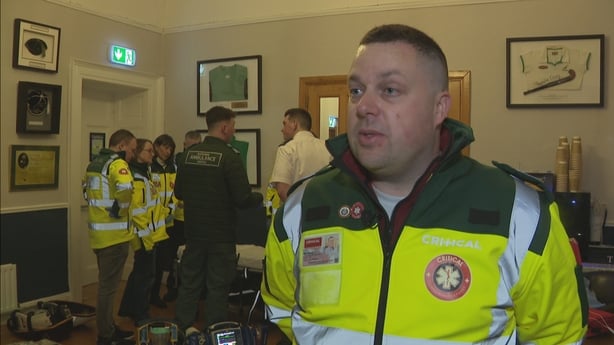
"They volunteer with our sports groups, they volunteer other ways, so they know a lot of the people they go to, and it is very rewarding for them to understand that if somebody is having a stroke or a chest pain, or maybe they are having a heart attack, our volunteers can go, they might know the person, they can really bring a sense of calm to the situation, so being able to do that in the community it is really rewarding, really valuable."
The Limerick-based charity CRITICAL supports Douglas CRF and eight other groups providing equipment such as defibrillators and on-going training.
CEO David Tighe said it is about empowering communities to save lives.
"Ambulances can't be everywhere all the time, so the power of people coming from your own community to a situation is really, really powerful.
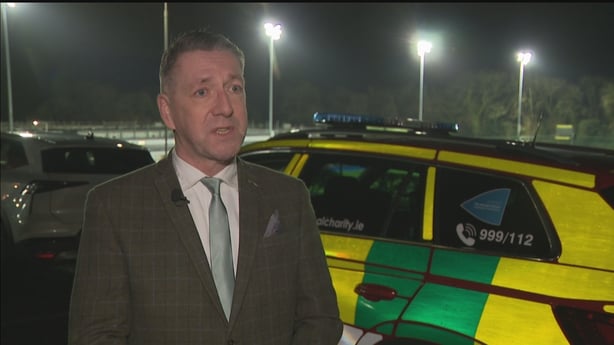
"Seeing a familiar face or being able to make a local connection at a time when you are not feeling so good can actually help in a difficult situation so it is all about the magic minutes," Mr Tighe said.
CRITICAL has reported a 54% increase in calls to its volunteers last year, responding to more than 2,000 medical and trauma emergencies in 2025 - up from 1,308 in 2024.
Critical volunteers in Dublin responded to 493 separate incidents during 2025, followed by 376 calls in Cork, 165 in Tipperary, 120 calls in Donegal, and 112 in Waterford.
The Douglas CRF is part of a nationwide network of some 343 first responder groups who are all affiliated to the NAS.
The network is now in its 21st year and continues to grow.
NAS National Community Engagement Manager Ger O'Dea has said the CFR groups are a very important part of the ambulance network when it comes to saving lives.
He said it is very reassuring to ambulance crews going to a cardiac arrest call to know that a first responder team is on site.
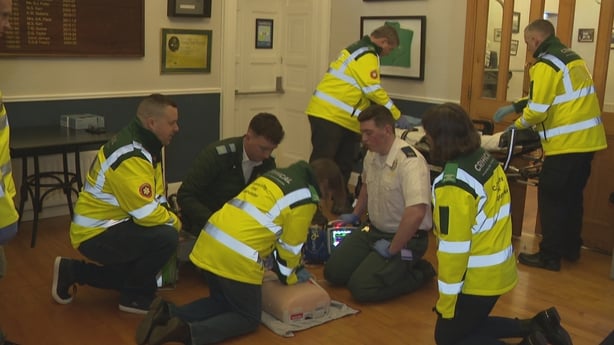
"In the past, people were not doing CPR, they weren't getting a defibrator and when we arrived, unfortunately too much time has passed to be able to meaningfully save that person.
"But now when we are responding to emergency calls, and we know there is a CRF at the scene, we know that they've got excellent training, excellent experience, we know that the CPR is going to be of excellent quality, that they have a defibrillator, and it just gives us that reassurance (that) we know when we get there we have something that we can work with and hopefully save that person's life," Mr O'Dea said. "We have seen that making such a difference now in recent years,"
He added that Douglas CFR has responded to 44 incidents since 19 December - eight of which were the most serious cardiac arrest calls.
"So, that in itself is showing the value of having this group live in such a big, populated area and ultimately they are going to save lives.
"They are out there, they are doing the job and we are absolutely delighted to have them on board," Mr O'Dea said.
We need your consent to load this rte-player contentWe use rte-player to manage extra content that can set cookies on your device and collect data about your activity. Please review their details and accept them to load the content.Manage Preferences