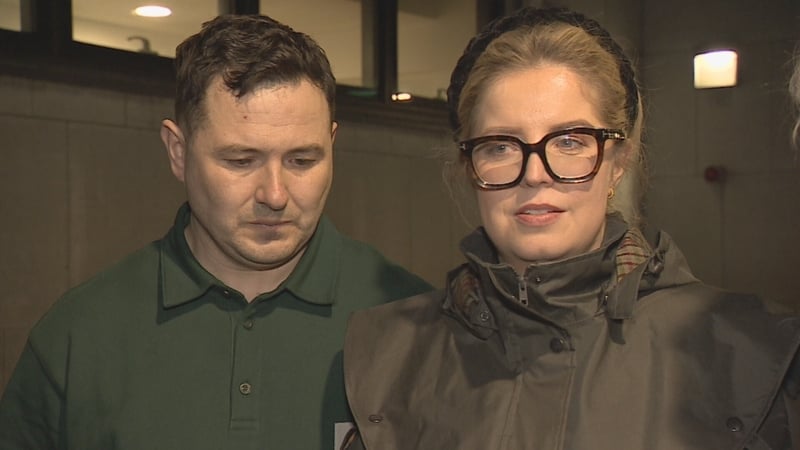

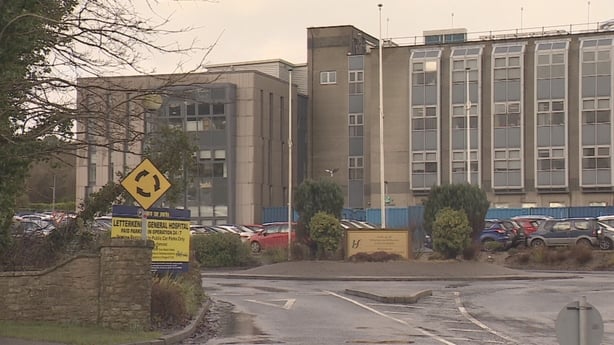
The parents of a baby girl who died within an hour of birth at Letterkenny University Hospital have said they have got "some closure" following a two-day inquest.
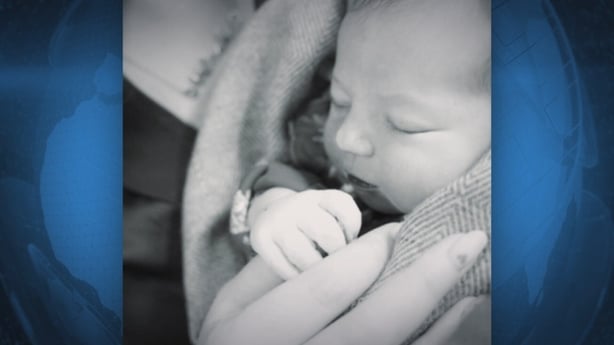
Baby Bláithín O'Riordan was born to Natasha and Liam O’Riordan at 6.56am on 4 February 2023.
The inquest, which returned a narrative verdict, heard of placental issues that had not been detected during prenatal screening and challenges during initial resuscitation.
After the inquest, Ms O’Riordan described the experience as harrowing, but said it provided some clarity about the circumstances of their daughter’s death.
"This has been a harrowing two days. We're delighted it's over. We got some answers in relation to our beautiful daughter, Bláithín, who died.
"Those we didn't receive today we got from the civil action, which we resolved in our favour last year. I suppose we feel somewhat that we've got some closure," Ms O'Riordan said.
Narrative verdict
The narrative verdict was agreed by Damien Tansey SC representing the O'Riordan family and Luán Ó Braonáin SC, representing the HSE, at the request of Coroner Dr Denis McCauley.
It read: "Bláithín was born on the 04/02/23, at term and 4 days. She died within an hour of birth. She had aspirated meconium. At five minutes of life her heart had stopped.
"Post-mortem examination revealed extensive placental disease impeding oxygen exchange. This had caused widespread chronic ischaemic brain injury that predated the onset of labour by at least seven days.
"There was also fatal acute brain injury that occurred at least six hours before Bláithín's birth, when the placenta was no longer able to cater for Bláithín's perfusion needs towards the end of pregnancy and during labour.
"During the initial resuscitation, there was an issue with the component of the resuscitation equipment that allows for increase of IPPV pressure, resolved over a minute and a half.
"During a period of the first intubation the CO2 monitor was negative."
'This has been a harrowing few days. We are delighted it's over'
Joy at the expectancy of first child
At the outset of the inquest, Ms O’Riordan, a senior midwife manager in Letterkenny hospital, recalled the joy she felt when she and her husband, Liam, learned IVF treatment was successful, and they were expecting their first child.
Ms O’Riordan told the inquest that the 20-week scan was perfect, that ultrasound scans were perfect and while blood pressure raised on occasion, it always settled.
The inquest heard that screening tests such as CTGs and ultrasound scans have limitations and do not pick up all problems during pregnancy.
The inquest heard that some of baby Bláithín’s health issues were present at least a week before delivery.
Pathologist recognised placental issues
Perinatal Pathologist Dr Laura Aalto, who carried out a post-mortem examination, told the inquest that there was fibrinoid in the placenta, which can cause issues not recognised during pregnancy or visible on ultrasound scans.
Former master of the National Maternity Hospital Consultant Obstetrician Peter Boylan, who was tasked as an expert witness, was of the view that baby Bláithín was very unwell going into labour.
Mr Boylan said screening tests do not pick up every problem during pregnancy and that CTG data was not typical of a baby whose oxygen was deprived during course of labour.
He said despite intensive resuscitation efforts that were unsuccessful, that death was unavoidable, in his opinion, which the coroner referenced in his closing summary.
He said scans should document amniotic fluid and that a woman is either in labour or she is not. Mr Boylan said he felt clarity was needed.
The view about the inevitability of death was challenged by Mr Tansey, who questioned the interpretation of fetal monitoring results before birth and resuscitation protocol.
Ms O’Riordan told Mr Boylan that she recognised the perinatal pathologist’s report found issues with the placenta. She felt, however, Bláithín never got a chance.
"We would’ve dealt with whatever we were given, her CPGs were normal, her scans were normal and her movements were normal.
"I appreciate the pathologist’s work. She was born alive… I find it really difficult because she never got a chance."
'Dreams had come true'
Natasha O’Riordan went for a planned induction after her blood pressure was slightly elevated on 3 February 2023.
She said the happiness and joy in the room was palpable and all of their "dreams had come true" when baby Bláithín was born at 6.56am on 4 February 2023 with a vacuum assisted delivery.
She described how she felt Bláithín moving until the very end and that her husband saw her little face.
A midwife determined that Bláithín was a pale pink, with eyes wide, a little stunned, and that her tone appeared good when born.
A standard assessment of a newborn’s physical health, called an APGAR score, determined Bláithín had a score of 5 out of 10 at one minute, post birth.
The inquest heard that the APGAR score is normally nine at one minute, post birth. At five mintues post birth, Bláithín’s APGAR score was one.
Consultant Paediatrician Dr Asim Khan said an APGAR score after five minutes was more a reflection of the health of a baby.
Ms O’Riordan described how Bláithín’s eyes were wide and her arms were outstretched, when born.
She showed signs of being a shocked baby, which Ms O’Riordan had seen before, but she was reassured that everything would be okay.
"I honestly didn’t know there was anything to be worried about until my husband Liam said it to me," Ms O’Riordan said.
Mr O’Riordan conveyed to his wife that something was wrong. He described a state of panic and that a call was made for another machine when it was recognised that there was an issue with the resuscitaire.
A button on the machine that increases pressure did not do so when pushed and a change of machine delayed the escalation of resuscitation by one and a half minutes.
Mr Ó Braonáin acknowledged that the replacement of the machine mid resuscitation must be a source of unhappiness and concern.
However, he said that it was not established in evidence that it was related to the cause of death.
Dr Denis McCauley asked Mr O’Riordan about how he noticed things were not going well.
He answered: "They were loud and stressed. They were clearly panicking… it was utter chaos."
The inquest heard that efforts to place an endotracheal tube into the trachea of baby Bláithín did not happen on two occasions.
Mr O’Riordan described how he sat with his head in his hands.
"They were working on Bláithín… I remember hearing they couldn’t get her intubated… I remember sitting with my head in my hands watching this unfold."
Ms O’Riordan called for an anaesthetist so that he could intubate Bláithín. The on-call paediatric consultant, who later arrived, had no difficulty intubating the baby.
Ms O’Riordan said after resuscitation stopped, baby Bláithín was placed on her chest. "I placed Bláithín skin to skin and our lives stood still," she said.
Baby Bláithín O’Riordan weighed 7 pounds and 7 ounces.
"We dreamed of holding our baby in our arms. We could never have imagined this nightmare," Ms O’Riordan said.
She told the inquest that the most important person in the room did not get a chance and was not given the resuscitation that she deserved.
Clinicians who outlined the resuscitation efforts undertaken did not agree about the description of chaos.
Senior Counsel Luán Ó Braonáin, representing the HSE, briefed by VP McMullin Solicitors, Letterkenny, on instruction of the State Claims Agency on behalf of Letterkenny University Hospital, conveyed his condolences on behalf of himself and the staff of the hospital.
A comprehensive discussion took place on the interpretation, protocol and guidelines surrounding high-risk pregnancy and the assessment of babies during contractions, as well as detailed discussions on the functioning of resuscitation equipment.
Both senior counsels accepted the perinatal pathologist's finding as the medical cause of death. Dr Laura Aalto said the final cause of death was critical hypoxic multi-organ injury, acute on chronic, occurring on a background of placental pathology with marked fibrinoid deposition and acute chorioamnionitis, complicated by fetal pulmonary inflammatory response and meconium aspiration.
Coroner’s comments
Coroner Dr Denis McCauley said Bláithín’s parents have been seeking answers as to how their baby daughter died shortly after birth, despite antenatal tests indicating a healthy pregnancy.
He told the O’Riordan family that they should not have doubts about screening carried out in the hours before the birth. He also said that they could not have done anything more as testing indicated that everything was fine during pregnancy.

Dr McCauley said Bláithín was very seriously ill when she was delivered and that resuscitation was appropriate in the first minute, described as the golden minute.
He said, irrespective of APGAR at one minute, that when Bláithín was presented to the doctor, that he found a child who was unwell and seriously ill.
Dr McCauley extended his condolences to Natasha and Liam O’Riordan, as did every person who spoke during the inquest.
Senior Counsel Damien Tansey in his concluding remarks said that, fortunately, the O’Riordan family have been blessed with another child. He said Bláithín was a miracle, who will always have a place in their hearts.
Coroner’s recommendations
Coroner Dr Denis McCauley made two recommendations at the conclusion of the inquest. Dr McCauley will write to the HSE to seek clarification on the diagnosis of the onset of labour.
Both the coroner and the expert witness, Mr Peter Boylan, had concerns that there are no obvious guidelines in relation to monitoring of women, in particular in their first pregnancy, when they are having significant regular uterine contractions and the neck of the womb is shortening but cervical dilation has not started.
Dr McCauley said the inquest heard that the monitoring of the fetal heart during this period is very arbitrary and can be between every four hours or every hour rather than continuously when the cervix reaches a particular level of dilation.
He also said it is important that during labour when amniotic fluid drainage is being assessed and if is deemed to be absent or indeed low in volume, it should prompt a reassessment of the present clinical condition of the baby.
He said this should occur even when antenatal scans indicated reassuring amniotic fluid volume.