The loss of five sailors on active duty in Cork harbour 80 years ago during 'the Emergency' was commemorated in a series of memorial events this weekend in Cobh.
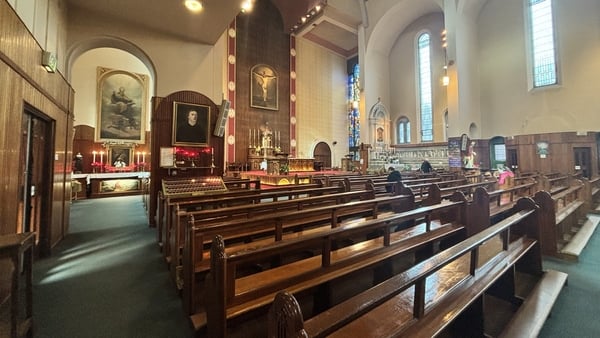
A special mass was held at St. Colman's Cathedral today, before a wreath-laying ceremony took place at the Cork harbour tragedy memorial in the town.
Yesterday, the families of the five men who died travelled on board the LE WB Yeats to the Dognose Buoy in the harbour to lay wreaths near the site where the tragedy occurred.
The five were killed during appalling weather conditions on 12 December1942 when the two launch boats they were on collided with the propellers of a merchant ship, the Irish Poplar.
The Irish Poplar was the first ship bought by the Irish State for its fledgling merchant navy fleet, Irish Shipping, in 1941.
Five members of the Marine Service William Duggan, Frank Lloyd, Frank Powell, Patrick Wilshaw and John Higgins all lost their lives in the tragedy.
The pilot helmsman Jimmy Horgan, managed to swim to Spike Island to raise the alarm.
Mick McCarthy of the Cobh branch of ONE, (the Organisation for National Ex-Service Personnel) who organised the commemoration events, said the five men were the only people who died during The Emergency on active service.
"They were defending the State," he said.
"Weather conditions on the night were appalling with 20-foot waves and strong wind," he added.
"There were no lights in the harbour. These guys were operating in pitch black. The only lights were the navigation lights," Mr McCarthy said.
The pilot boat had just dropped off its pilot onto the Irish Poplar as the port control boat was coming in to port. Huge waves caused one boat to slam against the other, forcing both into the path way of the propeller, which destroyed the boats and killing all but one on board.
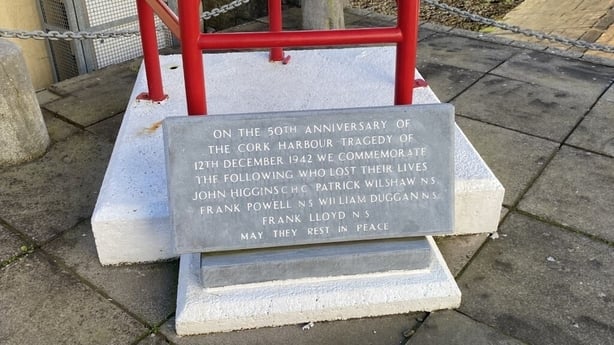
Among those who laid wreaths at the memorial in the town following the commemoration mass at St Coleman's Cathedral was Eddie Powell. The body of his uncle Frank Powell was never found.
"The most difficult part for the family is that Frank's body was never found. For my grandparents it was the one thing, like that word closure, if you could have had a funeral.
"So, I suppose this in a way makes up for that, that they are being remembered."
Today's memorial mass and commemoration at the town's memorial was organised by ONE. Among those to attend were current and retired members of the Defence Forces, the Royal Naval Association, local councillors and family members of the deceased.
One man who will never forget 12 December 1942 is Fr George Agger, who will be 80 years old on Monday.
"My father should have been on one of those launches that were destroyed, but he swapped places because he wanted to stay home for his son's birth," Fr Agger said.
"The only survivor of the tragedy was a first cousin of my father Jimmy Horgan who swam to Spike Island so I have always been associated with the tragedy.
"As a little boy my father would tell me this is where so-and-so's body was found, and people would come up to my father and say: is that the boy who was born on the night of the tragedy. I have always felt very close to it."
His father's cousin Jimmy Horgan managed to swim from where the boats went down to Spike Island guided by a light, which today can be found on top of the memorial to the tragedy. It is light now lit by solar power.
Patricia Twomey (nee Wilshaw) and her husband, Kevin attend the commemoration every year to remember her uncle, Patrick Wilshaw who was 21 years old when he died.
"Either fair weather or foul weather, you have to go to sea at all times when you are called. Unfortunately, it was an accident that happened and here we are today, remembering them," said Mr Twomey.