Ireland's road safety record is continuing to move in the wrong direction and is increasingly out of step with the rest of the EU.
The European Commission recently released its annual road safety report, and it shows that while road deaths across the EU fell by 3% last year, fatalities in Ireland rose by 7%, with 190 people dying on Irish roads.
The longer-term trend is even more stark: compared to pre-pandemic levels (2017–2019), deaths on Irish roads have increased by 28%, while across the EU they have fallen by 16%.
We need your consent to load this flourish contentWe use flourish to manage extra content that can set cookies on your device and collect data about your activity. Please review their details and accept them to load the content.Manage Preferences
But fatalities are only part of the picture.
Across Europe, attention is increasingly turning to the number of people who survive road crashes with serious, often life-changing injuries - and whether those numbers are also moving in the wrong direction.
In Ireland, the number of serious injuries has edged upwards in recent years, reaching more than 1,500 in 2024 according to garda figures. But hospital data suggests the true toll is likely significantly higher.
At EU level, bodies such as the European Transport Safety Council (ETSC) have raised concerns not just about the number of serious injuries, but about how well they are understood and recorded.
In most countries, police data has historically been used to record serious injuries, but it is now known that it understates the true scale of injury.
That underreporting is a "significant issue", according to Jenny Carson, project manager at the ETSC and author of a major recent report on serious injury data.
She says police records do not capture all serious injuries, particularly among more vulnerable road users such as cyclists and pedestrians.
"Police reports don’t collect all the serious injuries happening on our roads," she said, warning that gaps in the data can leave authorities without a full understanding of where and how people are being seriously hurt.

The scale of that gap is also evident in Irish data.
The Road Safety Authority (RSA) recently published analysis combining hospital admissions data with An Garda Síochána collision records - work prompted by an EU request that member states report serious injuries using hospital data alongside police figures.
It found that between 2020 and 2024, 11,241 people were hospitalised following road traffic collisions, compared with 7,465 serious injuries recorded by gardaí.
That equates to roughly one and a half hospitalised casualties for every serious injury recorded by gardaí.
In a statement to RTÉ's Prime Time, the RSA said these gaps have also been observed in other countries and can arise where crashes are not reported to gardaí, or where injuries are not initially identified as serious.
"This difference might be explained by the police not being alerted of a crash; or by injuries not being detected or being misclassified due to the assessment of the injuries sustained being done by a police member and not by a medic," it said.
While garda figures suggested serious injuries were stabilising in recent years, the hospital data showed the annual number of hospitalised casualties rising from 2021 onwards, reaching its highest point in 2024.
In other words, more people are being seriously hurt on Irish roads than police figures alone suggest - and the gap between police and health data is becoming increasingly clear.
We need your consent to load this flourish contentWe use flourish to manage extra content that can set cookies on your device and collect data about your activity. Please review their details and accept them to load the content.Manage Preferences
For clinicians working with the most serious cases, the scale of those injuries is stark.
Dr Jacinta Morgan, Clinical Director at the National Rehabilitation Hospital (NRH), said a significant proportion of patients treated there are recovering from road traffic collisions.
"About a quarter to a third of patients admitted to the National Rehabilitation Hospital have been involved in road traffic collisions," Dr Morgan said.
READ: 'I can't move my legs': the reality of surviving a road crash
For many of those admitted, Dr Morgan says their lives "shatter in a split second."
"If they live, they emerge intact from intensive care or partially intact and many spend years, if not the rest of their lives, paying the price," she added

While the injuries that lead to admission to the NRH are typically severe, visible and highly likely to appear in official statistics, others are less obvious, and less likely to be recorded.
Sophie’s story
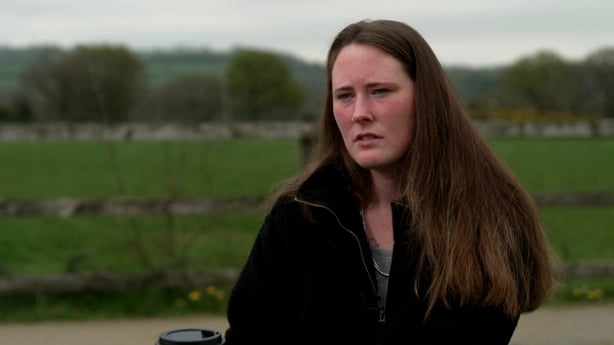
Dublin cyclist Sophie Armstrong told Prime Time she suffered two separate concussions within weeks of each other two years ago after falling from her bike.
After leaving a gym on George’s Street in the city centre, she got on her bike and made her way towards Westmoreland Street where she says she came off her bike and hit her head on the pavement.
"I don’t remember what happened during the actual fall and a little bit afterwards. It's just not clear in my mind," Sophie said.
It was only at her boyfriend’s house a short time later that she realised something was wrong.
"Suddenly I was in the hospital and being told that I had a concussion. I didn't feel like myself for about a week. I was really confused, slow, couldn't focus, and just exhausted," she said.
Weeks later, she suffered a second concussion when her tyre became caught in Luas tracks, once again throwing her from her bike.
Both incidents required hospital treatment, but neither was reported to gardaí.
"There’s nothing that tells you to report on it. It never would have crossed my mind," she said.
"I didn’t feel like myself at all. I was walking around just confused, in between being awake and asleep. My memory hasn’t been the same since. I’m sure there’s huge numbers of those kinds of accidents that are just never reported."

The RSA said that 64% of cyclists hospitalised after road crashes were injured in single‑cyclist collisions, like Sophie's, compared with just 17% of cyclist serious injuries recorded by Gardaí.
Data gaps
In Ireland, unlike in countries like Sweden, it is not currently mandatory for hospitals to routinely share data on road traffic injuries, meaning hospital data is still primarily used for retrospective analysis rather than real‑time monitoring.
Jenny Carson said gaps in the data can make it harder to identify risks and respond effectively.
"If we don’t have the data and the knowledge that that data gives us, we can’t then act to take those preventative measures and address the issue," she said.
Across Europe, there is a growing push to better integrate hospital and police data to build a more complete picture of road safety.
"By not fixing these issues, it could be at a cost to ourselves. There's a huge cost to road trauma, whether it's deaths or serious injuries," Ms Carson said.
Ms Carson said that while placing a value on a life or the cost of disability services relating to a road traffic collision is difficult, having full access to data is essential to understanding the true scale of harm and shaping effective preventative measures - including how resources are allocated.
"If we're underestimating the number of people seriously injured, perhaps those cost benefit analyses aren't being fairly done," she added.
And for those working with patients in the years after a crash, that cost is not abstract.
"Anyone who has been severely injured themselves, or has a family member who has, will know exactly what the inestimable cost of these injuries is," Dr Morgan said.
"They go, in most cases, from being highly functioning adults and suddenly they are cast into this unknown place. They've sustained brain injuries, spinal injuries, they often lose their sight. Many times, they will require life-saving surgery.
"There are ways of estimating cost, but they don't go anywhere towards estimating the extreme effect and personal cost of these injuries."
A report on serious injuries resulting from road collisions by Jack McCarron and producer Lucinda Glynn is broadcast on the 14 April edition of Prime Time at 9.35 on RTÉ One and RTÉ Player.