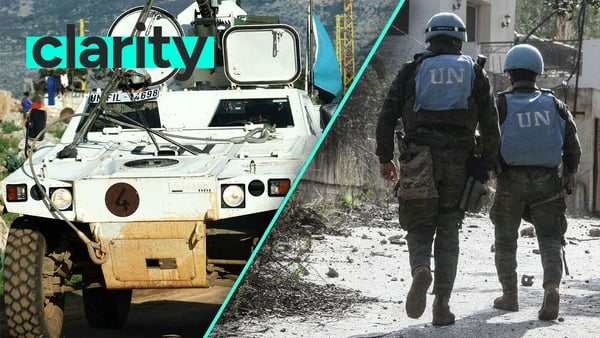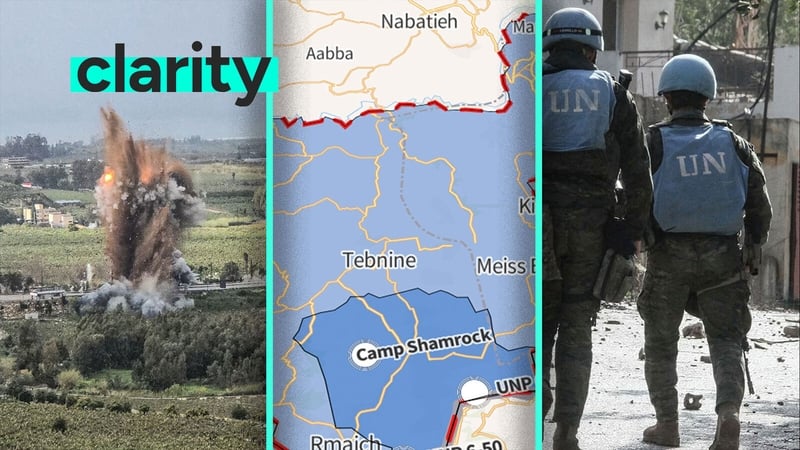

Irish peacekeepers are operating in southern Lebanon as Israel signals plans to take control of territory to create what it calls a buffer zone.
Recent Israeli escalations include strikes on bridges, ground operations and evacuation orders. All of which are unfolding inside the same UN-monitored zone where Irish troops are deployed.
Irish UN peacekeepers remain in place in southern Lebanon, the Defence Forces said, as Israel is implementing plans to take control of the area through military force.
"Irish personnel are well and accounted for amid ongoing tensions along the Blue Line, where the situation is most intense," the Defence Forces said in a statement.
Earlier this week, Israel's Defence Minister Israel Katz said the Israeli military will take control of what he called a "security zone" in southern Lebanon, up to the Litani River. That would encompass the area currently overseen by all UN peacekeepers in Lebanon.
The IDF has demanded all residents to leave the area, saying failure to do so puts them at risk. It says its operations target Hezbollah, an Iranian-backed Lebanese Shia Muslim military and political group, which has operated for decades, often clashing with the IDF.
"The IDF will continue to operate in Lebanon with full force against Hezbollah," Mr Katz said.
"Hundreds of thousands of residents of southern Lebanon who evacuated northward will not [be allowed to] return south of the Litani River until security for the residents of the north [of Israel] is ensured," he said, according to the Times of Israel.
Dr Cathal Berry, a former commander in the Irish Army Ranger Wing, said it appears the "plan is to replace UNIFIL with the IDF."
"Even the proposed Israeli buffer zone has practically the same dimensions as the current UNIFIL area of operations. They are not even trying to hide it," he said.
Mr Berry said Irish and UN peacekeepers "are more important than ever now, so they can continue to monitor the situation on the ground" and "send accurate information to the UN in New York and back to Dublin."
We need your consent to load this flourish contentWe use flourish to manage extra content that can set cookies on your device and collect data about your activity. Please review their details and accept them to load the content.Manage Preferences
The Irish UNIFIL area of responsibility ('The Irish AOR') includes the main urban centre in south Lebanon, Bint Jbeil.
A UN battalion led by Irish officers operates a large base called Camp Shamrock near Bint Jbeil and two outposts called UNP 6-50 and UNP 6-52, near the border towns of Maroun El-Ras and Yaroun.
These areas are each considered Hezbollah strongholds.
The Defence Forces said "all necessary force protection measures are being strictly observed by our personnel," in the Irish AOR and "there has been limited disruption to framework operations."
"Army personnel of the 127th Infantry Battalion continue to observe and monitor the situation, acting as the eyes and ears of the international community."
Cutting off the area
We need your consent to load this flourish contentWe use flourish to manage extra content that can set cookies on your device and collect data about your activity. Please review their details and accept them to load the content.Manage Preferences
Since mid-March, geolocated footage, as well as IDF reports, have shown Israeli attacks on bridges across the Litani River and in sites across the Irish AOR.
Mr Katz confirmed that the IDF had blown up bridges over the Litani River, effectively cutting off southern Lebanon from the rest of the country, and said that the "IDF will control any remaining bridges and the security zone up to the Litani."
The IDF claim the bridges are being used by Hezbollah to manoeuvre from north to south to transfer weapons, rockets, and launchers with "the aim of executing terror attacks against the State of Israel."
Even before Israel Katz’s announcement on Tuesday, there were fears in Lebanon about the actions.
Bassel Doueik, Lebanon and Jordan researcher at ACLED, said that the attacks on bridges came as "many Lebanese flee their homes as a result of clashes and evacuation orders from the IDF, fearing the effective isolation of southern Lebanon and that this could precede a deeper ground incursion similar to 1982."
Attacks in UNIFIL areas
We need your consent to load this flourish contentWe use flourish to manage extra content that can set cookies on your device and collect data about your activity. Please review their details and accept them to load the content.Manage Preferences
Towns and villages across the Irish AOR have been hit multiple times, and seen recent ground fighting between Hezbollah and the IDF.
Hezbollah said on its Telegram channels on Wednesday that it was continuing to hit targets and troops in Israel and southern Lebanon, including the town of Debl, within the Irish area.
The IDF meanwhile said it continued to attack border villages and Hezbollah cells in southern Lebanon.
It said five Hezbollah anti-tank missile operatives were killed in an Israeli strike in Bint Jbeil, the largest town in the Irish AOR.
Outside the Irish AOR and within the wider UNIFIL area, a projectile hit a building inside UN headquarters in Naqoura, roughly 20km to the west of Camp Shamrock. UNIFIL said it believes the strike was fired by a "non-state actor."
"Bullets, fragments, and shrapnel have hit buildings and open areas inside our headquarters, putting peacekeepers at risk. As a result, peacekeepers have been restricted to shelters to avoid injury," it said.
In August, the UN Security Council voted unanimously to end its peacekeeping mission in southern Lebanon after nearly five decades, following pressure from the United States and Israel to wind down the force.
UNIFIL will remain in place under a final mandate until 31 December 2026.
The mission, established in 1978 and expanded after the 2006 war, has long acted as a buffer between Israeli forces and Hezbollah along the Blue Line.
Cathal Berry warned that once the Irish and other UN peacekeepers leave the area, that monitoring will cease.
"The worry is what will happen when the UN mission comes to an end in December, who will take up that role."