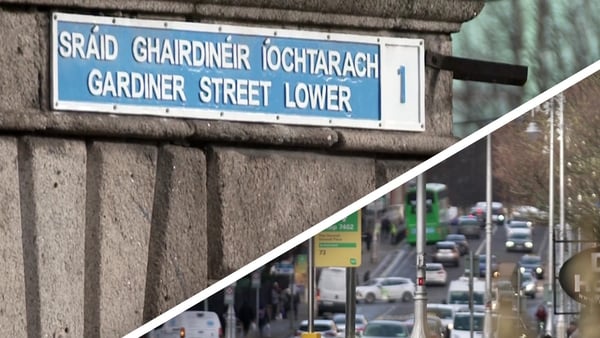

Ireland's representation at one of the world’s largest real estate conferences on the French Riviera draws to a close today.
Prime Time’s Louise Byrne reports from MIPIM (Marché International des Professionnels de l'Immobilier) on how the Irish pavilion has made the case for international investment and the domestic criticism the presence has attracted.
In a packed Irish marquee, Michael Stanley, CEO of Cairn Homes, joked that the overflow crowd gathered on the terrace outside would benefit from a loudspeaker.
"It's like an over-attended Irish funeral," he quipped.
Other countries’ pavilions were ostentatious but lacked footfall, while the Irish installation was "understated and rammed," he said.
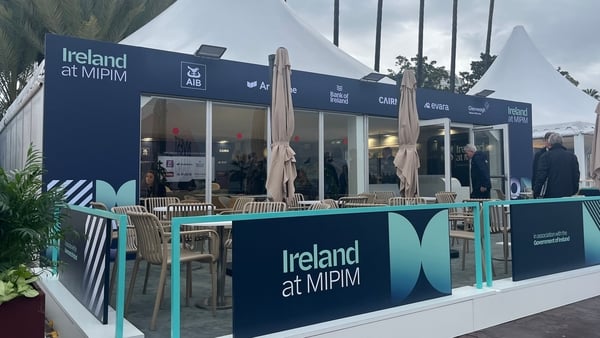
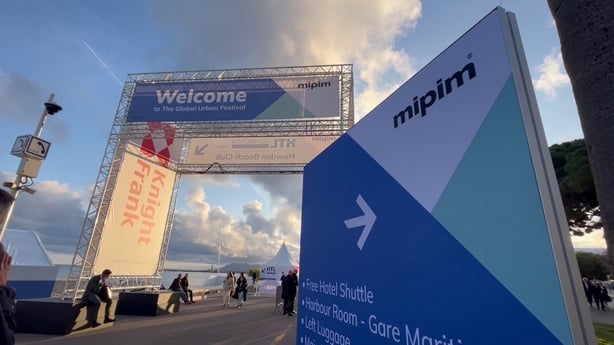
The marquee was there to try to attract the eye - and the cash - of those who hold the purse strings for global investment funds. 20,000 delegates were in attendance at MIPIM; the intention is some of those with capital might eventually fund housing developments in Ireland.
The Cairn boss was speaking on a panel entitled 'Irish Housing; Unlocking Growth in a High Demand Market.’ He was among a large cohort of Irish property figures who travelled to Cannes.
Over three days, industry voices joined senior civil servants working across housing and planning to speak on topics on the marquee’s programme.
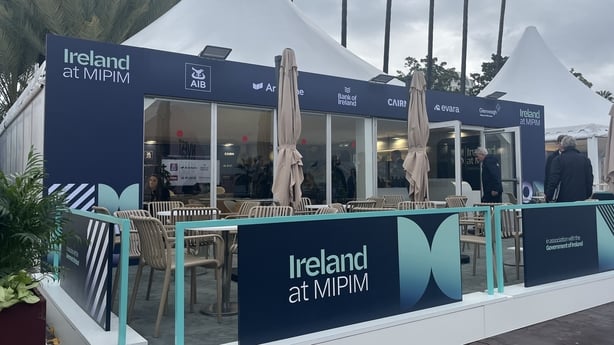
The competition for investment was fierce. The Irish pitch was situated on the Cannes waterfront alongside similar setups for Oman, Liverpool, Berlin and London.
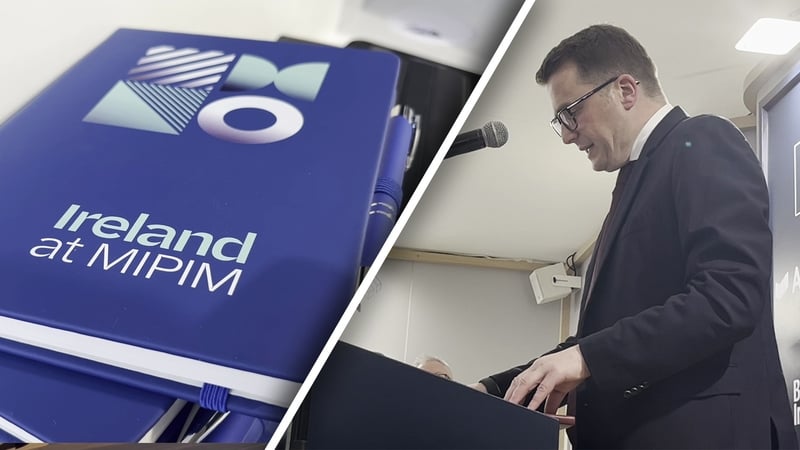
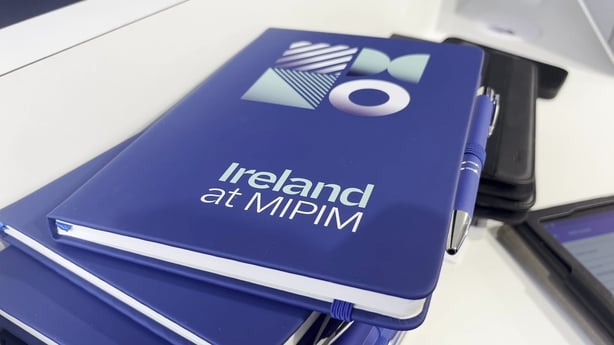
Outside there were tables and umbrellas in the Riviera sunshine, inside ‘Ireland at MIPIM’ stationary was offered to arriving visitors.
The Irish approach was less flashy than other jurisdictions. The Saudi Arabian pavilion featured an enormous LED-lit architectural model of a future city, Newcastle was booming house music on its veranda, while the Belgians had their own bar serving the country's best-known beers.
The Manchester pavilion flew in big names for the event. Olympian Sebastian Coe and actor Steve Coogan, both involved in regeneration projects in the city, took part in panel discussions.
What Ireland may lack in star power, the Government contends, it makes up for with stability, clarity of regulations and a strong economic outlook.
CEO of Glenveagh - another of Ireland’s biggest home building companies - Stephen Garvey, was also there. Speaking to Prime Time, he was bullish about the prospects for Irish property and housing development. 50,000 new homes a year could be possible by 2027/28, he said.
"What I’m picking up from German investors, Dutch investors, is that Ireland has addressed a lot of the issues that needed to be addressed.
"One institutional investor said they are genuinely now looking at Dublin as an area to invest in for the first time in a number of years."
The CEO of I-RES Reit, the country’s largest landlord, said he also believes the needle is moving. "What we're seeing is an awful lot of conversations starting to happen that hadn't happened in the past," Eddie Byrne told Prime Time.
"20,000 of people are here, the word will get out that Ireland is serious."
In constrast, Dr Lorcan Sirr, Senior Lecturer at TU Dublin told the News at One the pavilion was a sign the Government had little control over the creation of housing.
"I don't think it's right that the Minister is out there selling the country to investors, inviting them to come in and outbid Irish builders and Irish home buyers for properties."
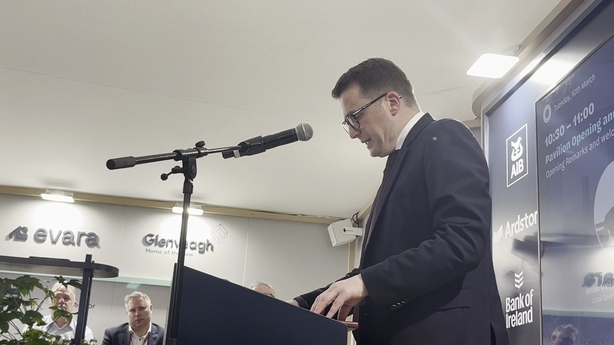
Lead sponsors of the pavilion included Cairn, Glenveagh, and Evara - three of the largest residential developers in the State - as well as property investment fund Ardstone, Bank of Ireland and AIB.
Responding to criticism of the sponsorship and the pavilion, Minister for Housing James Browne dismissed the suggestion that housing policy was being shaped by industry.
"The only policy I have is to solve the housing crisis and get people into the homes that they need as quickly as possible," he told Prime Time.
Speaking in the Dáil last week, Sinn Féin TD David Cullinane described the plan for the conference as "very cosy", suggesting that firms that benefit from the Government's "rent-hike bill" were paying the costs.
The Department of Housing said the sponsorship was developed after reviewing how other countries manage their presence at the annual event. It hasn’t said how much will be spent but clarified that civil servant travel and accommodation was funded by the State, not private industry.
In recent years improving interest rates for investors has provided alternative options to Irish real estate.
"The reality is this type of financing dried up several years ago, and we've seen a collapse in apartment delivery," the minister said, adding that along with increased State spending in housing, a ramping of private investment is needed for a blended approach.
"I think what international investors are looking for is a level of certainty. They're not interested in high-end rents either. It's been very clear that they want mid-level because that drives sustainability."
John Coleman, CEO of the Land Development Agency - the State body established to manage public land and accelerate delivery of affordable and social housing - also defended the decision to host the pavilion.
"We put a very high level of investment as a State into housing as it is, including through our own organisation, but we have to prepare for a resilient housing market going into the future that isn't totally reliant on the State.
"The message to the global investor base is that we're open for business."
Glenveagh’s Stephen Garvey compared the involvement of foreign investors in Irish property to FDI employers.
"What if we turned around and said we don't want any foreign companies in Ireland. How about the hundreds of thousands of people that are employed in really good jobs? We have to think of housing in the same context."
Asked whether there was a risk in pursuing a model reliant on private investment, Martin Whelan, CEO of the Housing Agency, said the sector had potentially become reliant in the other direction - on State finance.
"What I would argue for is a rebalancing of greater private sector capital alongside high levels of State capital to achieve a balanced housing output."
A central question hanging over the State's approach at Cannes is whether it can deliver affordable housing.
The scale of the challenge is stark: last month the median Dublin home price hit €500,000, while the national median stands at €387,000. Rents, meanwhile, are 80% higher than they were a decade ago, according to Daft.ie.
Eddie Byrne of I-RES Reit said while everyone wants to build affordable housing, achieving it is difficult. He pointed to Ireland's high building standards which increase construction costs, but which he said reduced running costs for residents.
"You can't build good housing cheaply. The cost of building housing has gone up higher than wages, so we have to find other ways of making housing affordable, which the State is actually doing to a large degree," Mr Byrne said.
He referenced the Croí Conaithe initiative - a fund to support the building of apartments for sale to owner-occupiers and the First Home, shared equity scheme for buyers.
An increase in the number of larger builders in Ireland would also help to bring additional scale and efficiencies into the market, he contended.
There are strong alternative perspectives. The Social Democrats maintain the Government’s presence at the conference represented a doubling down on failed policies.
"Unfortunately, the type of properties provided under this flawed model mostly results in build-to-rent homes that are completely unaffordable," Housing spokesperson Rory Hearne said.
At a global conference, the global picture was inescapable.
The instability in the Gulf region loomed large. Many of the products used in home building are oil-derived or manufactured in high energy environments.
Dermot O'Leary, Chief Economist at Goodbody told a discussion on the rental market that Ireland had a "collective and positive story to tell that maybe we couldn't a year ago because there were still a lot of reports and analysis being done ahead of the (rent) changes."
But there was a note of caution too - the country was carrying a deficit of 250,000 homes as of 2024, he argued, describing the challenge ahead as "a decade of delivery" for homes and infrastructure.
"It's going to take a long time to fill that supply shortage."
Irish officials attending the event spoke of side meetings and introductions which had been made considerably easier because of the pavilion’s presence. But whether the connections on the Côte d'Azur translate into the kind of impact on housing supply that the Government is hoping for won’t be known for some time yet.