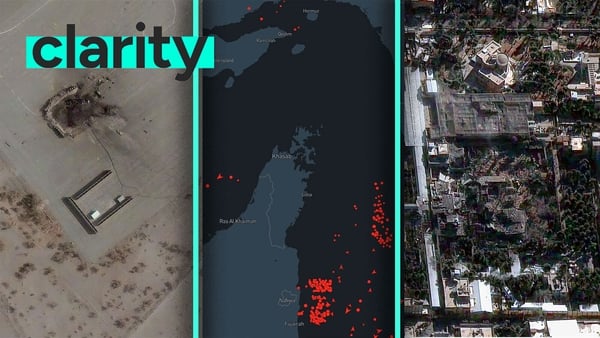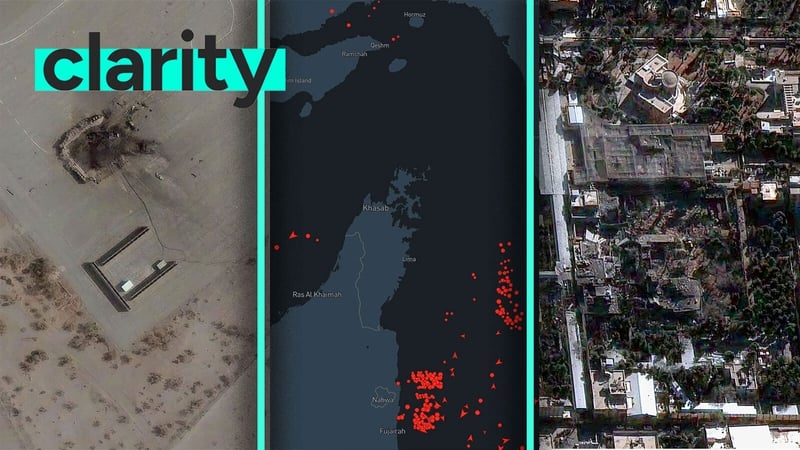

As strikes continue across the Middle East, satellite imagery and real-time tracking data give insight into the wider impact. New images show damage at Iranian military sites, marine traffic data points to a slowdown in oil tanker movements around the Strait of Hormuz, while flight tracking shows airspaces closing across parts of the region.
Satellite imagery released by Vantor, a commercial geospatial intelligence firm shows fresh damage linked to the escalating conflict in Iran and neighbouring countries.
Images captured on March 2 show airstrike activity observed at Iran's Natanz nuclear complex. Damage can be seen on several buildings that cover the personnel and vehicle entrances to the underground fuel enrichment complex
We need your consent to load this flourish contentWe use flourish to manage extra content that can set cookies on your device and collect data about your activity. Please review their details and accept them to load the content.Manage Preferences
Others show heavy destruction at the Choqa Balk-e drone facility west of Kermanshah in western Iran, with storage buildings, bunkers and launch infrastructure visibly damaged.
We need your consent to load this flourish contentWe use flourish to manage extra content that can set cookies on your device and collect data about your activity. Please review their details and accept them to load the content.Manage Preferences
We need your consent to load this flourish contentWe use flourish to manage extra content that can set cookies on your device and collect data about your activity. Please review their details and accept them to load the content.Manage Preferences
Separately, imagery of the Ras Tanura oil refinery in Saudi Arabia shows firefighting crews working in an area of the complex following what is described as a drone strike.
We need your consent to load this flourish contentWe use flourish to manage extra content that can set cookies on your device and collect data about your activity. Please review their details and accept them to load the content.Manage Preferences
Other images taken on Sunday March 1 show damage following airstrikes on multiple military facilities across Iran. Significant damage has been observed at Iranian air force, naval and leadership facilities.
We need your consent to load this flourish contentWe use flourish to manage extra content that can set cookies on your device and collect data about your activity. Please review their details and accept them to load the content.Manage Preferences
We need your consent to load this flourish contentWe use flourish to manage extra content that can set cookies on your device and collect data about your activity. Please review their details and accept them to load the content.Manage Preferences
We need your consent to load this flourish contentWe use flourish to manage extra content that can set cookies on your device and collect data about your activity. Please review their details and accept them to load the content.Manage Preferences
Before and after images also show damage to the Khamanei residence complex in Tehran.
We need your consent to load this flourish contentWe use flourish to manage extra content that can set cookies on your device and collect data about your activity. Please review their details and accept them to load the content.Manage Preferences
Several airspaces were closed as of March 2, including Israel, Iran, Iraq, Syria, Qatar, Bahrain and Kuwait, according to flight data from Fligthradar24. Lebanon, Jordan, and the UAE are technically open, although flights are extremely limited. It was reported on Monday afternoon that some flights had resumed from Dubai and Abu Dhabi airports.
The Middle East has evolved into a pivotal crossroads for long-haul aviation, meaning disruption there reverberates far beyond regional carriers. Even after restrictions lift, airlines are likely to grapple with passenger backlogs and complex schedule resets as they work to stabilise operations amid continued uncertainty over reopening timelines.
We need your consent to load this flourish contentWe use flourish to manage extra content that can set cookies on your device and collect data about your activity. Please review their details and accept them to load the content.Manage Preferences
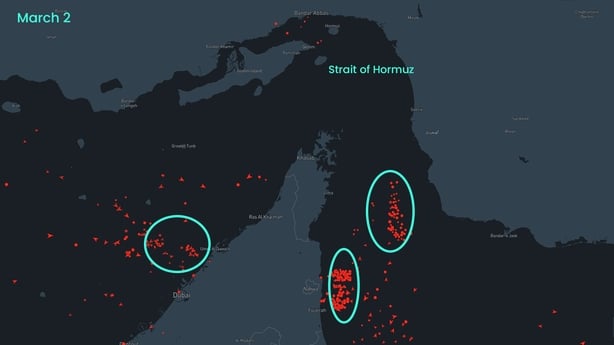
Images from marine traffic data service Marine Traffic/Kpler show a slowing of vessel traffic around the Strait of Hormuz, a crucial trading route on Iran's southern border.
The strait of Hormuz handles roughly 20% of global oil consumption and a significant share of LNG exports.
According to Kpler, product tanker traffic through the Strait of Hormuz has collapsed in both directions as tensions involving the United States, Israel and Iran intensify.
The firm reports a drastic fall in both westbound and eastbound transits, affecting laden and ballast vessels, as recent strikes heighten security concerns and discourage passage through the chokepoint.
Animation from Marine Traffic showing vessels moving through the Strait of Hormuz from 28 February - 2 March.
Europe is particularly exposed, it says, as it sources around 45% of its jet fuel from the Middle East, meaning sustained disruption poses a direct threat to supply.
In an image below from Marine Traffic taken on February 27, oil tankers can be seen passing through the strait.
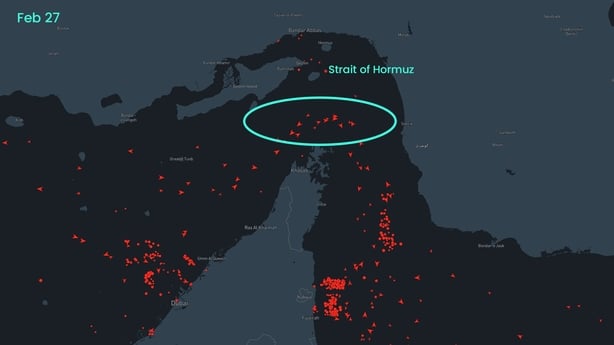
However, in an image below from March 2, oil and gas tankers in the region can be seen grouped near ports on either side of the strait, while traffic through the strait itself has decreased if not stopped entirely.