People in east Cork are raising questions about the urgency of flood protection programmes, two years on from experiencing the impact of rising waters on their homes and businesses.
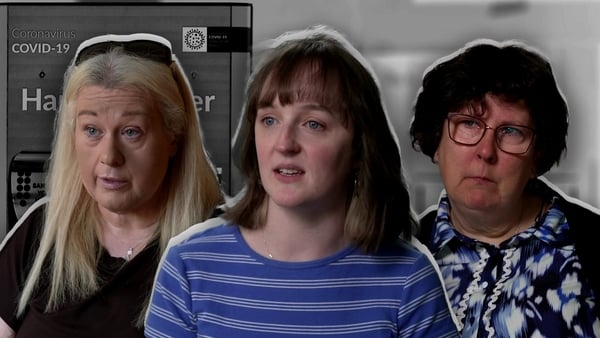
Vivienne Jeffers, along with her two children, was rescued from the upper floor of her home in Mogeely, east Cork, as floodwaters rose during Storm Babet in October 2023.
She says recent flooding in the Midlands and along the east coast make her question the timelines for implementation of local flood protection schemes.
"I see all these people flooding up the country, it's bringing back the raw emotions," she told Prime Time. "It's absolutely breaking my heart. God love them. It's not fair. It's not fair in any of us. It's not fair on them. It's not fair on us."
Despite, she says, commitments made in the aftermath of Storm Babet, there has been little visible progress on the ground.
"I see lots of promises. I see surveys, but there's nothing physical. I'm in my third year of trying to protect my home. When we moved in, it was my forever home. It was my happily ever after. Now it's strangling me. If I could move tomorrow, I'd be gone," she said.
In the aftermath of the flooding, the then Minister for the Office of Public Works Patrick O'Donovan said the Government would "do what it takes" to bring flood protection to east Cork.
For Mogeely, a village of roughly 400 people, that means inclusion in any flood relief scheme for flood-prone Castlemartyr, when delivered by the Office of Public Works (OPW).
Both locations are listed as a 'Tranche 2' project, to be delivered after the completion of Midleton's long-awaited flood relief scheme, now scheduled for 2031.
Their flood risk was considered "medium probability" or a one in every 100 years event.
Ms Jeffers, however, says that climate change and recent rainfall changes means that residents in her estate, Gleann Fia, and three other relatively new housing estates in the village, feel that they are all at an ongoing risk.
"Saying that the flood is once in 100 years isn't good enough because it can happen. We need protection. It's traumatising," Ms Jeffers said.
The OPW's flood risk maps shows that Mogeely and Castlemartyr's flood risk status is now under review.
Cork County Council says it has cleared debris from rivers, installed non-return valves on water channels, along with some "compound channels", allowing more gradual outflows in places. It says it is also "progressing drainage upgrades" to reduce flood risk.
Castlemartyr
In nearby Castlemartyr, which is on the Kiltha River, residents have also been watching the news from flood-hit towns around the country.
Catherine Power has been campaigning as part of the Midleton and East Cork Flood Protection Group for many years.
After the 2023 flooding, Ms Power and her husband Paul were out of their home for six months. It was their third serious flooding experience in 15 years.
She points to the frequency of flooding - in 2009, 2015 and 2023 - and believes it will happen again soon.
"There's a pattern, and more houses are getting impacted every time."
Ms Power acknowledges Cork County Council’s efforts last year in carrying out "minor works" such as the clearing debris and dredging in parts of the river. Her real hope for action on flood protection was raised in August 2025, when the town was visited by the Minister for the OPW, Kevin 'Boxer' Moran.
"[He] came to visit the village last August and met with residents here in the village. He announced that day funding for the technical assessment for interim works," Ms Power said.
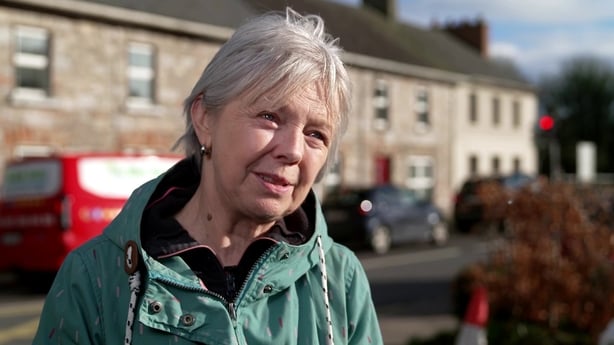
What concerns her is the pace of delivery. A contract for the assessment of interim works was put out to tender in late December 2025, four months after it was announced.
The assessment will start later this year and take a further 12 months to complete.
In a statement to Prime Time, the OPW said: "For those communities impacted by this flooding event and where a major flood relief scheme is planned but not yet completed, the OPW has asked those local authorities to set out a plan of all interim measures that can help mitigate flood risk from all sources. The OPW expects to receive these plans over the coming weeks."
It added that, "major flood relief schemes involve complex engineering and construction operations and require lengthy planning lead-in times."
Earlier this month, after a ministerial meeting on recent flooding Minister Moran said that 100 flood relief schemes are under way but interim solutions are required.
Lack of clarity
Ms Power says the lack of any deadline for either interim or permanent flood protection measures is difficult for locals to understand.
"We need assurance. We need a timeline as to what is happening."
The proposed pace of even interim works is reflected in some of the country's biggest flood defence projects, including those which are deemed "priority" by the OPW.
Midleton, the site of the country's worst flood event in 2023, is one of the priority sites. The OPW states there will be "substantial completion" of its flood defences in 2031. Plans for the project originated in 2010.
Some advance works to provide permanent flood defence to the Tir Cluain housing estate, protecting 135 properties, however "is scheduled to commence on site in Q4 2026", according to the council.
Cork County Council says it also provides funding for flood gate barriers for 725 properties in Midleton and the wider east Cork area under the Individual Property Protection (IPP) Scheme.
Local Social Democrat TD for Cork East Liam Quaide says that while flood defences for Midleton "should have happened many years ago", at least they now have a clear plan.
Other equally affected towns in east Cork have no target date.
"All the villages that also flooded during Storm Babet, like Castlemartyr, Mogeely, Killeagh, Rathcormac, Whitegate, Ladysbridge, they're really entirely in limbo at the moment," Deputy Quaide said.
"We have no sense of whether we'll be spared next week, next month, next year. The science tells us that it's a matter of when, not if. We desperately need to see a sense of urgency," he added.
Deputy Quaide also raised concerns that a study commissioned in 2024 by Cork County Council into the potential for near term nature-based solutions – where rivers are naturally slowed down by measures in its upper catchment - has not been published or acted upon.
"We know from international best practice that nature-based solutions can be delivered at relatively low cost. They're not a silver bullet by any means, but they should be an important part of our overall flood resilience," he said.
"It beggars' belief why we're not pulling out all the stops to maximise the potential for nature-based solutions in tandem with the more traditional engineering methods."
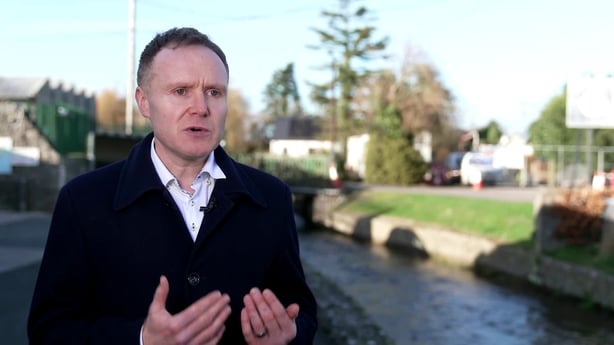
Dr Darragh Murphy, from Flynn Furney Environmental Consultants and Rivus Ecological Engineering, told Prime Time that such measures work with "varying degrees of effectiveness".
He says they "will always offer some mitigation of the worst effects of flooding".
"If they can be done in a way that water is held on farmland, for example, for a short amount of time, it doesn't preclude the normal farming activities. It's the same with forestry," Dr Murphy said.
In other cases, more permanent changes are needed but may be compensated for.
In a statement, the OPW said: "Nature-based solutions have been demonstrated to be effective for more frequent, less extreme flood events in small catchments."
However, it added "there may be more limited benefits from nature-based solutions during such extreme events when catchments are fully saturated and natural storage areas are full."
Cork Council says: "Where feasible, nature-based solutions will be incorporated into the Midleton Flood Relief Scheme."
Catherine Power says any action on this would be welcome, given pace of progress on flood barriers.
"I would love to see engagement with landowners to try and dissipate floodwater just in those times of flood, and then that it can be allowed back into the river again, because the river incredibly goes down very fast. It’s a no brainer."
A report on flooding in east Cork from Oonagh Smyth and producer/director Aaron Heffernan is broadcast on the 17 February edition of Prime Time at 9.35pm on RTÉ One and RTÉ Player.