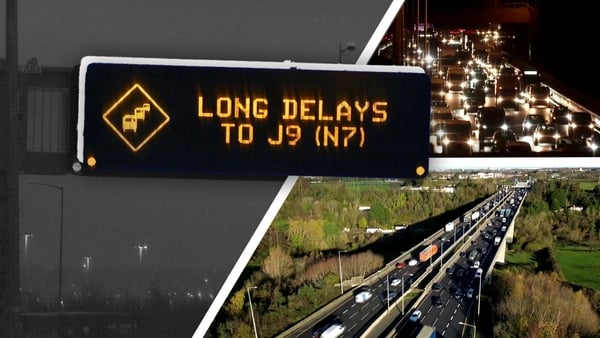
Transport Infrastructure Ireland (TII) says there is almost nothing it can do to address traffic gridlock on the M50, while accepting that the road has reached capacity.
"We're actually beyond the Celtic Tiger numbers, we're at capacity. We can't make it any wider, and you can't make it a double decker," TII's Director Corporate Communications Sean O'Neill told Prime Time as part of a report examining how the road operates, and potential solutions for improving traffic flows around the Dublin commuter belt.
Some 187,284 vehicles - the highest ever number in a single day - travelled on the stretch between Junction 6 Blanchardstown and Junction 5 Finglas on 26 June this year.
Commuters using the M50 say travel times have become increasingly unpredictable, with journeys that once took under an hour now stretching well beyond that.
The Irish Road Haulage Association (IRHA) labelled the M50 "no longer fit for purpose", while warning delays on the road contribute to consumer price inflation.
Some motorists are regularly spending over three hours a day commuting to and from work on the M50.
Longer peak times
Traffic managers say the pattern of congestion has changed in recent years, with peak periods now beginning earlier and lasting longer than in previous years.
Real-time feeds from 100 cameras along the M50 are monitored from the TII's Motorway Operations Control Centre beside the entrance to the Dublin Tunnel in East Wall.
Daniel Pentony, the TII's Motorway Operations Manager, said peak times for traffic in the mornings and evenings have lengthened. For example, Friday rush hour on the M50 now starts shortly after midday.

Increased traffic volumes on the country's busiest road have also meant there are more collisions.
"We've had the same number of collisions for the first ten months of this year, compared to all 12 months in 2024," Mr Pentony said.
"A lot are to do with driver behaviour and motorists being distracted on their mobile phones. And there's rubbernecking of incidents where drivers are seeing something in the opposite carriageway and not paying attention," he added.
Incidents from breakdowns to fatalities are dealt with by the M50 Incident Support Unit, which has vehicles strategically placed along the motorway to respond quickly.
Ryan Mulroy, who has been working with the incident response team for 13 years, says they "could have anything from ten to 20 call-outs per day".
"We usually take between 13 to 18 minutes to get to any incident on the road. We have four trucks and four vans on the road at any given time, so we are able to get out to the incidents fairly quick," Mr Mulroy added.

Even with these response times, there is a view that a minor incident on the M50 during rush hour can grind the whole capital to a halt. For businesses that rely on the motorway, those delays can have significant knock-on effects.
Economic impacts
"It is Russian Roulette. It's a roll of the dice when you come onto it," Noel Whelan, who operates the DPD Ireland parcel delivery depot in Balbriggan, north County Dublin, said.
That depot is one of the company's seven across the capital. DPD delivery drivers are constantly on and off the M50, in around 300 vans. Predicting delivery times is a vital part of the parcel delivery business and traffic congestion makes that particularly difficult.
"If there is an incident on the M50, that cascades onto the ancillary routes coming on and off it. That just affects every part of the business and you cannot keep on time," Mr Whelan said.
"There is no rhyme or reason to it. There is no two days the same on it. Anything can happen," he added.
Mr Whelan also believes driver behaviour is a huge factor behind the related traffic chaos.
"I commute 450km a week along the M50 and you see everything. You see every kind of bad behaviour from mobile phone use, eating, putting on makeup, tailgating and speed," he said.

Traffic issues on the M50 ripple out onto various other roads in the commuter belt.
Tara McManus lives in Mullagh, Co Cavan, and drives daily to work in Phibsborough, Dublin, where she works with the Garda Representative Association.
She travels in on the M3 motorway. As with other radial routes onto the M50 - such as the M4, M7 and N2 - the M3 road is clogged with traffic every morning from 6.30am for about three hours as motorists make their way onto or over the M50.
"It is getting progressively worse all the time. And it's just really draining. It's a lot to do before you go in and do a day's work," Ms McManus told Prime Time.
She drops her four children for the school bus at 7.45am before starting the 70km journey to work in Dublin. She passes through two toll plazas on the way to work and the same on the return journey, costing approximately €6 per day.
"It can be anywhere from an hour and 20 minutes to over two hours," she said.

The pressures facing commuters and businesses are related to wider changes across the Dublin region, according to Professor Aisling Reynolds-Feighan, a transport economist at UCD.
'Investment maxed out'
She points to a buoyant economy and 17% population increase since the M50 was completed in 2010 as the main reasons for the current levels of congestion.
She said the largest employment centre in Ireland is within the M50 and "because of our housing shortage and inability to build houses within the M50, people are being forced to live further out in the commuting counties".

While TII is the State body responsible for maintaining and upgrading the national roads network - including the M50 - the National Transport Authority oversees transport planning, in particular, public transport provision.
In response to questions from Prime Time about the issues facing the M50, the National Transport Authority (NTA) said its strategy to address congestion focuses on reducing car use and improving alternatives, rather than expanding motorway capacity.
It will take time for that to have an impact, while TII says much of the available potential to upgrade the design of the M50 has already been used up.
Sean O'Neill from TII said that over the last decade a number of measures have been introduced to improve traffic flows, including the redesign of junctions and the introduction of variable speed limits.
"We've also added lanes. We've elongated merging corridors, which means it gives you safer time and more distance to get in and out of an interchange," he said, before adding "all of that investment and redesign has been maxed out".
Mr O'Neill said such upgrading has been a success "but we've done everything we can do and anything additional would have to be a significant policy decision by government. That wouldn't be for us to decide."
"The M50 really is the Achilles' heel of the country's motorway and road network, because it gets you to everywhere else on the island of Ireland on a road," Mr O'Neill said, adding "it allows goods and services coming in and out of Ireland to get throughout the entire island."
Alternative options?
Laois man Ger Hyland, of the Irish Road Hauliers Association (IRHA), says M50 congestion comes at a huge cost.
"We estimate for every hour that we're standing up on the M50, it's costing us €100," which, he says, trickles through into prices for consumers.
"It's now taking an extra hour to do a load from Naas into Dublin and the same on the way back... that extra cost is going to be found in the shopping basket at the weekend."
Mr Hyland is among those calling for the Government to revisit plans to build an Outer Orbital Route around Dublin.
The route would run from Drogheda to Naas, via Navan, Trim and Enfield. It was previously mooted, before it was shelved a few years ago in favour of developing public transport infrastructure.
"The M50 at the present time is just not fit for purpose. There has to be an outer ring road from Naas the whole way up as far as Drogheda or Dundalk," Mr Hyland said.
"It won't alleviate it completely, but it will be a huge help. There's a lot of traffic going from the M7, up on to the M50 and heading on up the M1. The outer ring road would take all that traffic out of Dublin completely," he added.
It's a proposal Professor Reynolds-Feighan believes is worth exploring, but she says it won't solve the overall problem.
"I think the problem, however, will remain for the greater Dublin area where the M50 at capacity is still going to be a major constraint for a large share of the population.
"Our environmental concerns around emissions and decarbonisation as a priority are also somewhat in conflict with our transport policy and de facto what people are living with, in terms of how they undertake journeys in this country," Professor Reynolds-Feighan said.
She points out that the M50 was originally envisaged as a ring road around Dublin where motorists could bypass the city to the east and the west, "and what we built is a 'C' ring".
"The only way that we can expand capacity in the short to medium term, in my view, is by reconsidering the Eastern bypass and completing the ring around the city as was originally envisaged in the plan in the 1970s.
"If we were to complete the ring, it would give an alternate east or west bypass of the city."
The Eastern bypass advocated by Professor Reynolds-Feighan has been proposed and shelved again at various stages since the 1970s.

An RTÉ News report about it in 2000 said: "The most recent proposal for the route takes it from the Dublin Port Tunnel through Sandymount, Booterstown, up Fosters Avenue and through Goatstown to Sandyford where it will connect with the M50 motorway almost completing a circular route around the capital."
In a statement, the NTA said that in 2022, the project "was deemed not to be aligned with the objectives of transport planning in relation to environmental protection.
It added: "There is no evidence that the Eastern bypass would be the panacea to congestion on the M50."
It said a new motorway linking directly into the M50 "would potentially attract new car users to the strategic road network, add traffic to the existing M50 and the radial national routes linking to the M50".
The NTA says alternative public transport measures are under development including MetroLink, Luas Finglas, BusConnects Dublin and DART and rail improvements.
'It's gotten worse'
For commuters like secondary school teacher Seán O'Neill, the debate about solutions is distant from the day-to-day reality of getting to and from work.
He lives in Finglas on the north side of Dublin and drives around the M50 to Loughlinstown in the south, where he works as a teacher in St Laurence College.
"I've been doing it for 24 years, since I began working in Saint Laurence's. It's got significantly worse," he said.
Seán drives the M50 in the morning from Junction 5 Finglas southwards to Junction 16 Cherrywood. Sometimes after getting caught in traffic, he has had to call the principal or other teachers to take his class until he arrives at school.
One day he was almost three hours getting home around the M50, as there was a bad crash.
Seán leaves for work before 7.30am and the journey takes around an hour and 20 minutes door-to-door, passing over the West Link toll bridge near Blanchardstown twice a day.
"It's costing me about €5 a day to come back and forward over the M50 and I'm not really sure exactly what I'm paying for."
Spending many hours on Ireland's busiest road also comes with another concern.
"You're always worried about whether your clutch will hold up. That's probably the most worrying thing," he said.

For commuters travelling in from outside Dublin, like Tara McManus, the worry and uncertainty can be just as draining.
Prime Time travelled with Ms McManus last Tuesday to see how long her commute would take. It was seamless until the Dunboyne exit off the M3. From there she was caught in a long line of traffic all the way into the intersection with the M50.
A collision earlier in the morning on the M50 seemed to clog up all of the approach routes for a few hours.
"Your biggest dread is when you put on the radio in the morning to get the traffic updates, and you hear that there was a collision," Ms McManus said.
"If it's anywhere on the M50, it has repercussions. It's hitting all the other roads that join the M50."
Last Tuesday, 26 November, it took her 40 minutes to move a short three-kilometre distance along the M3 past the exit for Blanchardstown Shopping Centre.
She left her home in Mullagh, Co Cavan at 7.45am, and arrived in work at 10am.
"There's a record - 2 hours and 15 minutes to get to work today. It's terribly frustrating. It kind of puts you in bad form for the whole day."
A report on the M50 from Conor McMorrow and producer/director Sallyanne Godson will be broadcast on the 2 December edition of Prime Time at 9.35pm on RTÉ One and the RTÉ Player.