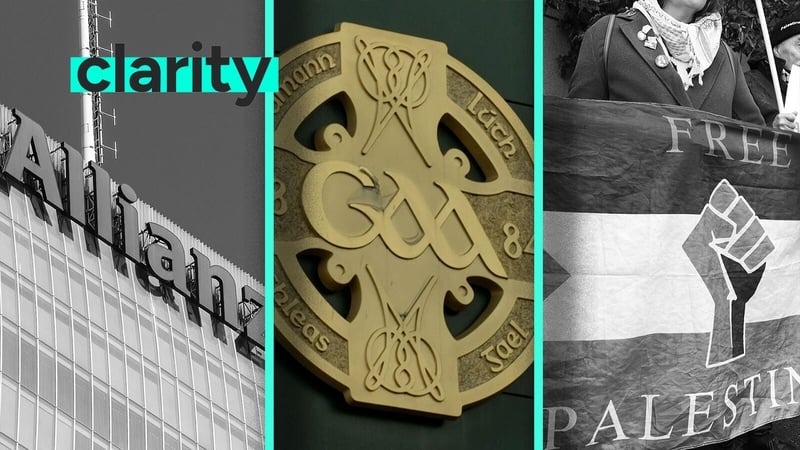
There have been petitions and protests, internal reports and newspaper columns all calling for an end to links between the GAA and Allianz, the insurance company.
What's behind the campaign, why are the GAA intending to maintain the link, and are we about to see players protest over Allianz's continuing sponsorship of GAA competitions?
Allianz has sponsored the GAA’s national leagues since 1993 - and is due to until 2030 under the current deal.
The insurance giant – through its German parent company - was among a number of companies named in a report by the United Nations Special Rapporteur on the Palestinian territories last June, as being involved in sustaining and paying for Israel's actions there.
That triggered petitions from current and former GAA players, and motions from county boards, demanding the GAA ends it links with Allianz.
These were rejected by GAA headquarters late last month.
An internal report concluded the organisation was legally obliged to fulfil its contract with Allianz. The GAA later issued a statement saying: "Allianz plc has no involvement with the IDF or corporate entities involved in the war in Gaza. Any such relationship is with a sibling or cousin company."
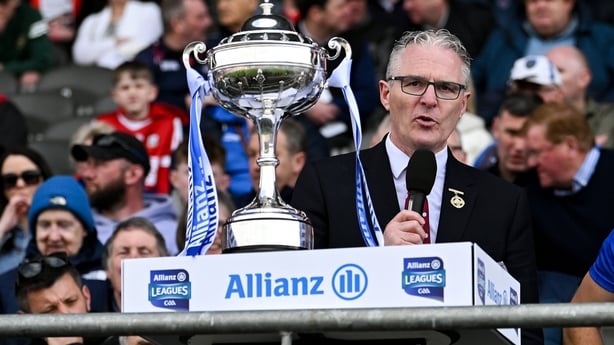
The football leagues start tomorrow with two games scheduled for Croke Park – the Division 2 clash between Meath and Derry, followed by the Division 1 game between Dublin and Donegal. Despite the report and GAA statement, some players are reportedly planning to avoid standing in front of Allianz-branded signage during the competitions.
Several prominent former players and commentators have spoken out in support of the idea. Speaking on Prime Time last night, former Donegal player Brendan Devenney asked: "Where’s our morals in this?"
"Our reputation has been savagely hit by this, the fact we are connected into this," he said.
He suggested that there is strong interest in GAA sponsorship and that the organisation would not struggle to find a similar replacement for Allianz.
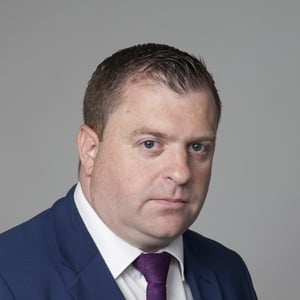
Also speaking on Prime Time was Rob Hartnett, CEO of Sport for Business - a business network of more than 300 member companies and sporting organisations. Allianz, RTÉ and Dublin GAA are among its members.
Mr Hartnett argued that it is difficult for sporting organisations to make moral judgements on sponsors like insurance companies due to the globalised nature of the modern economies.
"The problem with it is from a corporate point of view is that we live in a world that is incredibly connected, and the ability to make moral judgements with any degree of certainty are definitely compromised," he said.
He pointed out that the GAA has decided against allowing sponsorship from alcohol and gambling companies, and said ruling out companies with secondary links to what has been called Israel’s 'war economy’ would prove difficult.
He added that the UN report last year listed 48 companies – many of them that Irish people use on a daily basis.
"Where do we draw the line? The Allianz sponsorship delivers good for the GAA. It enables the GAA to programmes on which allow children to play, which allow the national leagues to take place, and by tearing that up and sending that away we are damaging ourselves."
The Allianz leagues were launched virtually yesterday – with no current players appearing publicly.
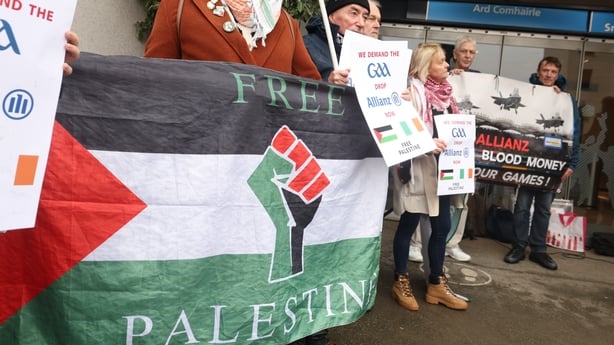
A protest attended by about 40 people against the company's continued sponsorship of the GAA took place outside Croke Park at the same time.
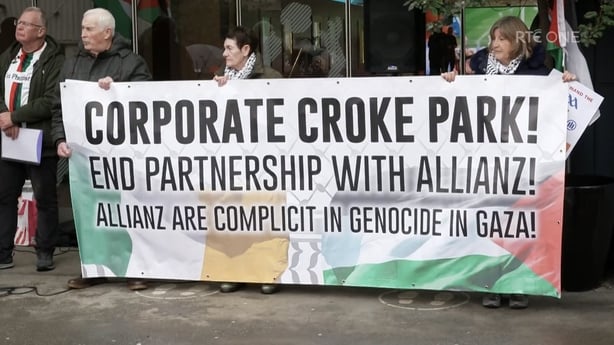
Speaking to Prime Time at the protest, activist and All-Ireland winning former Dublin footballer Dr David Hickey said: "The history and the morality of the GAA is directly opposed to having Allianz and its genocide enabling fraternity involved in anything to do with our national games."
Dr Hickey is a transplant surgeon and pro-Palestinian rights activist, and has been the driving force behind the campaign aimed at ending the GAA’s links to Allianz.
Allianz Ireland has sponsored the national leagues for more than 30 years. It has said previously that its GAA sponsorship is "about supporting Irish sport and communities."
"Allianz Ireland is part of a global group, and while the wider group operates internationally across insurance and investment, as a matter of principle, we do not comment on individual customers or business matters.
"What we can say is that all Allianz business decisions are guided by strict legal standards and world-leading ESG (environmental, social and governance) principles."
It was reported earlier this week that Dublin players would refuse to appear in front of Allianz-branded signage during the leagues. However, it’s not clear how many such players have made such a decision.
Dublin footballer Greg McEneaney confirmed on Wednesday - at an event hosted by Dublin GAA sponsors Staycity Aparthotels - that there has been no collective discussion on the matter among the Dublin senior football or hurling panels.
Mr Hickey said any such protest would "strengthen the team’s resolve, show that there's more important things than kicking the ball around, and they will rise up and they will be a threat to our association."
Tomorrow, they face Donegal. Again, it’s not known if any Donegal players will attempt to distance themselves from any Allianz signage or logos, which for example is often used on backdrops in TV interviews.
The weekend’s games may prove indicative, or potentially divisive.
Speaking at the protest outside Croke Park, Brian Flynn, of Ferbane GAA in Co Offaly said: "We just feel that Allianz is completely at odds with the ethics and values of the GAA."
Mr Hartnett, of Sport for Business, told Prime Time that the GAA risks cutting off future income streams if it cuts its ties with an insurance company with which it has legal obligations.
"In the Premier League in the UK there are four categories of sponsorship - financial services, technology, gambling and alcohol. We say that the GAA should grow a backbone and a spine, they have already ruled out sponsorship from alcohol and from gambling firms. If we continue to move the line, then there will be no sponsorship," he said.