


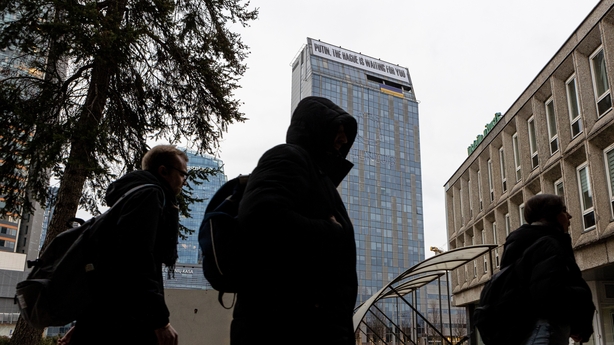
Remigijus Šimašius is a man who doesn't mince his words. He has festooned the 22-storey office block where he is based with a giant banner with the message, "Putin, The Hague is waiting for you".
It dominates the city skyline. The controversial Mayor of Vilnius, the capital of Lithuania, admits it’s a bold move, but he shrugged his shoulders and told Prime Time "we have to stop it and the right time for stopping it is right now".
Asked whether the banner was deliberately provocative, Mr Šimašius said he knew it was. But he said it was also what was needed.
If the Russian leader is not "stopped", he said, the world will pay a price.
"When Putin will stop? Putin will never stop. So our obligation is to stop him, because if we don’t stop Putin, then there is a really big clarity, 100%, that he will move forward to Moldova, to Georgia, to Poland or the Baltic States, to Finland.
"I have 100% certainty that this time he will be stopped," he said.
There are videos circulating on social media of Mr Šimašius spray-painting the Putin Hague remarks on the street leading up to the Russian Embassy in Vilnius.
But it’s obvious that his next move was the one he is most proud of. He has decided to rename the street leading to the Russian Embassy. Smiling, he said it will now be called "Heroes of Ukraine Street". "So now that will be the Russian Embassy’s address here in Lithuania."
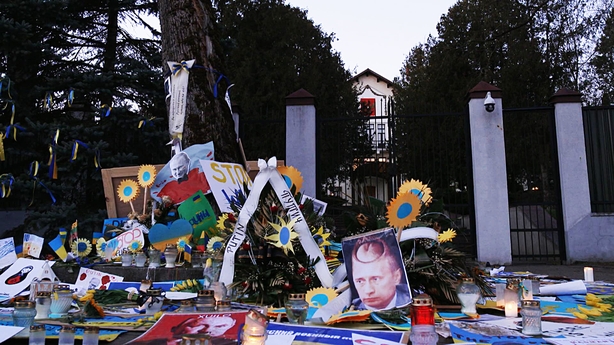
The embassy is like a shrine to Ukraine. Over a few hours late in the evening, hundreds of people turned up, to light candles and say a prayer. The area is covered in blue and yellow.
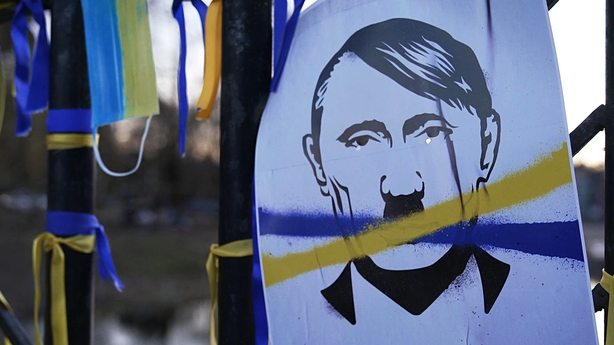
Posters mocking Putin and Russia are everywhere to be seen. The embassy overlooks a park, named after Borisas Nemcovas, a Kremlin critic shot dead in Moscow in 2015.
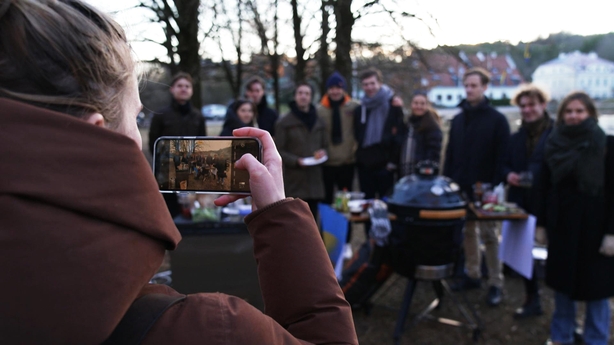
On Saturday evening, a group gathered around a barbecue and the smell of food wafted across the park.
Almost everyone we spoke to talks about the fear in the Baltics that Putin won’t stop with Ukraine. Lithuania has faced occupation before, and many of the people here remember living under Soviet control. They cherish their independence.
"We had a history of Russian invading, so naturally, to a large extent, we are afraid," said Ricarda Bielskis, who was having a beer poured from the mobile beer tap the group had brought to the park.
Even though he fears Russia striking again, he doubts the capacity of the Russian military.
"I don’t think that the Russian war machine has sufficient resources to really carry through," he told Prime Time.
"Notwithstanding the unpredictability of the man who is in charge, we are within the zone of danger. And we will do anything that we can in order to draw attention and raise awareness about this crisis."
As soon as he mentioned the word "crisis", Ricarda was taken to task by one of his friends.
"Don’t call it a crisis. It is very important to say that it is not a crisis," said Alexandra Pasakova.
"That’s what Russian propaganda is trying to make people say. It’s not a crisis – it’s a war."
Alexandra said that people who talk of a crisis are "probably on the side of Russian Propaganda". But it’s clear she does not think her friend, who let the C-word slip, is guilty of that.
"In my opinion, it is not a question of if. It’s more a question of when", said another man, Pijus Kibildis.
He too, like many here, is convinced that the Russian advance will not stop in Ukraine.
"I hope, someday, if he would come here, we will show our balls," said Laurynas Bagatyrius.
There is just one among the group who disagreed. He thought Russia would never move on a NATO member like Lithuania.
"They can poke us verbally, but the second they do anything else, there will be a swift response," said Petra Tursa.
"I think that our country has never been safer than now, because this has finally gathered attention from all around the globe. NATO has never been more united, the European Union has never been united. To invade a NATO country with American and German soldiers at the border – that’s a completely different thing, and the response would be the same as attacking the United States."
This group is young, liberal and educated. In Ireland, they would not be the type you normally see backing NATO.
It is cold and dark when we finished chatting. The grass under our feet was frozen solid, and a fingernail moon was reflected on the perfectly still water in the small lake in Borisas Nemcovas Park.
All was calm – the polar opposite to the chaos in Ukraine.
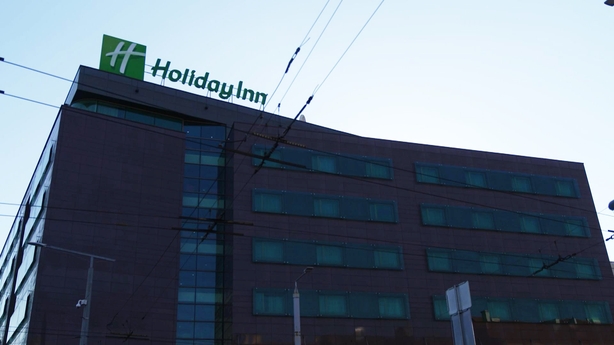
The next morning, breakfast was being served at the Holiday Inn opposite the municipal building where the banner taunting Putin and Russia hung. We received information that 110 refugees were staying there. Some 84 adults and 26 children were staying in 55 rooms. This was one of several hotels in the city providing accommodation free of charge.
Three women approached the front door of the hotel. They embraced and kissed, and then one of them burst into tears and ran out the door to a waiting car.
Her sisters were safe, with a bed for the night, for now. In the past two weeks, we have seen similar exchanges dozens of times, from the border crossings with Ukraine, to hotels and car parks across Hungary on our journey to Lithuania.
As we travelled with the refugees as far as Estonia, the scale of the crisis across Europe became evident.
A woman came toward us and spoke Russian, agitated and asking questions. We tried to use a translation app to communicate, but her eyesight was too poor to read the text. A worker in the hotel approached and translated for her.
The woman wants to know when the war will be over and when the bus will bring her home. She wants to return to Ukraine, not now, but when the war is over. She was looking for clarity on when that would be.
We have seen heartache and pain since we first landed on the Ukraine–Hungary border last week, the effect of the refugee crisis everywhere to be seen.
Most people involved agree the suffering of children affects them most. But this woman, confused and anxious to return to her home, seemed too cruel.
The kind hotel worker reassured her, gave her some words of comfort. The hotel worker told us later that she too was from Ukraine. In Lithuania – more than anywhere we have been – the response to the refugees has been organised, kind and heartening to witness.
The volunteer response is mind blowing: people are working long shifts matching refugees with places to stay, and tens of thousands of people have volunteered properties. People are driving to the Polish border to collect people and bring them to safety.
Agne Goldbergaite is spending all her free time helping. She works on a helpline on two 12-hour shifts at the weekends.
When we met in the lobby of a Vilinus hotel, she was working on finding accommodation for 15 Ukrainians who arrived in on a late flight the night before.
"This is breaking my heart like anybody, like other Ukrainian hearts" Agne told Prime Time.
"I think it is our duty to help them without any questions asked. I don’t care what I need to do – I will do it, no matter what it is."
She is kind and caring, driven and organised, one of many thousands of people mobilising to help. If predictions are true, Agne and her fellow volunteers will have to help up to 100,000 refugees expected to come to Lithuania in the coming weeks and months.
Before we left Lithuania to travel to Tallinn, the capital of Estonia, where US Secretary of State Anthony Blinken is continuing his Baltic tour, we took a trip to the border with Belarus.
Berta Tilmantaite, who was driving, said that everyone was afraid that Lithuania would be next.
"The Belarussian regime is pretty much the same as the Russian regime – they are united, they are together, so it is pretty much Russia, just run officially by another leader, who is the puppet, you could say, or ally of Putin."
The Lithuanian journalist raised an eyebrow and smiled when she said "ally", and she would have pulled air quotes were she not driving up an icy road, with snow piled on the roadside as we approached the border through a dark and leaf-bare forest.
The Lithuanian-Belarus border is also an EU border. Many fear that, if the Russian President wanted to, Russian tanks could role as far as that border.
No one expects there would be a hint of reluctance in Belarus. That reality has hit home, Berta said.
"Since Russia attacked Ukraine, here the state of mind, I think, for almost everyone just switched dramatically."
She explained how her stepfather gave her 40 litres of diesel in a can to have in her car in case Russia might one day make a move.
Her grandmother who lived through famine and Soviet occupation is insisting they dry bread so that can have something to eat should there be a shortage of food.
Berta said she was not stockpiling, since the focus needs to be on Ukraine. If logic tells people there’s no way Russia would invade a NATO member, history and experience means these people still feel the fear.
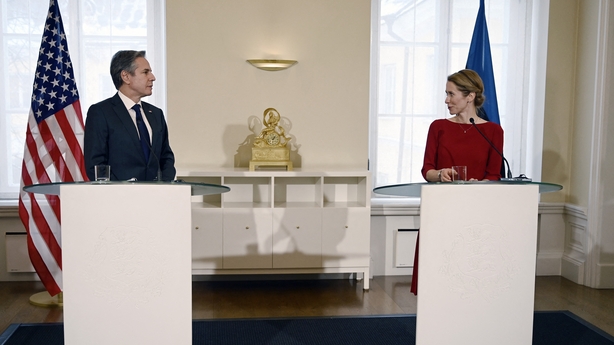
In Tallinn, we were in the room when the United States Secretary of State committed the support of the US army to their allies in the Baltics on Tuesday.
"We hoped for the best in avoiding that aggression, but we prepared for the worst," he told Estonian Prime Minister Kaja Kallas.
"We will defend every inch of NATO soil," Mr Blinken added. That commitment has been repeated and trumpeted in each of the Baltic States on his visits over the past few days.
Later, Kaja Kallis talked about the fourth package of EU sanctions and said Europe needed to "close the seaports for Russian vessels".
Like in Lithuania, Mr Kallas does not hold back.
"We need to focus on the full isolation of Russia from the free world. We must paralyse Putin’s war machine."
More than once, the prime minister referred to Vladimir Putin as "the aggressor". Evidently, she thought there was no room for diplomacy. Rather, the Baltics are standing firm and standing tall, NATO and the United States by their side. Tiny nations making a stand.
