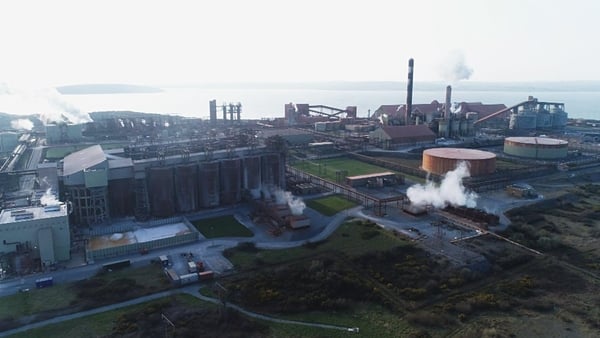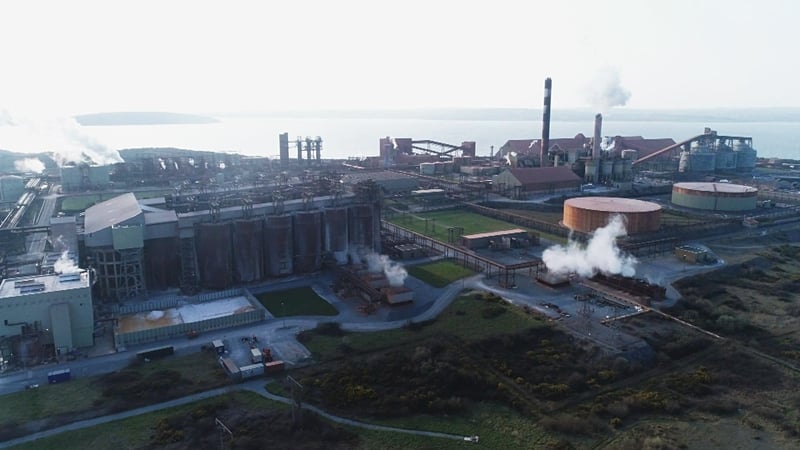

The Taoiseach has signalled there will be no change in the State's support for the Aughinish Alumina plant in Co Limerick, despite an investigation indicating its exports to smelters in Russia, where it is used to make aluminium, end up with Russian arms manufacturers.
Micheál Martin said: "There are no restrictions on Aughinish Alumina, and there haven't been, and Europe hasn't proposed them... in other words, the sanctions were never designed to punish Europe, or indeed to punish Ireland, more than Russia."
Speaking on RTÉ's This Week, Mr Martin said it was a "factor" that Aughinish Alumina is the EU's largest alumina refinery and produces 37% of its smelter-grade alumina.
"Let's be under no illusions, if there were severe restrictions, it would be devastating for Aughinish and all those working there as well," he added.
The Taoiseach said the Government would "keep everything under review" but, referencing investigations undertaken by the departments of Enterprise and Foreign Affairs and trade, he stated: "There's no new developments per se.
"We'll work with our European colleagues on this, and the full implications of this for European industry has to be taken on board as well. Because it's a valuable product, not just for Ireland, but for Europe."
His comment followed an Irish Times report, citing financial documents, revealing links between Irish-made alumina - a white crystal compound used to make aluminium - and Russia's war effort against Ukraine.
The company said in a statement that it operates in strict compliance with all EU laws,
"We particularly underline the fact that both alumina and aluminium are an internationally recognised basic commodity, the very nature of which means they serve broad general purpose societal needs and vital for countless civilian industries," it said.
However Mr O'Sullivan suggested action was needed.
"I think the company should undertake a review. It is the responsibility of all companies to do due diligence and to make sure that their products are not finding their way into the Russian military machine," he said.
It is unclear if such a review was undertaken.
Meanwhile, the Government has been under pressure on the issue in the European Parliament, where dozens of MEPs are demanding the European Commission take action.
European Parliament vice-president Pina Picierno cited the Irish Times investigation when writing to the commission, asking if alumina will be included in the next sanctions package targeting Russia over its 2022 invasion of Ukraine.
"It is unacceptable that, while the EU funds Ukraine's defence, a Russian-owned company operates undisturbed within a member state, supplying the Kremlin’s military industry," Ms Picierno wrote.
Martin wants outstanding issues facing Thalidomide survivors resolved
The Taoiseach said he wants all outstanding issues facing thalidomide survivors, including a State apology, to be resolved in 2026.
Mr Martin said: "We're going to bring this to a conclusion. There's been very positive meetings with the Irish Thalidomide Association. I've been very anxious to take this out of the legal frame for quite a long time."
In February, Tánaiste Simon Harris has said 2026 "has to be the year" when the Government finally resolves outstanding issues.
The Taoiseach confirmed that approach and the 2026 deadline, saying, "we're making good progress on this, and we would like this to be brought to conclusion this year."
Thalidomide was prescribed to pregnant mothers in the 1950s and 1960s as an anti-morning sickness drug, but was later pulled because of links to birth defects and lifelong disabilities.
The German manufacturer apologised in 2012 to those born without limbs as a result of its use.
Members of the Irish Thalidomide Association met Mr Martin and Mr Harris at Government Buildings this year.
In a statement issued after the meeting, the Government said that Mr Martin and Mr Harris told the group "that the pathway for people who have not yet had their injuries affirmed as caused by the thalidomide drug is being completed".
It confirmed at the time that Minister for Health Jennifer Carroll MacNeill "has agreed to provide discretionary medical cards to unacknowledged thalidomide survivors" and "this will apply to individuals who are currently seeking acknowledgement, or those who intend to seek acknowledgement, as survivors of thalidomide through the State process".
Mr Martin and Mr Harris "also confirmed an enhanced package of services to all thalidomide survivors and agreed to meet with members of the board" in November as the resolution process continues its work.
In 2024, then-taoiseach Mr Harris announced an enhanced health package for survivors, including simplified access to local health and social care professionals, access to clinical and holistic therapies, independent living supports to include housing adaptations, car adaptations and home supports, annual health assessments and free travel passes.
A resolution process, led by retired judge Paul Gilligan, was also set up.
However, Thalidomide campaigners claim that this process, which is confidential, has yet to deliver.