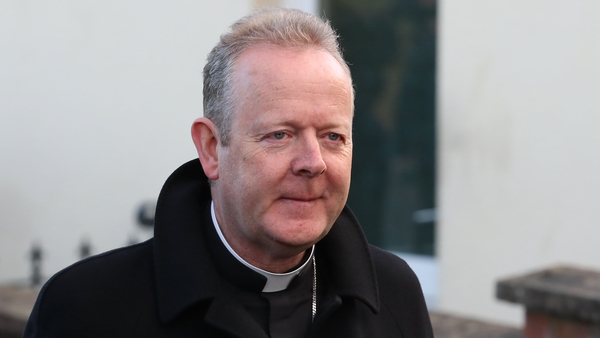

The International Protection Bill 2026 has concluded its passage through the Oireachtas.
Described by Minister Jim O'Callaghan as the most significant reform of Irish asylum laws in the history of the State, the bill is tied to the EU Migration & Asylum Pact which will come into force across the EU in June.
Rather than viewing the pact as one single law, it can be summed up as a package of regulations.
They include the Asylum Procedure Regulation (APR) and the Asylum and Migration Management Regulation (AMMR) and regulations around screening, tracking and reception conditions.
The APR is viewed as important because it standardises asylum decisions and time limits in which they're made.
In 2025, the International Protection Office (IPO), delivered over 20,200 first-instance decisions which was a 44% increase compared to the 14,100 decisions made in 2024.
Under the APR, decisions on standard cases will be made within six months, three months for accelerated cases, and 12 weeks for border procedures (including appeals and return decisions).
The regulation requires that certain applications be fast-tracked, particularly those considered weak, late, or from countries with low recognition rates.
The APR also makes border procedures compulsory for specific categories of applicants, who may be processed without entering the State.
While their cases are being considered, they are kept in a designated location or a "screening centre".
The Department of Justice has been running a pilot project in Citywest for a number of months, which has involved applications from "safe countries" and applications where the acceptance level is less than 20%.
Under the APR, applicants can continue to appeal decisions, but those appeals are subject to tighter deadlines and are expected to be integrated into faster overall decision-making.
However, one only has to look at the number of appeals at the International Protection Appeals Tribunal (IPAT) to see blockages in the system.
Increase in appeals
In 2022, appeals to IPAT stood at 895. They have grown to 19,000. A year ago, the median processing time for appeals was around 12 months.
So, while the IPO is making more rapid decisions - something the government is keen to highlight - thousands more are appealing.
When it comes to the use of "safe country" rules, the APR aims to produce quicker refusals along with EU-wide quotas for border processing.
Under the new pact, most of the Reception Conditions Directive remain the same however, one of the major changes comes under the Asylum and Migration Management Regulation.
It replaces the current Dublin III Regulation, which determines which EU country is responsible for processing an application for asylum.
The first EU country that an asylum seeker enters (or is entered into the Eurodac system) is responsible for their asylum application.
However, the AMMR now also includes an obligation on asylum seekers to apply in the first country they enter, which was not in the previous Dublin Regulation.
While there was a rule that the first EU country people entered was responsible for the asylum claim there was not a strict legal obligation on asylum seekers.

The AMMR has sought to strengthen transfers back to the first-entry country and allows for "solidarity" payments.
Rather than accepting the relocation of asylum seekers from frontline EU states, the Irish state has opted to pay into a common EU fund which will cost of over €9.2m next year.
The government’s argument is that there is already too much pressure on accommodation and a sustained number of international protection applicants to participate in the mandatory relocation scheme.
The screening regulation means the identity of everyone entering the asylum system will be checked through security checks and fingerprinting before admittance. Asylum seekers will essentially be tracked across the EU.
The bill which passed in the Oireachtas today includes an independent Chief Inspector of Asylum Border Procedures, who will monitor border procedures, inspect designated asylum facilities, and supervise complaints.
Concerns over Ireland's human rights obligations
As the legislation went through the Houses of the Oireachtas in recent months, concerns were raised about Ireland’s human rights obligations.
The Minister agreed to take the special reception needs of applicants into account when accommodating disabled people, pregnant women and victims of trafficking.
The term "legal counselling" was defined in the bill through an amendment and it was agreed that the needs of asylum applicants would be assessed at later stages in the process, because some applicants who have experienced a trauma, often need time to disclose.
However, the Irish Human Rights and Equality Commission has ongoing concerns about the bill including around powers to detain applicants in order to establish elements of their claims.
It has also pointed to the absence of legal advice and representation at first instance, with access only guaranteed at appeal stage.

IHREC has said that limiting legal assistance at the earliest stage risks undermining access to justice, weakening decision-making, and increasing the likelihood of legal challenges.
UNHCR Ireland has called for proper resourcing of the Legal Aid Board and the new Chief Inspector’s office "to support timely access to legal counselling and representation, effective access to asylum procedures, and robust monitoring of the asylum border procedure".
Spokesperson Maria Hennessy said it would require "significant investment in training, staffing and infrastructure."
The UNHCR also expressed regret that the International Protection Bill provided for the detention of children in exceptional circumstances even if only as a measure of last resort.
It is an aspect of the bill over which the Ombudsman for Children has previously expressed concern.
This evening, UNHCR Ireland said children should not be detained for immigration-related reasons as per human rights law.
As the debate over the bill reached its conclusion in the Dáil, an amendment was sought over the reunification of families.
Both IHREC and the UNHCR are unhappy with the introduction of a two year waiting period before beneficiaries of international protection can apply for reunification, the latter pointing out that "prolonged separation can have a long-lasting detrimental effect and can hinder integration."
Decision defended by Minister for Justice
Minister for Justice and Migration Jim O'Callaghan defended the decision before the debate was guillotined.
He said he didn't it was unreasonable that those granted refugee status needed to show they had the means to pay for family members coming to Ireland.
He said that the two-year wait and proof by applicants that they could support their family in reunification was a reasonable request by the State.
He also pointed out that if Ireland had a family reunification policy for refugees that was more attractive than the UK - which has has paused family reunification - it could become a pull factor.
"It’s a huge obligation to take in you and your family. It’s a huge obligation and a huge cost. We’re going to shift the balance towards the State in that case," he said.
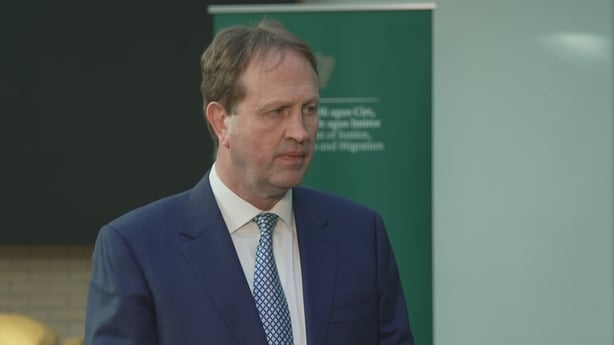
IHREC Chief Commissioner Liam Herrick has said that being separated from family is one of the most difficult parts of being an international protection applicant.
"Being reunited with them is one of the most effective ways of promoting integration and family cohesion," he said.
The Coalition on the EU Migration Pact - Doras, NASC, the Irish Refugee Council said they would continue to stand alongside families and individuals navigating the new system, much of which, they said, remained unclear in how it would operate in practice.
They group said substantial work would be needed to ensure the system efficiently functions in practice, particularly in relation to capacity, processes, and resourcing.
The deadline for the EU Migration and Asylum Pact to become fully effective across member states is 12 June.