


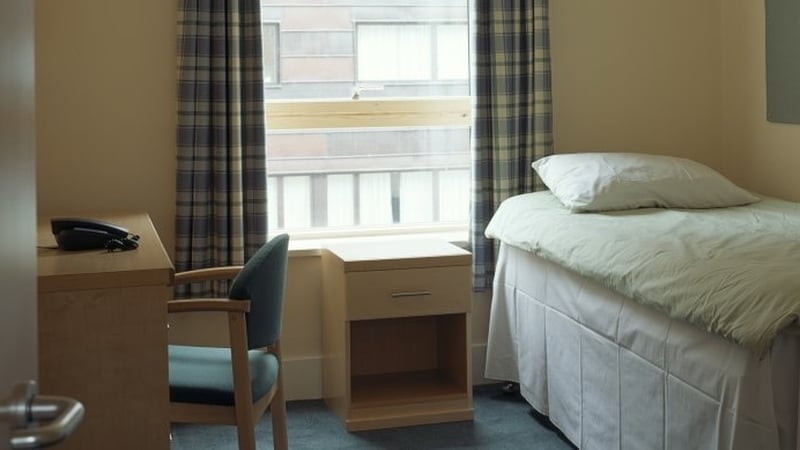
The Government will use public-private partnerships and spare bedrooms in private homes to create an additional 42,000 beds for students over the next nine years.
The measures are part of a new student housing strategy published today.
It envisages an additional 10,000 places for students through the provision of 'digs' by private households.
A further 32,000 places will be created by private companies building on campus lands using a public private partnership model. This means that the private sector will build and operate the facility, constructed on land that remains owned by Higher Education Institutions.
Expressing disappointment with the strategy, the national students' union AMLÉ said: "AMLÉ’s position is and always has been that the solution to the student housing crisis is significant public investment into state owned and HEI run purpose-built student accommodation."
Minister for Further and Higher Education James Lawless defended the use of public private partnerships, saying there were competing interests for public money. "It is appropriate that we use every lever," he said.
The minister said sites in Dublin, Cork and Galway would be the first to be progressed, followed by Limerick, Waterford and Athlone.
In a plan with no annual targets for delivery, the minister said, "we will run expressions of interest, open it up to the market and gauge that interest".
He said he hoped to deliver as quickly as possible.
There will be a three-year rent protection window for purpose-built student accommodation, but no checks or controls on the rent charged by private operators to students.
"The universities will enter into an agreement with the accommodation providers. They are free to negotiate an agreement," Mr Lawless said.
Under the strategy, measures will be introduced which will for the first time allow the technological universities to borrow money to construct student accommodation. This is a measure the sector has called for.
Public funding will be made available to universities to prepare sites and assess feasibility. The minister declined to put a figure on this but said it would be "significant".
On digs accommodation, AMLÉ Regional Officer Daniel Walsh said: "If there is to be increased reliance on digs, a renter's rights bill needs to be introduced."
The plan does not envisage this. It says a communications strategy will be developed to encourage householders to offer digs accommodation.
The Irish Universities Association said its members are committed to playing their part in expanding the supply of purpose-built student accommodation.
"The challenge of providing affordable accommodation is a serious wider societal concern, affecting students and young people across the country," it said.
"Addressing it effectively will require coordinated action and innovative funding approaches that balance affordability for students with the financial realities of developing and maintaining new accommodation."
The Technological Universities Association has welcomed the publication of the strategy.
"The Government's commitment to enable the Technological Universities for the first time to build Purpose Built Student Accommodation through a combination of nomination agreements, licensed sites and site servicing is particularly welcome," it said.
Unlike traditional universities, technological universities do not currently hold government-approved borrowing powers to build student accommodation.
Cutting red tape
Minister for Enterprise Peter Burke has brought a memo to the Government to cut red tape for Irish companies working in the area of defence.
It will remove the requirement for the IDA to secure Government approval prior to engaging with Irish small and medium enterprises (SMEs) who may be involved in the defence sector.
Mr Burke is proposing to delete part of the Science and Technology Act 1987, which he considers a constraint to businesses making dual-use products.
He says this is particularly relevant in areas such as cybersecurity, AI and space systems where Irish companies have built up expertise.
Mr Burke believes the change will give Irish firms opportunities at a time when many EU member states are spending more on defence.
Critical infrastructure
Minister for Public Expenditure Jack Chambers is bringing two items to Cabinet aimed at speeding up the delivery of critical infrastructure.
The first is a circular that will set out reforms to be implemented by the public sector bodies responsible for the key infrastructure areas of housing, energy, water and transport.
These reforms will introduce strict timelines, clear guidance, and the use of parallel processes where possible.
A second circular will establish a new cross-Government approach for responding to court judgments that may impact infrastructure projects.
It will see senior officials and the Office of the Attorney General meeting following any such judgment to quickly respond.
UK relations
Taoiseach Micheál Martin has updated colleagues today on the deepening levels of cooperation with the UK following the second annual UK-Ireland 2030 Summit, which took place in Cork earlier this month.
It focused on areas such as energy security and the transition to clean energy, protection of subsea infrastructure, cyber security and competitiveness.
A new group led by the Department of the Taoiseach and the UK Cabinet office has been set up to keep track of the summit's goals.
Minister for Housing James Browne informed the Cabinet that the terms of reference for a comprehensive review of the Office of the Planning Regulator have been agreed.
The review will determine the future role of the office and how best to align its work to the swift building of homes and infrastructure.
