


The Government and Opposition have come to blows over "eye-watering" rent increases that are expected as a result of reforms to the market.
The Dáil debate was sparked by Ireland’s largest residential landlord, Ires Reit, saying that the changes - due to take effect this weekend - could see a 25% rise in its rental income over the next ten years.
Sinn Féin said this proved that the new legislation would allow landlords to "significantly jack up rents".
Any tenancies beginning from this Sunday, 1 March, will be for a minimum duration of six years.
At the end of that term, landlords can raise rents beyond the nationwide cap, set at the rate of inflation or 2%, to match the market rate.
The Government has said the changes offer renters security of tenure for the first time and effectively end no-fault evictions.
The main aim, it added, is to boost supply, helping to moderate prices.
The Opposition said the changes will raise rents by thousands of euro a year, adding that people who change tenancies often, such as students or trainees, will be hardest hit.
Sinn Féin's Spokesperson on Finance Pearse Doherty said that, on average, 60,000 renters move into a new tenancy every year and will face significant increases.
He described the 25% increase in rent costs as "staggering" and "eyewatering" considering they were already at record highs.
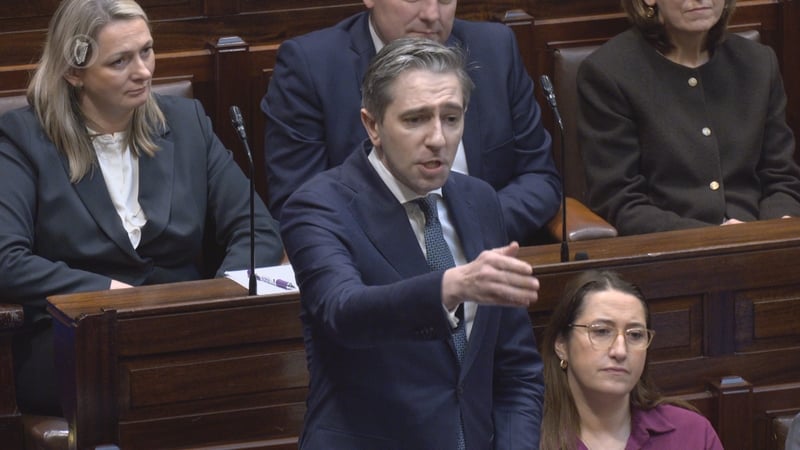
"You do accept, don’t you, that every single one of those new tenancies now can see their rents jacked up?" Mr Doherty told Tánaiste Simon Harris during Leaders' Questions.
"What you need to do now is you need to reverse it or defend why you think it’s appropriate that rents would go up that high."
Watch: Pearse Doherty, Simon Harris clash on rental changes
Mr Harris said there was an "ongoing effort to misrepresent the factual situation" on the rental reforms, calling it "scaremongering and misinformation".
"So firstly, from March 1st, there is no change at all for existing tenancies, none, zero, none at all. No change. That's really important.
"What does come into place from the 1st of March is a balanced package of measures, which includes within it some of the greatest protections that we’ve ever had in the history of our state for renters."
He added: "We’ll see greater protection for renters than ever before. For the very first time ever, we’ll see nationwide rent pressure zones.
"For the first time ever, we’ll see six-year rolling tenancies providing people with that security of tenure.
"For the first time ever, in many ways, we’ll see an effective no-fault eviction ban, and we brought in very, very strict and stringent rules in relation to that as well."
"All of this is done with one aim and one aim only ... increasing more supply."
Mr Harris said the 25% figure cited as an increase was "not a fair representation at all".
"The position put forward by Sinn Féin in telling people the rents are going to rise by 25% is categorically untrue. It is being done to scaremonger and to worry."
"We’re on the side of renters," the minister said, prompting laughs and jeers from the Opposition benches.
Mr Harris accused Mr Doherty of a "complete mischaracterisation" and Sinn Féin of "hypocrisy".
Mr Doherty, and his colleague Thomas Gould, interrupted the minister several times, prompting an intervention from Leas Cheann Comhairle John McGuinness.
He said: "Robust exchange is fine, but the carry on here on a Thursday morning is nothing short of shameful, in a way, and I would ask you to acknowledge the chair, to acknowledge standing orders, and to please conduct the debate in an orderly fashion."
Social Democrats deputy leader Cian O’Callaghan said the Government had a "craven ideology of giving these corporate landlords whatever they want" and said renters are already paying the highest rates in Europe.
He said the coalition’s only defence on the reforms appeared to be that the 25% increase would not be felt immediately.
"Do you not realise that a 25% increase in your rent, if it’s this year or next year or the year after, is completely unmanageable for the vast bulk of renters?
"How do you think people are going to be able to pay this increase?"
Mr O'Callaghan added that Ires Reit is to buy a block of 77 apartments in Naas, Co Kildare, which is under construction.
"They are not building anything new. They are not increasing supply.
"Individuals and families were hoping to buy one of these apartments and homes when the construction was completed. Now are being left disappointed. Ires Reit are doing this because of your government policy.
"You refuse to ban corporate landlords and investment funds from bulk-buying apartments now, by letting rents rip, you’ve opened the floodgates.
"These corporate landlords are going to snap up more and more homes."
Mr Harris said: "I’ve never been accused of having a craven ideology before.
"Our only policy objective in this coalition Government is to make sure we build more homes for our people to buy and rent, to make sure that we deliver supply, supply, supply."
"When I patronisingly get asked by the Opposition, 'do I not understand, do I not understand?’, do you not understand that we have to increase supply?"
A spokesperson for Ires Reit (I-RES) said: "The 25% potential increase in overall rental income referenced in a recent investor presentation relates to a cumulative portfolio-level projection over a period of at least ten years.
"Under the new regulatory framework, the 2% annual cap continues to apply to all existing tenancies, including renewals.
"Existing I-RES tenants will not see rent increases above 2% per annum," the statement added.
Rents will 'absolutely' rise - Irish Institutional Property
Irish Institutional Property, the representative body for institutional investors, said there was a "mischaracterisation" about the 25% increase prediction.
The figure is projected over a ten-year period, Chief Executive Pat Farrell told The Claire Byrne Show on Newstalk.
However, he admitted that rents would "absolutely" rise as a result of the Government’s reforms.
"Of course they will, because they have to, because in order to attract the money we need, to build the 50,000 houses per annum, we have to be able to remunerate that investment."
Asked about Ires Reit’s estimation that its rental properties are charging an average of 20% below market value, and if the new rental reforms mean these rents would be hiked up by 20% when the six-year tenancies end, Mr Farrell said that "it depends".
"It depends on what the current market rent is in that particular area," he said.
