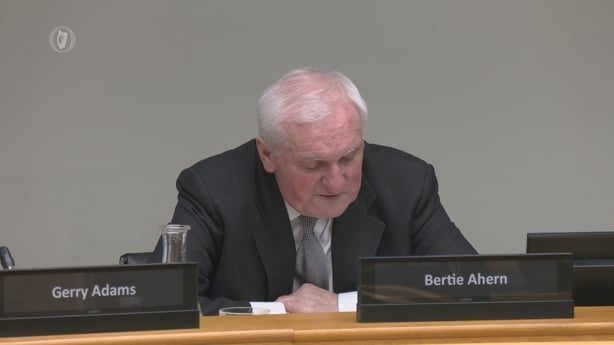
Former taoiseach Bertie Ahern has called for an international peace conference to be held to help resolve the conflict between Israel and Palestine.
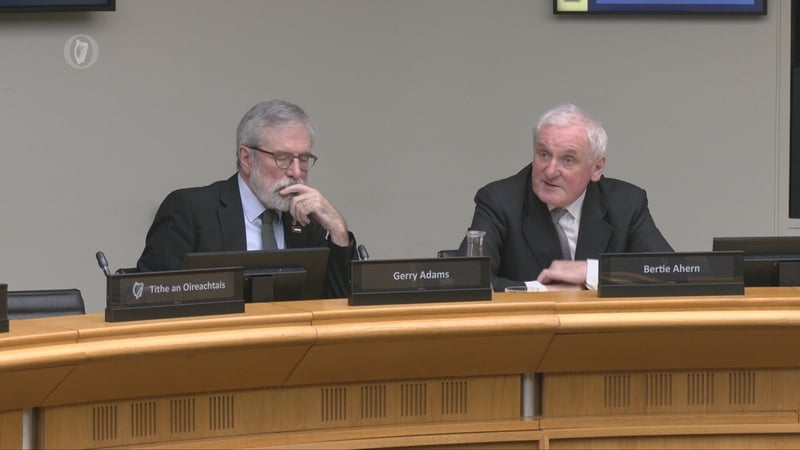
Mr Ahern and former Sinn Féin leader Gerry Adams addressed the Oireachtas Committee on Foreign Affairs as part of efforts to examine how the Northern Ireland peace process can be used to inform conflict resolution in the Middle East.
Mr Ahern called for the international community, including Arab, Gulf and Western states, to come together to create a peace group, led by a chair of "international understanding".
The former Fianna Fáil leader said he did not believe the United Nations had the capacity to lead the initiative, as they were under huge pressure due to cuts to staff.
Mr Ahern said: "Now there has to be a new effort, and the challenge is what that new effort is going to be.
"There are European countries that have taken a different view to Ireland, we understand that, we don't like it but that’s the way it’s been for the last few years.
"I agree there has to be a unified political position.
"I think we need a new initiative now, we need the Palestinians to get their house in order, you need to try and win the support of people who have been reluctant to be helpful about the two-state solution, or what that means now.
"These are building blocks that need to happen. I’m not too sure what the American initiative will bring, we just have to sit on our hands and watch that for the next few months."
Mr Ahern said the organisation that should be doing this is the United Nations, but he said he does not think they are in a position to at present, "or have the capacity to be able to pull this together".
"But somebody has to pull it together," he said.
When asked about US President Donald Trump's Board of Peace, Mr Ahern said we would "just have to wait to see what it brings".
But, he said the fact there is no representation of the Palestinian people, it does not make it very easy to see how any progress can be made.
"I think we need a new initiative now, we need the Palestinians to get their house in order, you need to try and win the support of people who have been reluctant to be helpful about the two-state solution, or what that means now.
"These are building blocks that need to happen. I’m not too sure what the American initiative will bring, we just have to sit on our hands and watch that for the next few months."
Board of Peace an 'exercise in colonisation' - Adams
Former Sinn Féin leader Gerry Adams described the Board of Peace as an "exercise in colonisation" and said he did not believe anything would come out of it that would resolve the issue.
"You have to see it in the context of what President Trump said when he talks about the Gaza Strip being a 'wonderful piece of real estate’ and that it could be developed into a big holiday park," he said.
"I would hope, but I don’t think anything will come out of that [Board of Peace] that will resolve the issue.
"This is a man-made problem, it’s not an accident, it’s not a fluke. The difficulty for the Palestinian people is they’re poor and they’re Arab.
"Other parts of the world don’t pay much heed to their rights or entitlements, so I don’t see the Board of Peace being able to deal with this because it’s not set up to deal with it in the way it requires," he said.
Watch: Gerry Adams tells committee UN charter was at heart of peace process
Earlier, Mr Ahern told the committee, that implementing a peace process is a "key challenge" in any agreement designed to end violence.
In his opening statement, Mr Ahern said that while "no conflicts are the same", Ireland has "examples of how we solved problems, overcame obstacles and created opportunities to end violence and engage in the patient work of sustaining a peace process through periods of difficulty as well as progress".
Mr Ahern said that it is hard for current generations of people in their early 30s to imagine an environment where violence and the threat of violence permeated almost every aspect of life in Northern Ireland, and to a different degree south of the border.
Mr Ahern, who was taoiseach when the Good Friday Agreement was signed on 10 April 1998 told the committee that a key challenge he discovered in the aftermath of any conflict, or any agreement designed to bring a permanent end to violence, "is the challenge of implementation, and the question of how to set in place the structures and architecture of what was signed on Good Friday".
In his opening statement, Mr Adams said Israel's actions in Palestine show they are determined to ignore international law, and called for the Irish Government to play a leadership role by encouraging international opposition to these actions.
Israel 'determined to ignore international law' - Adams
"The Israeli state’s genocidal occupation of the Gaza Strip, its recent moves to effectively annex the West Bank are clear evidence that they are determined to ignore international law, including reems of UN resolutions and rulings by the International Court of Justice.
"We have seen, all of us, the two-state solution and the Palestinians’ right to self-determination torn up.
"The international protections, the legal systems that should be shielding the Palestinian people from genocide have been broken, discarded and ignored, and this needs to be reversed."
Mr Adams also said that some Western governments have refused to stand against Israeli occupation and instead they have actively supported it with armaments and other measures which he said needs to stop.
He said the Irish Government can play a leadership role by encouraging international opposition to Israel’s illegal actions by calling for and contributing greater humanitarian aid, by seeking a genuine process of inclusive dialogue under the auspices of the United Nations that seeks to agree solutions.