


Minister for Housing James Browne has said that Met Éireann needs to use "judgement calls" in addition to mathematical formula in relation to weather alerts.
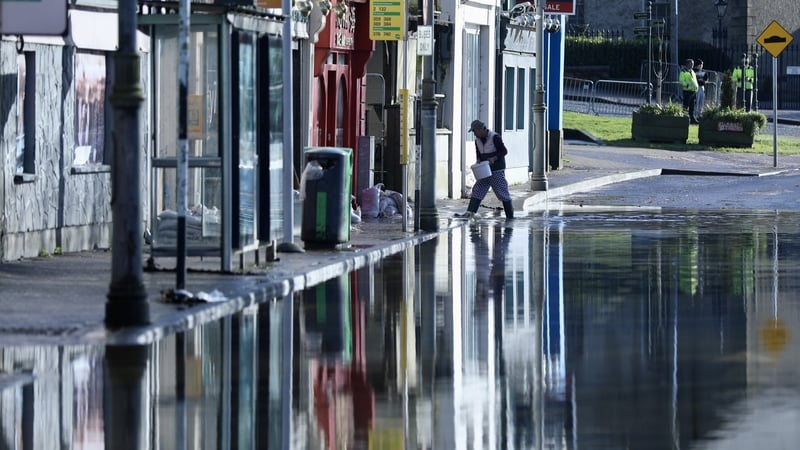
He was speaking after criticism that there was not sufficient warning about the risk of flooding from Storm Chandra, particularly in his home town of Enniscorthy in Co Wexford.
Mr Browne told South East Radio that the forecaster should make "judgement calls", rather than just issuing alerts based on a mathematical formula.
He also accused Met Éireann of "guarding" information.
"We will be bringing Met Éireann in and say that, look, there needs to be an understanding here that information is not to be guarded, information is to be put out there, and we need to be doing a much better job of communications.
"Also what we've asked Met Eireann to do as well is to look at how they bring these warnings - Yellow, Orange, Red warnings.
"It's based on a mathematical formula, whereas in other countries they use a mathematical formula, but they also make a judgement call.
"I think there needs to be a greater use of that judgement call in terms of warning people what is coming down the line."
'Extraordinary' comments by minister - Opposition
The Labour Party accused Mr Browne of attempting to shirk the blame for a "communications failure".
Spokesperson on Climate and Environment Ciarán Ahern said: "The comments made by the Housing Minister about Met Éireann are extraordinary.
"Attempting to blame Met Éireann for a communications failure during Storm Chandra is ridiculous given his own failure to host a storm preparedness media briefing in advance of the storm arriving on our shores."
Mr Ahern, a TD for Dublin South-West, said the Government has failed to fund flood defence systems for years, or to put a national warning system in place.
"At a time when many areas across the country are flooding due to this Government's failure to fund flooding defence systems, that have been called for for years, this blatant attempt to distract and deflect must be called out.
"This Government needs to acknowledge that modern communication plays a vital role in crisis management and that Government must lead from the front."
Earlier, Social Democrats' Spokesperson for Climate and Environment Jennifer Whitmore accused Mr Browne of making an "extraordinary accusation" against Met Éireann.
In the Dáil, she asked Taoiseach Micheál Martin if he agreed with the minister. He responded that he did not hear the interview.
South Dublin flooding was 'surprise' - official
National Director of the National Directorate for Fire and Emergency Management Keith Leonard said the flooding in south Dublin yesterday caught authorities by "surprise".
The areas most severely hit, he added, were Aughrim in Co Wicklow and Bunclody and Enniscorthy in Co Wexford.
Speaking on RTÉ's Morning Ireland, Mr Leonard said that Met Éireann had issued a high and elevated risk of flooding to all local authorities in the east before Storm Chandra.
"Local authorities were very aware of what was coming down. Unfortunately, south Dublin particularly caught us a little bit by surprise. We just weren't expecting those levels of rainfall that fell."
Mr Leonard said that Met Éireann has established a first phase of flood warning, and is bringing a second phase into operation, which it is hoped will improve localised flood warnings, but the forecaster is not at that point yet.
Unfair 'to scapegoat Met Éireann' - climatologist
A climatologist at Maynooth University said that "it is not fair to scapegoat Met Éireann".
"I think there were warnings issued well in advance and this was a very difficult storm to forecast," Professor John Sweeney said.
"It was explosively developing in a 24-hour period. All the models I looked at said it could be west of Ireland, it could be south of Ireland. They weren't really sure where it would end up," he told RTÉ's Drivetime.
Prof Sweeney added that extreme weather events do not observe county boundaries.
"So, what we need to do is change the way in which the public are alerted, at a smaller scale, to what might be happening in their own catchment area."
He added: "Our obsession with county boundaries" means that "we don't really get down to the catchment level in terms of flood alerts and flood warnings".
We need your consent to load this rte-player contentWe use rte-player to manage extra content that can set cookies on your device and collect data about your activity. Please review their details and accept them to load the content.Manage Preferences
Prof Sweeney said that a coordinated approach would include the Office of Public Works, the collector of river level data.
It would also involve Met Éireann and the Environmental Protection Agency, he said, to look at trigger events so as to issue more accurate alerts at a local level.
"We have an ability to connect with people's mobile phones in a restricted area and issue the kind of detailed warning and alert which would enable some of the property losses, some of the damage which occurred in eastern Ireland over the past 48 hours, to have been at least minimised," Prof Sweeney added.
