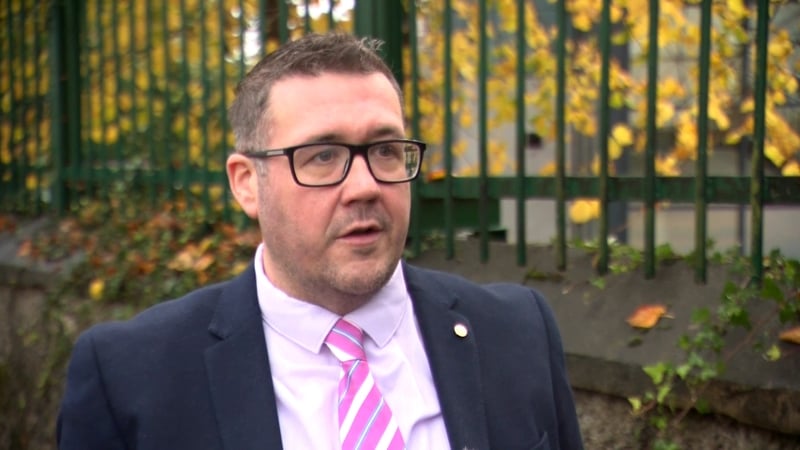

The brother of a 24-year-old woman who was fatally stabbed by her former partner in 2021 addressed an Oireachtas committee that examined changes to the law on domestic violence.
Jason Poole has called on the Minister for Justice to name the Criminal Law (Sexual Offences, Domestic Violence) Bill 'Jennie's Law’, once it is commenced as an Act.
Mr Poole made the request at a meeting of the Oireachtas Committee on Justice, which is examining changes to the law on domestic violence.
Jennifer Poole was murdered by her former partner Gavin Murphy in 2021.
Mr Poole believes that his sister would still be alive today if a register of individuals convicted of domestic violence had existed.
The legislation would allow those convicted of domestic violence against a partner or former partner, to be publicly named on a Register of Judgments.
It was only during Murphy's trial that the Poole family learnt he had a history of violence against women and had previously been jailed for attacking a former partner and her mother.
Since then, the Poole family have campaigned for better support for victims, including the introduction of the register for those convicted of domestic violence.
Pre-Legislative scrutiny of the bill is underway by the Oireachtas Justice Committee this evening.
Number of witnesses appear before committee
Mr Poole is among a number of witnesses before the committee including representatives of Women's Aid, Offaly Domestic Violence Services, the Law Society, Alcohol Action Ireland and the Department of Justice to discuss the general scheme of the bill.
Mr Poole suggested that where a conviction is issued, that the Minister for Justice ensures correct supports are in place for victims and that victims would be given safety orders and protection orders of those convicted in that case.
Under the proposed legislation a person listed on the register can make an application to have their name removed three years after conviction.
Mr Poole said "these are people who are repeated offenders", therefore, he said the three-year time frame was not long enough.
Asked how long he thought would be a reasonable time frame he suggested a minimum of five or six years, which he said should not begin until the date that the person is released from that conviction.
He asked that the Minister for Justice ensure that under the offences where a person has a conviction for outlined offences, that the Family Law Court would have access to the relevant convictions.
Mr Poole asked the Department to consider the situation where a person causes harm against children and their partner, that they would be included on the register.
He asked that the Oireachtas Committee and the Department "push this process" as quickly as possible, because he said that as the process continued, others were being failed by the current system.
'Massive failure in the system'
Speaking during the meeting, Mr Poole said he wanted to point out that "there is a massive failure in the system in relation to barring orders, safety orders and protection orders".
"My phone is ready to explode with the amount of victims and a lot of them have the same issue", he said.
"It is the barring orders that are being breached the whole time," he said, adding that "everything is taking too much time" and that it "leaves victims in a very vulnerable situation".
Mr Poole reiterated that he would like to see, through the committee's recommendations, barring orders, safety orders and protection orders "addressed and very clearly laid out".
"Because a lot of the time in the cases that I have heard is that these people have breached barring orders on several occasions, and are still walking the streets and are not registered anywhere," he added.
Determining a 'reoffence'
Committee members asked witnesses about the removal of names from the register and if gender based violence should be separated from offences like to theft in determining a "reoffence".
Women's Aid CEO Sarah Benson said that as currently drafted, the legislation enabled the Rules Committee to issue guidance and there would be judicial discretion.
She suggested a "compound of components" if someone had several low-level offences or had reoffended.
"For simplicity it should be named offences - we're concerned stalking, harassment, or online abuse against a relevant person - that should be considered more expansively, theft I'm not so sure about that."
Submissions to the Oireachtas Justice Committee from domestic violence services like Women's Aid and Safe Ireland suggested the inclusion of additional offences to the legislation.
Women's Aid suggested that harassment and stalking offences from the 1997 Act and harmful communications offences from the 2020 Act be included.
It also recommended adding some summary convictions - particularly for breaches of domestic violence orders under the 2018 Act, and especially where someone had multiple convictions.
Ms Benson said coercive control and many offences under the Non-Fatal Offences Against the Person Act could be tried both summarily and on indictment 1.
If tried summarily in the District Court, she pointed out that currently, they would not be included in the register.
"Including these summary offences would better capture the most common criminal patterns of abusive behaviour," she said.
Asked if he felt the legislation should be broadened, Jason Poole said he did not think that anyone was setting out to make the legislation as narrow as possible.
He said anything Jennifer's family had done was to look at his sisters story and at where she was let down.
Mr Poole told the Committee that while ministers, TD’s and many organisations have commended him for his bravery, and the pride Jennifer would have in him, he was not doing it for credit or for anyone to be proud of him.
"I would much prefer to have my sister with me and so would her children," he said.
A total of 277 women have died through male violence since Women's Aid's first Femicide report in 1996.