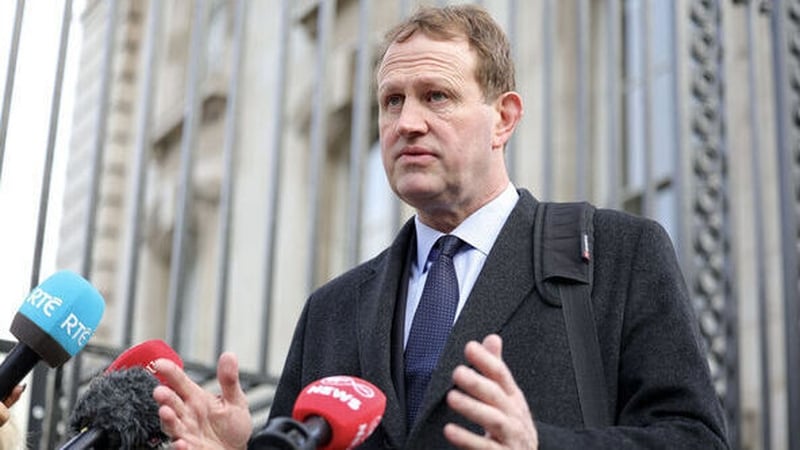

Minister for Justice Jim O'Callaghan has said that a series of procedures under new proposed legislation on immigration laws will make the system fairer and more efficient.
The International Protection Bill 2026 was brought to a meeting of the Cabinet this morning.
The Bill would bring major changes to asylum laws by giving effect to the EU Migration and Asylum Pact and aligning Ireland with the approach to migration in other member states.
The Bill proposes that processing of asylum applications is streamlined with decisions on granting or refusing refugee status and issuing return to country of origin orders to be made within a three-month time limit.
The Bill would also change regulations that allow people who are granted refugee status to bring family to Ireland.
We need your consent to load this rte-player contentWe use rte-player to manage extra content that can set cookies on your device and collect data about your activity. Please review their details and accept them to load the content.Manage Preferences
It is proposed that they wait three years for reunification while applicants would have to show they were financially self-sufficient and only immediate family members would be allowed to come to Ireland.
Last year, just over 13,000 people sought asylum in Ireland, which was down on 2024, but was still substantially higher than the numbers arriving a decade ago.
Speaking on RTÉ's News at One, Mr O'Callaghan said: "The purpose of the legislation is to ensure that individuals coming to Ireland, claiming asylum, will get an answer to their asylum application within a specified period in law of six months."
"I think that this makes the system more efficient, it'll make the system fairer, not just for the asylum applicant, but indeed for the Irish public," he said.
We need your consent to load this rte-player contentWe use rte-player to manage extra content that can set cookies on your device and collect data about your activity. Please review their details and accept them to load the content.Manage Preferences
The Minister disagreed with claims that the speed at which applications are processed at is being prioritised over fairness to those applying.
"I think it is important to ensure that if people are looking for an asylum application in Ireland that they get a decision promptly.
"One of the characteristics of the asylum system in Ireland historically is that people have come here, made applications for asylum and they can be waiting two to three to four years for a determination of their application.
"I think it's much fairer for them, and indeed for the general public, if we can get a prompt determination of their application so that if they're referred, they can get on with their lives, and if they're granted they can incorporate into Ireland," he said.
Mr O'Callaghan also disagreed that the proposed bill was cruel and anti-family.
"If I'm a person who has applied for and is granted asylum in Ireland today, tomorrow I can apply to bring my family here.
"I'm proposing that that be changed, that the individual must wait for a period of three years and they must show self-sufficiency," he added.
We need your consent to load this rte-player contentWe use rte-player to manage extra content that can set cookies on your device and collect data about your activity. Please review their details and accept them to load the content.Manage Preferences
Opposition parties have criticised Government proposals to tighten rules on family reunification for those granted refugee status describing them as "deeply troubling".
'No clarity from Government'
Labour's Spokesperson on Housing Conor Sheehan has said there are "legal questions" around the legislation that has been proposed around the international protection process.
"We've had no clarity from Government beyond what Minister O'Callaghan said today on how this will be delivered in terms of the resources, in terms of the process," he said.
Speaking on RTÉ’s Drivetime, the Limerick City TD added that key parts of the legislation will not be introduced until committee stage.
"My concern is that if you look internationally, there is a line in what Minister O'Callaghan published today around this new system and restricting the right to oral appeal, which some legal experts say may breach fair procedure.
"There is actually a trend of courts overturning decisions internationally where oral hearings were not allowed.
"We could end up with a situation whereby you could have decisions being made very quickly, not good decision making, and the whole thing could end up tied in knots in judicial review and in appeal."
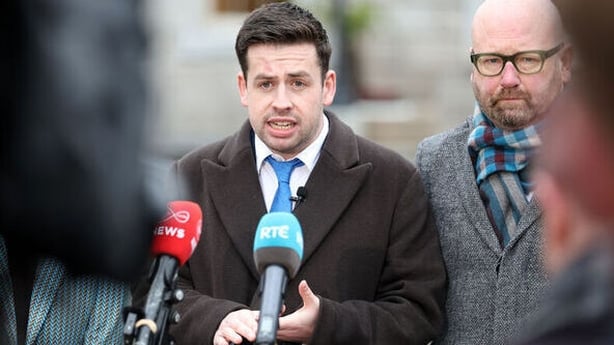
Mr Sheehan also said that the changes in relation to family reunification were "performative" and "cruel".
"I know our public services are under pressure. Our public services were under pressure before we had increased migration.
"We have a housing crisis. We had a housing crisis before we had increased migration.
"You’re delaying cohesion, and at a time when it's very, very dangerous for migrants at the moment in Ireland, you are further fanning the flames of a bad situation instead of having a public awareness campaign and actually selling to the Irish people the virtues of immigration," he said.
However, Minister of State at the Department of Justice Niall Collins said the Government does not want to "overburden" Irish taxpayers and public services with the number of people who could come here under family reunification.
"That's entirely reasonable because all of our public services are under pressure. We have a growing population. Our population is growing seven times quicker than the EU average.
"I think it is fair and proportionate that we're taking this three-year period," the Fianna Fáil TD said.
Mr O'Callaghan said that he believes that the legislation "gets that balance right".
Taoiseach Micheál Martin has also defended the changes, saying that the system has to be fair.
Speaking to reporters earlier, he said that a priority is to have a faster process so people get results earlier with regards to their applications.
Triple Lock and data centres on Cabinet agenda
The first meeting of the Government was also due to discuss other legislative priorities for the coming Dáil term, such as the Triple Lock, infrastructure and data centres.
The Critical Infrastructure Bill aims to speed up the delivery of vital infrastructure projects by including the common good as a consideration when assessing projects, giving the Government emergency powers to advance project delivery and address regulatory challenges.
Legislation to allow for a floating gas reserve in case of energy shocks was also due for publication as was a bill to end the cap on passenger numbers at Dublin Airport and the Occupied Territories Bill.
Also listed for publication is the Defence Bill, which would end the Triple Lock.

It guarantees that no more than 12 Irish soldiers can be sent into battle zones without the permission of the Government, the Dáil, and the United Nations.
Minister for Enterprise, Tourism and Employment Peter Burke was due to bring a 17-point plan to Cabinet to provide for further development of data centres.
The Large Energy Action Plan, or LEAP, says that all new data centres will have to eventually meet 80% of their own energy needs through renewable sources, but they may be developed in regional locations where renewable energy capacity exists.
Data centres on the east coast - where there is a a concentration of such facilities - would be permitted when further energy sources come on stream.
The minister was also to ask colleagues to approve legislation to bring greater transparency and responsibility on the rollout and use of artificial intelligence.
The legislation transposes the EU AI Act into Irish law and with it EU wide rules on AI.
Providers must ensure AI programmes are trustworthy with AI content being clearly identified so users are aware they are interacting with it. They must also try to reduce harmful content.
Companies who break the rules could be hit with fines as large as 7% of their worldwide turnover.