
Ahead of what's set to be another testy political year, Sandra Hurley takes a look back at events of 2025 - the rows, the talks and that Presidential Election.
Politics in 2025 began with the machinations of government formation and ended with a messy internal wrangle in Fianna Fáil.
A bitter row temporarily derailed the election of the new Taoiseach and dragged on for several months impeding the work of the new Dáil.
Along the way, the Coalition and the Opposition grappled with several issues, including the cost of living, migration and defence.
Here are some of the main happenings in Irish politics in 2025.
Government formation
January 2025 began with the dust settled on the General Election and intensive government formation talks under way between Fianna Fáil, Fine Gael and the regional independent group.
A deal had already been done for one of the group, Wexford TD Verona Murphy, to become Ceann Comhairle.
And another two TDs - Kerry representatives Michael and Danny Healy-Rae - also came on board.
This left the new Coalition with a solid majority as it agreed a Programme for Government.
In return, the Independents secured four junior ministries.
But before the Dáil could meet to nominate a taoiseach, a row was brewing over a bid by some of the Independents to also take part in a technical group.
Tipperary North TD Michael Lowry argued that he and three other regional Independents supporting the Government should be entitled to such speaking rights because they were not becoming ministers.
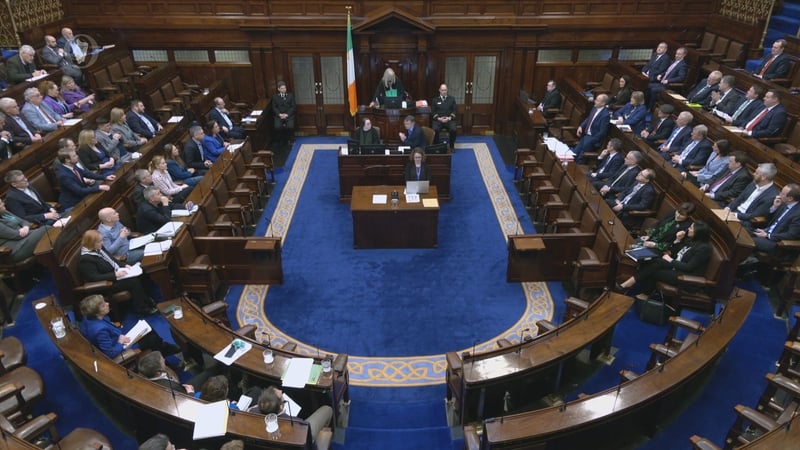
That row morphed into a raucous showdown on the day the 34th Dáil met to nominate Fianna Fáil's Micheál Martin as taoiseach.
Chaos descended as Ceann Comhairle Verona Murphy adjourned several times in a bid to restore order.
Mr Martin slammed the Opposition's actions as a "subversion of the Constitution".
Ultimately, the Dáil had to return one day later to finally nominate the new Taoiseach and the new Government.
It was an unholy beginning for the new administration but the speaking rights row was not over. It rumbled on for weeks holding up the real business of the Dáil.
Out of the row, an uneasy, tentative new political force was formed known as the combined opposition.
This usually included Sinn Féin, Labour, the Social Democrats, People Before Profit and the Green Party. And they would return repeatedly to this joint approach throughout the year to put pressure on the Government.
New Cabinet
The Cabinet contained several new faces, three men named James and fewer women than the previous government.
There were elevations for Jim O'Callaghan (Justice), James Browne (Housing), James Lawless (Further and Higher Education), Jennifer Carroll McNeill (Health) and Martin Heydon (Agriculture).
But the Opposition rounded on the fact that there were just three women out of 15 members.
Fianna Fáil asserted its dominance to secure a greater share of power as it was the largest party with 48 seats versus Fine Gael's 39.
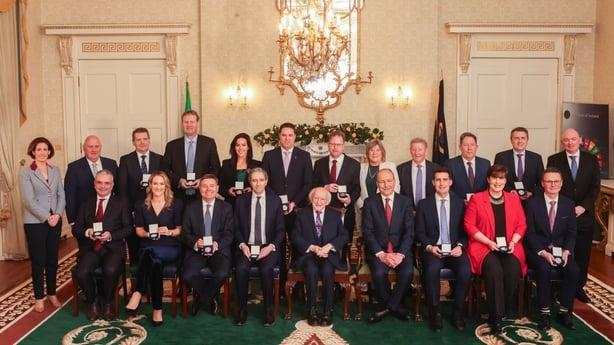
Micheál Martin nailed down one extra Cabinet ministry and, significantly, a much longer time in the Taoiseach's office with the switchover scheduled for November 2027.
White House visit
Usually the Taoiseach's meeting with the US president around St Patrick's Day is a cause for celebration with a small nation gaining prime access.
But the stakes were raised following the savaging of Ukrainian President Volodymyr Zelensky by President Donald Trump as they gathered in the Oval Office shortly before the Irish visit.
In the event, all went relatively smoothly, with a slightly nervous looking Micheál Martin surviving the encounter as President Trump hailed the Irish economic success story.
Although a quip about housing caused some unease.
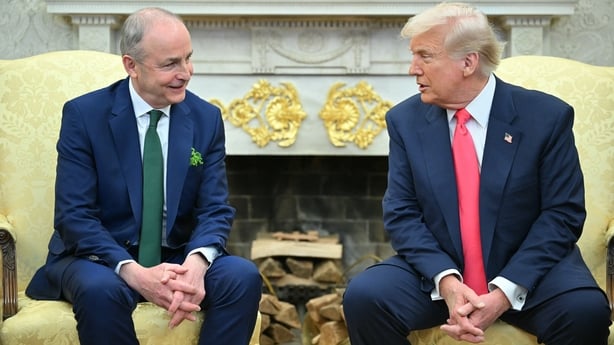
President Trump said: "Do you know why they have a housing crisis? Because they're doing so well. They can't produce houses fast enough. That's a good problem, not a bad one. Everybody should have that problem."
Mr Martin responded: "That's a pretty good answer, Mr President."
That exchange elicited some criticism but, overall, the conclusion was that the Taoiseach had handled the encounter pretty well.
Do nothing Dáil
Back home, the speaking rights row persisted, delaying the establishment of Oireachtas committees.
And with limited legislation coming through for scrutiny, proceedings in the lower House were, at times, dominated by statements on various issues.
This feature continued as the year ended with three-hour long statements on Ukraine and fisheries among other issues.
As 2025 drew to a close, it seemed the Government succeeded in getting at most 21 bills enacted by the end of the year.
This is far less than 2020 when 32 acts were passed but many of these (11) related to the Covid emergency.
Undoubtedly, time was lost with the speaking row and while the Government has strongly pushed back on accusations of a "do nothing Government", the Opposition has been liberally using the insult as an attack line.
But Chief Whip Mary Butler has rejected the criticism and insisted the legislative output is in line with the first-year achievements of previous administrations.
Cost of living
In advance of the General Election in November 2024, a generous budget rained down a swathe of once-off cost-of-living supports onto the electorate.
However, just after the election, briefings appeared that these extra payments were definitively off the table.
The first budget of the new Government focused more on capital spending with some limited, targeted supports.
That unleashed a barrage of Opposition criticism, which is still playing out several months later.
And despite October's Budget containing a record €9.4 billion in new measures, it succeeded in pleasing few.
Tariffs
President Trump delivered on his election pledge to "rebalance" global trade and tariffs became the nebulous problem for governments to grapple with.
The Irish economy has attracted particular focus, and while there have been no tariffs yet on pharmaceutical products the threat remains.

After months of fraught negotiations with moving targets, there was eventually a European-wide deal for 15% tariffs on many goods imported into the US.
And as the year closed, the Irish economy appears to have weathered the storm remaining resilient with strong growth.
Presidential Election
The Presidential Election delivered high drama throughout the year beginning with speculation on who might run.
Independent Catherine Connolly was the first to declare.
Then Fine Gael's Mairead McGuinness followed. But in August, the former MEP exited the race citing ill-health. Fine Gael moved quickly to replace her with former minister Heather Humphreys leaving MEP Seán Kelly aggrieved at the hasty coronation.
Fianna Fáil though had the dubious honour of the most disastrous campaign.
It began with a rebellion from Ireland South MEP Billy Kelleher demanding a contest. He then decided to put himself forward.
Party leader Micheál Martin anointed former Dublin GAA manager Jim Gavin, but Mr Kelleher ran a spirited campaign that saw him pushing the vote to 41-29.
Fast forward to October's election campaign and Mr Gavin got off to a faltering start with poor media interviews and a weak debate performance.
But he capsized completely when it emerged he owed a former tenant €3,300 leading to an unseemly early exit.
The fallout from that ignominious disaster is still playing out with the Fianna Fáil leader left considerably weakened.
Mr Gavin's departure left just two presidential candidates re-treading the same ground for the remaining few weeks.
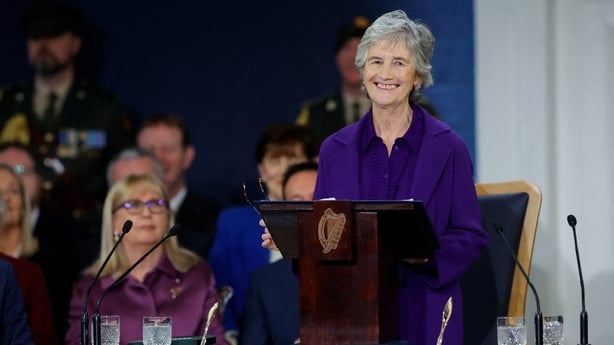
On the day, Catherine Connolly secured an emphatic victory with an unflappable performance.
But the other big talking point was the unprecedented level of spoiled votes at 12.9% posing big questions for the entire political system.
Fianna Fáil fallout
The aftermath of Fianna Fáil’s presidential campaign is still reverberating.
At its heart is the consistent complaint from the Parliamentary Party about the centralisation of decision making in Fianna Fáil with control exerted by leader Micheál Martin and a small coterie of advisers.
Recriminations were flung at a lengthy internal meeting and it is clear that the debacle remains a festering sore for the party.
Mr Martin heads into January 2026 on the cusp of celebrating Fianna Fáil's centenary and a personal milestone as party leader for 15 years.
But his handling of the presidential debacle has left him wounded with a lingering threat to his position.
2026
The Government agenda is already crammed with several contentious pieces of legislation due to be debated.
These include the Occupied Territories Bill and the outstanding question of whether services will be included.
In addition, a new Defence Bill is imminent. This will give effect to removing the Triple Lock which governs the deployment of Defence Forces overseas.
Also due is a mammoth International Protection Bill, which will tighten immigration rules and give effect to the EU's Migration Pact.
And the Government faces two tricky by-elections in Dublin Central and Galway West, which are likely to deliver a drubbing for the Coalition parties.
In the second half of the year, Ireland takes on the Presidency of the EU Council bringing major European leaders to the country along with concerns around security.
2026 promises to be another eventful year in Irish politics.