


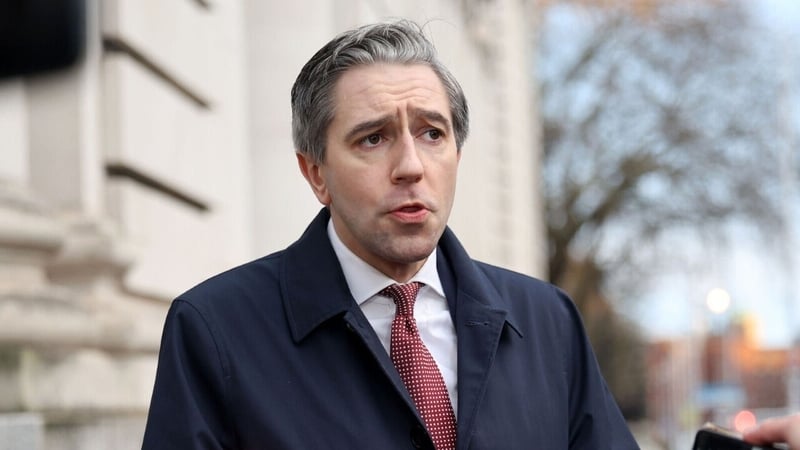
The Tánaiste has described a plan to make asylum seekers contribute between 10% and 40% of their weekly income towards their State accommodation costs as "a common sense measure".
Simon Harris said the Government has been working on the proposal "for a significant period of time".
He said there are a few thousand International Protection Applicants who have the right to work in the country and are earning a living.
"It seems really important to me, from a social cohesion point of view, that they're making a contribution in terms of their costs," he said.
"In fact, it would seem rather bizarre that they wouldn't be, and I think in terms of maintaining social cohesion, I think it's an important common sense practical measure that's simply about fairness," Mr Harris said.
"This is a country that benefits from migration. Migration is a good thing. There needs to be rules.
"The rules need to be common-sense-based and it simply doesn't make sense that you could be earning a living, but because you're in international protection, you're not making any sort of contribution, but if you're not in international protection, you're expected to," he said.
Mr Harris said the measure will be operated on a sliding scale basis, relative to the income that the person is earning, so he said it will be "very much means tested".
"We're a compassionate country, we're a decent country, we want to help people fleeing persecution, but we also have to make sure that international protection is never the same thing as economic migration," he added.
Mr Harris said that there is "a place in Ireland, an important place for people to come on work permits and contribute to our public services, contribute to our economy".
"Our health service would fall over, for example, if people didn't come and work in it from abroad," he said.
However, Mr Harris insisted that international protection is not about economic migration and he added that "those two things need to be clearly decoupled".
In the memorandum from Minister for Justice Jim O'Callaghan and Minister of State for Migration Colm Brophy, a person with a weekly income of up to €150 would have a potential contribution of €15; whereas a person earning up to €340 a week would be obliged to contribute around €83; and a person on €600 a week or more would contribute €238.
It is expected that the new model, if approved by ministers, could be operational by next year.
Figures compiled by the Department of Justice last year suggest that around 7,600 people in the IPAS system would have been eligible to pay a contribution charge.
However, it is anticipated that the number will likely fall once the EU Migration and Asylum Pact becomes operational next June, as it is expected to result in a fall in the numbers seeking asylum.
Two other measures being brought before the Cabinet tomorrow relate to tightening rules around family reunification and increasing the residency requirement for citizenship from three to five years.
"That's in essence what is envisaged by these reforms," he said.
Mr Martin said the reforms had come before the party leaders and also before the Cabinet sub-committee.
However, the Irish Refugee Council warned that the proposed changes are "deeply alarming".
"They severely undercut two key pillars of refugee integration: a clear route to citizenship and the ability to reunite with family," it said.
O'Callaghan 'virtue signalling' on immigration, says Nash
Earlier, Labour TD Ged Nash accused Minister for Justice Jim O'Callaghan of "virtue signalling" on immigration.
Mr Nash said there "seems to be more interest in virtue signalling on immigration than dealing with the crime and community safety issues that we are dealing with".
He described this as "virtue signalling", adding that Mr O'Callaghan is "seeking to deter people from coming to this country to secure safety".
Mr Nash said the minister is "taking his lead here from the UK", adding that the reformed system in the UK "simply isn't working and won't".
"The reality is what this Government should be doing is making the positive case for immigration, showing how immigration is supporting our economy, showing how skilled migrant workers are supporting our health service, our education system," he said.
