


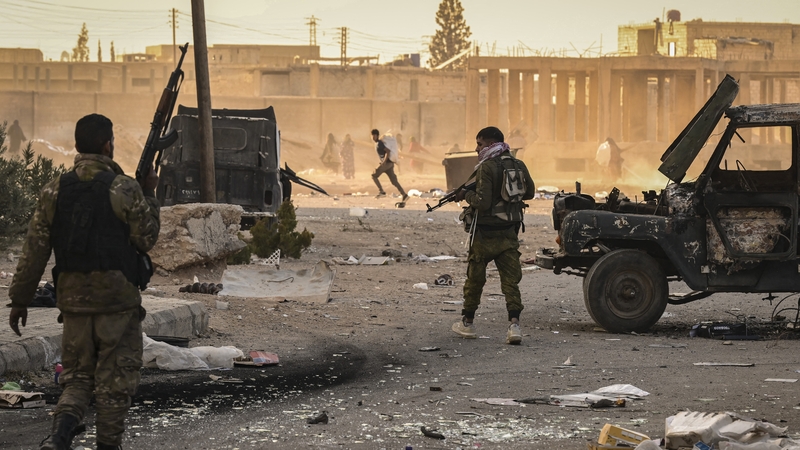
Syria's conflict "has not ended" even after the departure of former president Bashar al-Assad, the UN's envoy to the country has warned, highlighting clashes between Turkish-backed and Kurdish groups in the north.
Geir Pedersen, the UN's special envoy for Syria, also called at the Security Council for Israel to "cease all settlement activity in the occupied Syrian Golan" and said an end to sanctions would be key to assisting Syria.
"There have been significant hostilities in the last two weeks, before a ceasefire was brokered. A five-day ceasefire has now expired and I am seriously concerned about reports of military escalation," he said.
"Such an escalation could be catastrophic."
Mr Pedersen also said he had met with Syria's new de facto leadership following the rebels' lightning takeover, and toured Sednaya prison's "dungeons" and "torture and execution chambers," operated under Assad's government.
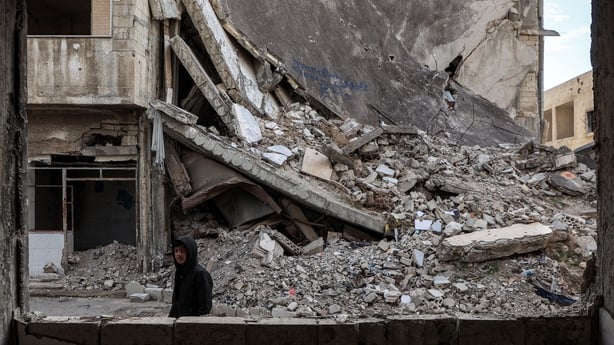
He called for "broad support" for Syria and an end to sanctions to allow for reconstruction of the war-ravaged country.
"Concrete movement on an inclusive political transition will be key in ensuring Syria receives the economic support it needs," Mr Pedersen said.
"There is a clear international willingness to engage. The needs are immense and could only be addressed with broad support, including a smooth end to sanctions, appropriate action on designations, too, and full reconstruction," he said.
Western countries are wrestling with their approach to Hayat Tahrir al-Sham, which spearheaded the takeover of Damascus and has roots in the Syrian branch of Al-Qaeda.
It has largely been designated in the West as a "terrorist" group, despite moderating its rhetoric.
Mr Pedersen noted Israel had conducted more than 350 strikes on Syria following the departure of the former regime, including a major strike on Tartous.
"Such attacks place a battered civilian population at further risk and undermine the prospects of an orderly political transition," he said.
The envoy warned against plans announced by Israel's cabinet to expand settlements inside the Golan, occupied by Israel since 1967 and annexed in 1981.
Israeli Prime Minister Benjamin Netanyahu held a security briefing atop a strategic Syrian peak inside the UN-patrolled buffer zone on the Golan Heights that Israel seized this month.
"Israel must cease all settlement activity in the occupied Syrian Golan, which are illegal.
"Attacks on Syria's sovereignty and territorial integrity must stop," said Mr Pedersen.
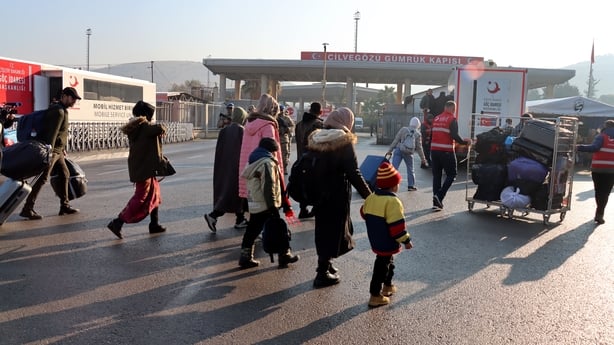
Earlier, a UN refugee agency official said that some 1 million Syrian refugees are expected to return to the country in the first six months of 2025, asking states to refrain from forcing them to do so.
"Now we have forecasted that we hope to see somewhere in the order of 1 million Syrians returning between January and June next year so we shared this plan with donors, asking for their support," said Rema Jamous Imseis, UNHCR Director for the Middle East and North Africa.
"We have massive humanitarian needs on a scale that hasn't in any way diminished," she added, noting that 1 million people have been internally displaced since the rebel advance began.
In the immediate aftermath of the rebels seizing power, thousands of people fled Syria, while thousands had also returned to the country mostly from Turkey, Lebanon and Jordan, Ms Imseis said.
She added that some of those fleeing could be linked to the former government or else be religious minorities with concerns about their standing under the new authorities, led by the HTS.
Countries should be patient as Syrian refugees consider whether to return, she added.
"It's important to maintain that protection for Syrians who have already found refuge in host countries, and that they are not forcibly returned to Syria," she said.
Asked about some countries' decisions to freeze asylum applications for Syrians, she said: "We have been very clear in the non-returns advisory to all countries. It is just far too soon to make this determination on the safety and stability of Syria and there are many questions that are that need to be answered."
Irish MEPs urge EU to take 'opportunity' to help Syria
Meanwhile, Irish MEPs have urged the EU to take the "opportunity" to help Syria and not "turn our back" on the people living in the country or allow Syria to descend into civil war.
Fianna Fáil MEP for Dublin Barry Andrews and Fine Gael MEP for Ireland South Seán Kelly made the calls during a two-hour debate on the crisis in the Middle East.
Speaking at the European Parliament, which is holding its monthly meeting in Strasbourg, Mr Andrews said while he is "pleased [ousted former Syrian president Bashar Al] Assad is gone", he has concerns over what could happen if the EU does not offer support to the country.
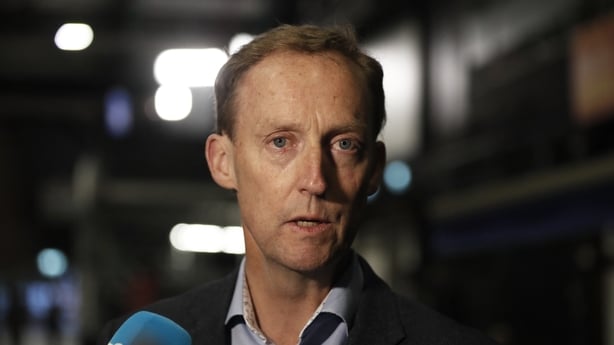
Mr Andrews said "the reality is we turned our back on the Syrian population", including people "haunted by gulags and prisons", during the aftermath of the Arab Spring more than a decade ago and the outbreak of the civil war in Syria.
He said "for the first time we have an opportunity to really prioritise the people of Syria" due to the sudden developments of the past week.
Urging humanitarian and supportive action, Mr Andrews said: "We turned our back on Syrians before, lets not make that mistake again."
The words were repeated by Seán Kelly who told the same European Parliament debate that the Assad government was "one of the most brutal and vicious regimes" of recent memory.
He said "a vacuum now exists in Syria", and - giving what he said was the example of the wider world's failure to help Sudan - said that "it is the time for the UN, EU and Arab League to facilitate a fair transition [of power] and elections".
Mr Kelly added that ordinary people remain caught up in the violence, and said those in positions of authority at home and abroad must "urge compassion to Syrian refugees".
The European Parliament debate on the situation in Syria began with Estonian MEP and High Representative of the European Union for Foreign Affairs and Security Policy Kaja Kallas saying there is "an historic opportunity" for the people of Syria, and that the EU stands "with Syrian people and the diaspora".
Her comments were echoed by a number of MEPs from France, Germany, Spain and the Netherlands, who said the EU will support those in need and that it is important to assist the creation of a democracy in Syria.
However, to some criticism in the chamber, other MEPs - in particular from France, Germany and Italy - criticised the comments, saying Syrian refugees should now be sent back "for humanitarian reasons", that Syria is now a "time bomb", and that the country could become "Afghanistan on the Med".
Ms Kallas and EU Commission President Ursula von der Leyen said the EU will establish contacts with Syria's new leadership and reopen its delegation in the country.
Ms von der Leyen also said the EU would increase humanitarian aid to Syria.
However, she warned of the risk of a resurgence by hardline Islamic State militants and said this must not be allowed to happen.
"We are ready to reopen our delegation, which is the European embassy, and we want this to be fully operational again," Ms Kallas said in the European Parliament.
Ms Kallas said she had asked the EU's delegation head to go to Damascus to establish contact with the new leadership in Syria and various other groups.
"We have already started to have a process to engage cautiously with Damascus pushing for an inclusive and tolerant approach. I see we have a chance here to really impact the region, and we need to follow closely the next steps in the short term," she said.
Ms von der Leyen told reporters in Ankara after a visit to President of Turkey Recep Tayyip Erdoğan that the EU must step up its direct engagement with HTS.
"However, the lack of predictability demands utmost caution. The risk of a Daesh (Islamic State) resurgence, particularly in eastern Syria, is real. We cannot let this happen. And Turkey's legitimate security concerns must be addressed," she added.
Ms von der Leyen said the EU would increase humanitarian aid to Syria and would aim to help restore basic services like electricity, water and infrastructure.
Germany, the United States and Britain said they would establish contact with HTS.
