


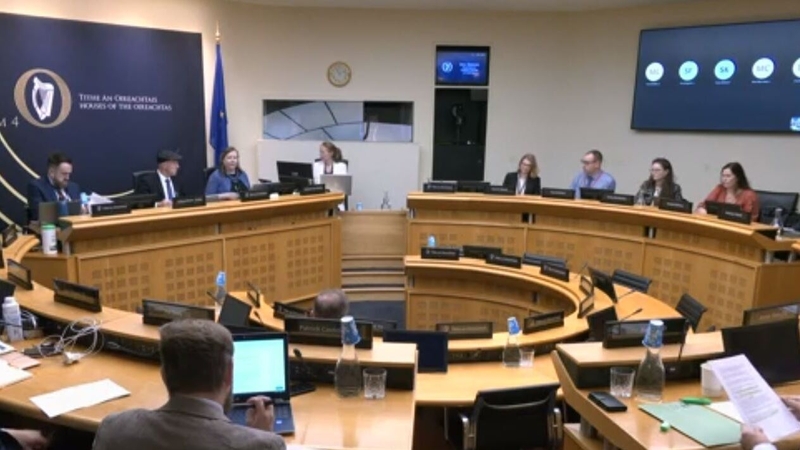
Some palliative care doctors who participated in assisted dying have been shunned by colleagues, an Oireachtas committee has heard.
Professor Nancy Preston, Professor of Supportive and Palliative Care at the University of Lancaster, said that there is "anecdotal evidence that they are shunned by their peers".
She told the Joint Committee on Assisted Dying that her research indicates that it is not "clear cut" how well assisted dying is operating in jurisdictions where it has been introduced.
"The evidence is conflicting," she said, while advocating for the use of panels of medical professionals to assess the suitability of a patient seeking to end their lives.
"Panels might be the safest option," she said.
Speaking of the psychological toll some medics experience, she quoted one doctor, who is in favour of assisted dying, as saying: "It's stressful to kill somebody".
Prof Preston said that most assisted deaths occur at home, in part because many hospitals fear "damaging trust with patients" by allowing the deaths to occur on their premises.
Ben White, Professor in End-of-Life Law and Regulation at the Australian Centre for Health Law Research, questioned the use of anecdotal evidence, and urged that research backed up by scientific data be prioritised.
He advised that, were Ireland to introduce voluntary dying, it should learn from Australia's experience, and be sure not to prioritise safety to the exclusion of accessibility.
Professor Roderick MacLeod, Health Professor in Palliative Care at the Dunedin School of Medicine in New Zealand, said that medical students are not given sufficient grounding in palliative care, despite the fact that many will deal with fatalities, particularly in the early years of their professional life.
He said that some medics found assisted dying to be a "drastic and sometimes even traumatic event" which "subsequently affected their ability to practice medicine".
In the year to March 2023, there were 328 assisted deaths in New Zealand, which introduced assisted dying in November 2021.
Prof MacLeod noted that this low number may be in part due to the fact that relatively few medical practitioners provide the service.
But he also pointed to a lack of data around assisted dying, saying that "we get the bare minimum of information" despite appeals for greater detail.
The Danish National Council on Ethics voted last year, by a majority of 16 to 1, against recommending the introduction of assisted dying.
Professor Merete Nordentoft told the committee: "We do not believe that legislation can be developed which will be able to function properly".
"If we offer assisted dying, it says, directly or indirectly, that some lives are not worth living.
"We argue that assisted dying risks causing unacceptable changes to basic norms for society and healthcare."
